


US Army Lieutenant Colonel Nicholas Steele revealed that severe winds halted a planned massive airborne operation in Zaragoza during joint military exercises with Spanish forces.
The sudden disruption occurred during Exercise Swift Response 23, forcing American and Spanish military planners to modify their scheduled maneuvers and switch to an alternative air assault plan.
Steele, the commander of the 159th General Support Aviation Battalion, explained that the gusts were strong enough to approach the startup and shutdown limits of their aircraft. His statement was published on June 21, 2023, in an official account by the 93rd Air Ground Operations Wing on the Defense Visual Information Distribution Service.
The 159th General Support Aviation Battalion provides heavy transport, air movement, and aviation logistical support for United States Army operations. The 93rd Air Ground Operations Wing, an active unit of the United States Air Force, coordinates tactical air control parties and battlefield weather operations to integrate air and ground forces.
Swift Response is a regular United States military exercise designed to test rapid airborne deployment and crisis response capabilities across Europe. The 2023 drills formed an integral part of Defender Europe, an annual multinational military exercise organized by United States Army Europe and Africa to strengthen tactical readiness between NATO allies.
Spanish command during Defender Europe
The exercise represented a historic breakthrough for the host nation, with the Spanish Army noting that it was the first time a division from outside the United States took command of a component of Defender Europe. Overall control of the wider maneuvers remained with United States Army Europe and Africa, with Spanish officers exercising authority within that established multinational framework.
Command responsibility was assigned to the Spanish Castillejos Division, which faced the complex task of coordinating military formations from multiple countries across widely separated theaters. The Castillejos Division is one of the premier deployable headquarters of the Spanish Army, designed to direct high readiness multinational combined arms operations.
According to official documentation from the Spanish Army, the operational scope of the exercise encompassed three distinct combat brigades simultaneously deployed in Spain, Estonia, and Greece. Managing forces across the three countries required the division staff to prepare and execute command and control for an allied air assault spanning multiple parts of the European continent.
Detailed preparation for the exercise began in Wiesbaden, Germany, where the Castillejos Division and its subordinate units presented their plan before the American command from March 13 to March 15, 2023. The rehearsal phase in Germany enabled allied commanders to review operational maneuver coordination and support requirements prior to live execution, culminating in a division-level operations order.
Helicopter assault from Zaragoza to Ablitas
When hazardous weather forced military planners to abandon the mass parachute drop, commanders adjusted their tactics to keep combat troops moving. Steele explained that allied forces deployed helicopters to conduct an alternative air assault insertion.
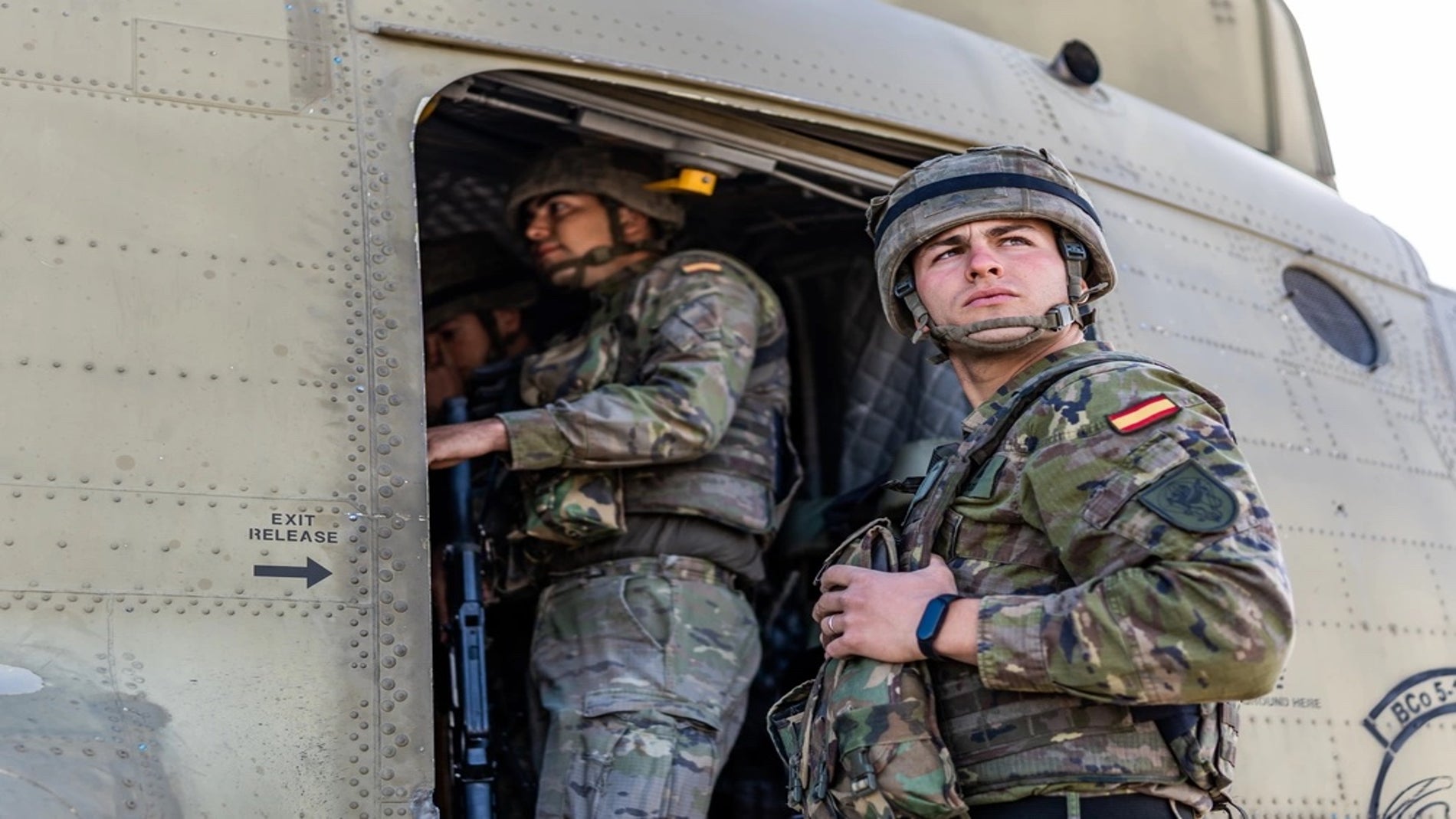
Photographic records showed Spanish soldiers boarding American Boeing CH-47 Chinook heavy-lift helicopters in Zaragoza. The tandem-rotor CH-47 Chinook is a versatile transport aircraft capable of carrying fully equipped infantry and heavy weapons directly into combat landing zones.
The Spanish Army also documented a successful air assault mission conducted on May 18, 2023, moving troops from Zaragoza to the military airfield at Ablitas in the neighbouring region of Navarra. The installation at Ablitas features an unpaved tactical airstrip frequently used by military aviators to rehearse austere forward landings.
The assault operation combined aviation assets from the United States military and the Spanish Army Airmobile Forces, known as FAMET. The coordinated aerial maneuver allowed the multinational force to maintain flight operations and meet training goals despite the adverse weather conditions.
Military communications and network systems
Organizing multinational forces across several countries required an extensive military communications framework. In preparation for the main maneuvers, the 1st Signal Regiment of the Spanish Army deployed personnel and specialized communication systems across Huesca, Valencia, Madrid, and Leon during a preparatory exercise held from March 27 to March 31, 2023.
Official information released by the 1st Signal Regiment indicated that the preparatory drills tested the services and software applications of Spain's national command and control network. The trials ensured that domestic systems could interface seamlessly with participating Spanish units and foreign allied forces.
Connectivity with international participants relied on the Mission Partner Environment, a standardized communications architecture provided by United States Army Europe and Africa. The Mission Partner Environment allows coalition partners to exchange operational data, track friendly forces, and share tactical intelligence securely across diverse national equipment.
According to the signal regiment, the operational networks combined terrestrial military infrastructure, satellite links, and encrypted internet channels. Mission coordination was maintained from Huesca, where military technicians liaised with communications operators and the specialized security centre responsible for protecting military information systems against cyber interference throughout the exercise.
Geographic intelligence and mission planning
Terrain analysis and operational mapping were delivered by the Army Geographic Centre, an institution of the Spanish Army responsible for official cartography and geographic information. Specialists from the centre provided detailed databases and digital mapping to support commanders during the initial planning phase and throughout active operations.
Technical personnel produced specific cartographic materials for the different maneuver zones, along with an overarching deployment map showing the positioning of the entire division. Part of the specialized geographic support was coordinated directly from Madrid.
The integration of geographic data and secure networks ensured that orders issued by the multinational command structure were underpinned by robust digital maps and reliable communications, allowing units to adjust rapidly when weather disrupted the initial tactical plan.


