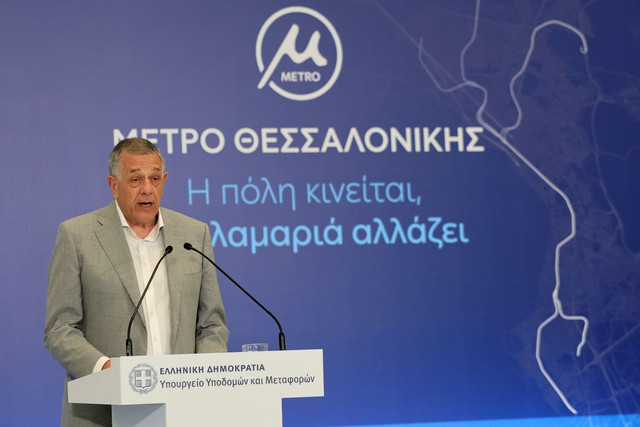
Greece's deputy infrastructure minister Nikos Tachiaos has outlined the benefits of five new Thessaloniki metro stations opened in Kalamaria, citing cleaner air and reduced traffic.
Speaking on state broadcaster ERT a day after the extension opened, Tachiaos said the five underground stations would serve a potential daily demand of 63,000 passengers and take up to 15,000 cars off the road.
The reduction in vehicle traffic is expected to keep between 12,000 and 15,000 cars parked on streets or in building parking spaces. Tachiaos noted that this shift would eliminate roughly 25 tonnes of carbon dioxide emissions every day, providing what he described as a major environmental benefit for the urban area.
Thessaloniki is the second-largest city in Greece and a major economic hub in the northern region of Macedonia. Kalamaria, situated southeast of the city centre, is one of the most populous municipalities within the metropolitan area, making transport links vital for daily commuters.
Traffic reduction and bus network integration
Addressing public transit integration, Tachiaos said a rapid transition toward electric buses is already under way in Thessaloniki. He added that the city's adoption rate of electric buses is proportionally superior to that of Athens, the Greek capital.
He explained that the main objective of the metro is to substitute car and bus traffic on primary thoroughfares. Under the planned transit model, municipal buses will act primarily as feeder services delivering passengers to the metro, which functions as the core rapid transit system.
Tachiaos also highlighted the necessity of completing work on Pontou Street, where an open roadway does not currently exist. The site features a central median strip lined with trees, which is slated to become a major avenue serving Kalamaria.
Constructing the avenue is critical for metro safety, according to the deputy minister. He noted that if an emergency or operational issue occurs at a nearby station, emergency access between stations would otherwise require navigating a complex, labyrinthine network of secondary streets.
Contactless payments and network expansion
Describing the newly built underground infrastructure, Tachiaos called the five stations finely crafted works of art beneath Kalamaria. He recounted taking the metro from the city centre the previous evening to observe operations firsthand, stating that the system elevates Thessaloniki and provides a level of service matched by few metros worldwide.
He acknowledged that residents do not change their daily travel habits overnight. Passengers often initially inspect the metro as a novelty attraction before gradually incorporating it into their daily commuting routines.
On passenger technology, Tachiaos confirmed that contactless tap and pay equipment has been physically installed at Kalamaria stations, though it is not yet active. The system will allow commuters to pass through turnstiles using credit or debit cards, with fares charged automatically.
While tap and pay features were included in the Kalamaria contract, the original contract for Thessaloniki's main metro line dates back to the early 2000s when contactless payment technology did not exist. Officials are currently extending the Kalamaria contract to cover the main line, aiming to have contactless payments operational across the network by early next year.
Future extensions to north-western districts
Addressing future development, Tachiaos expressed a desire to extend the underground network to north-western Thessaloniki. He specifically named Evosmos Square in Evosmos and Terpsithea Square in Evkarpia as major priority targets for future station construction.
Expanding the metro westward requires substantial funding that cannot be raised immediately, but Tachiaos stated that planning studies for the progressive extension have reached an advanced stage. A key cost benefit study is scheduled to be awarded within days.
The cost benefit study is required to secure financing from the European Union and loan facilities from the European Investment Bank, with formal negotiations on funding structures already under way. Tachiaos said these financing tools are expected to be finalized by the end of the year, while dedicated cleaning crews operate around the clock to maintain station quality.