The Greek theatre director Stelios Vrachnis is launching a nationwide September tour for Ai Laos, a large-scale music-theatrical production bringing together ancient tragedy and contemporary Greek music across 12 outdoor venues. The tour follows earlier premiere performances at the Earth Theatre during the 12th Forest Festival of the State Theatre of Northern Greece, as well as dates in Grevena and Alexandroupoli, where the production drew enthusiastic crowd responses.
The staging marks the first time that the historic 1983 album Ai Laos, composed by Dimitris Lagios with lyrics by Michalis Bourboulis and originally sung by Sotiria Bellou, has been adapted into a single theatrical event. Forty-three years after the album's release, Vrachnis has combined its musical framework with Euripides' ancient play Trojan Women, translated into modern Greek by Dimitra C. Christodoulou.
The production functions as a scenic requiem for the victims of conflict, examining defeat, loss, and survival among historical ruins. Set in the immediate aftermath of the fall of Troy, the narrative depicts Trojan women facing captivity and an uncertain future while the destroyed city lies in ruins.
A fusion of ancient drama and Greek song
In the performance, Trojan Women depicts the collapse of a city, while Ai Laos reflects the enduring wounds of a population. Vrachnis said that the two works engage in a shared dialogue around post-war survival, exploring what remains after conflict and what memories the living carry forward.
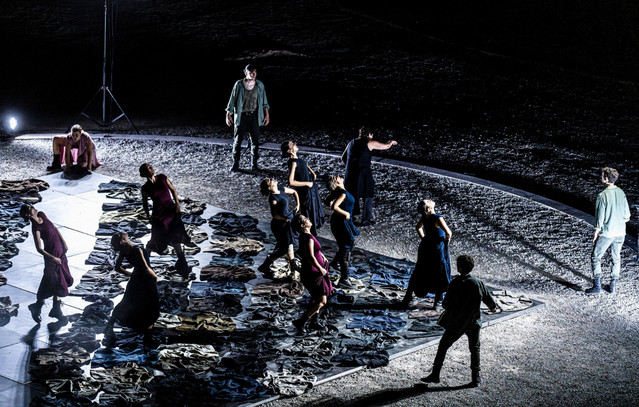
The production integrates 19 actors, singers, and live musicians on stage to form a single performance body where spoken text, song, and movement operate as a unified dramaturgical act. Performer Hyakinthi Lagiou, the daughter of the late composer Dimitris Lagios, sings in the show to link the live production directly to her father's musical legacy.
Sotiria Bellou's original vocal interpretations are re-examined through a polyphonic choral arrangement, while the original score by Lagios is re-orchestrated for string instruments, woodwinds, and electronic sound. The arrangements were created by Thomas Lazarou and Thanos Stamoulis to position the musical atmosphere between historical memory and contemporary sound.
Stage design and core cast members
At the center of the stage setting is a visual installation containing 2,000 items of men's clothing. The garments represent absent human bodies, turning the performance space into a physical landscape of collective mourning.
Actress Giota Festa returns to the lead role of Queen Hecuba, while Ioanna Pilichou portrays Andromache and Alkistis Angelopoulou plays the prophet Cassandra. The herald Talthybius is performed by a rotating ensemble comprising Odysseas Petrakis, Apostolos Linardos, Alkiviadis Stasinos, and Dimitris Markopoulos.
The theatrical chorus consists of ten performers: Alkistis Angelopoulou, Pelia Giannoulatou, Sofia Gioldasi, Eleni Dimopoulou, Dimitra Zachariadou, Maria Katirtzidou, Hyakinthi Lagiou, Mary Lioliou, Iro Salakou, and Myrto Chalemi.
Musical ensemble and production details
Live musical accompaniment is provided by a six-piece ensemble on stage. The lineup features Thomas Lazarou on electronic sound, Thanos Stamoulis on piano, Panagiotis Andreou on clarinet, Angeliki Gkana on violin, Christos Papadopoulos on electric guitar, and Maria Tsolka on cello.
Stelios Vrachnis directed the show and developed the overall dramaturgical composition. Sofia Gioldasi oversaw vocal preparation and music teaching, while Thanos Stamoulis served as musical director. Photography, videography, and media management were handled by Giannis Portokalidis, with advance ticket sales made available through the more.com ticketing platform.
September tour schedule across Greece
The September tour begins on 8 September with a newly added performance at the Fortress in Kavala. The show then moves to the Garden Theatre in Thessaloniki for two consecutive dates on 10 September and 11 September.
Performances continue on 12 September at the Open Amphitheatre of the International Hellenic University in Serres, followed by a show on 14 September at the Melina Mercouri Theatre in Volos. The production reaches Patras on 17 September at the Summer Municipal Theatre located inside the Panpeloponnese Stadium, before staging a performance at the Outdoor Phrynichos Theatre in Delphi on 18 September.
The tour proceeds to Ioannina on 21 September for a newly added date at the Outdoor EHM Theatre in Frontzou, followed by another new date on 23 September at the Mikis Theodorakis Open Theatre in Pontokomi, Kozani. Further dates include 25 September at the Katrakeio Theatre of Nikaia in Attica and 29 September at the Veakeio Municipal Theatre of Piraeus, alongside an upcoming date to be announced at the Municipal Garden Theatre Alcazar in Larissa.