Spanish mining companies have mobilized around 2 billion euros in corporate deals and investments in recent months, pressing ahead with acquisitions and stock market listings despite uncertainty over Spain's November 29 parliamentary election, which could produce a new Mining Law and a special tax on the sector.
The money has gone mainly toward boosting production capacity for copper, nickel, zinc and tungsten, among other raw materials, as prices for these metals have risen and the European Commission pushes for "strategic autonomy" so the continent can supply itself with metals needed for defence, energy, car manufacturing and technology without relying on countries such as China or Russia.
What the Election Could Change
The Frente Amplio coalition's program for the November 29 election includes a tax on extractive mining activities meant to charge for environmental externalities across roughly 2,800 operations, which it says would raise more than 470 million euros a year.
The PSOE's program instead speaks of guaranteeing sustainable management of mineral raw materials and passing a new Mining Law aligned with the ecological transition.
Whether either measure is applied will depend on the election result and on the negotiations to form a government. Even so, the scale of the proposals reflects a revival of Spain's mining industry, which only a few years ago seemed headed for slow decline without any need for tighter regulation.
Acquisitions Reshape the Sector
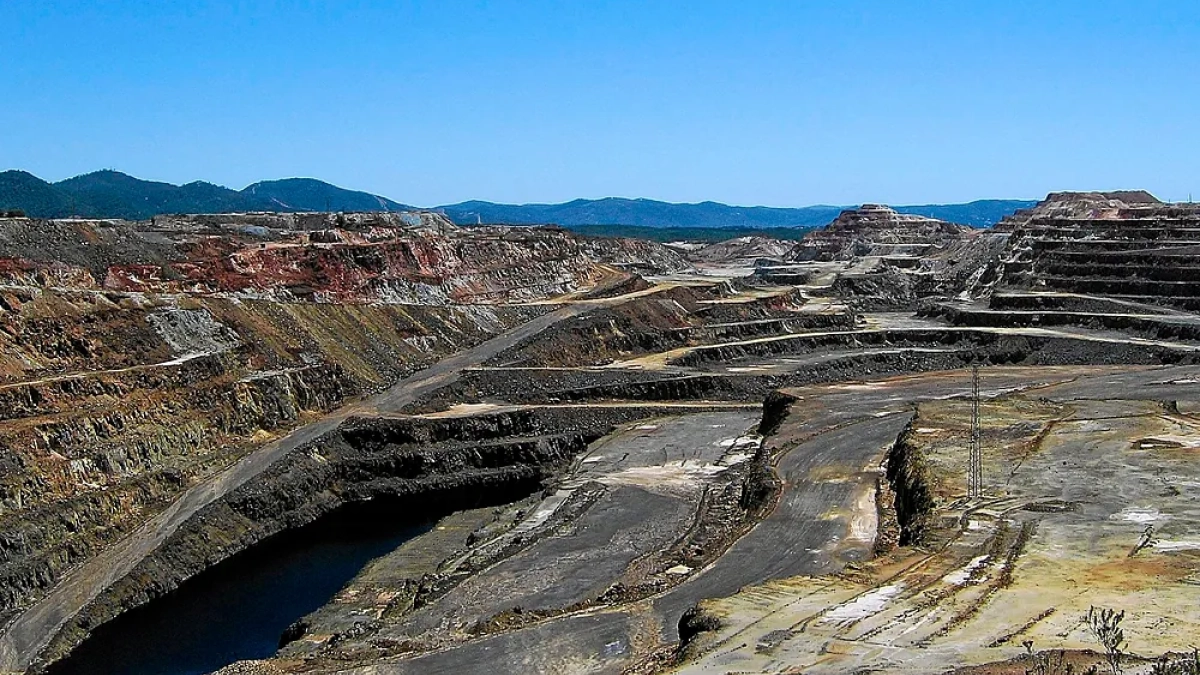
The most recent deal was Atalaya Mining's purchase of Tharsis Mining for 125 million euros. Atalaya, which operates the Riotinto deposit where it extracts copper and other metals, wants the acquisition to consolidate its holdings in southwestern Andalusia, where it already has other exploration licenses.
In the same area, investment firm Resource Capital Funds completed its purchase of Cobre Las Cruces from First Quantum Minerals in June for around 170 million euros. The new owner's challenge is to invest roughly 800 million euros in an underground mine to reach copper below the surface, along with a treatment plant.
Another major deposit in the region, Minas de Aguas Teñidas, known as Matsa, was bought by Australian group Sandfire Resources in 2022 for 1.6 billion euros.
In the same geological belt, known as the Iberian Pyrite Belt, the potential reopening of the Aznalcóllar mine remains pending. Its operating rights were granted to Grupo México, though Canadian firm Emerita Resources has challenged that decision in court. Emerita, which holds several projects in Huelva, rejected a merger offer from Denarius Metals before the summer. Denarius participates in the Aguablanca project in Badajoz and the Toral project in León.
After that rejection, Denarius turned to financing the Aguablanca nickel and copper project through its subsidiary Rio Narcea Recursos, which has signed a preliminary agreement for a 25 million dollar loan to begin the investment. Denarius also placed bonds worth 15 million dollars at the start of 2026 to help fund the mine's reopening.
On the Portuguese side of the same belt, Boliden bought the Neves-Corvo deposit last year for 1.45 billion dollars.
Stock Market Listings
The strategy of listing shares to finance a mine's reopening, already used by Atalaya Mining with Riotinto, has been followed by Abenójar Tungsten, which has debuted on the London stock exchange after a share offering worth 170 million euros. Its current market value stands at about 400 million euros.
Abenójar, controlled by the García San Miguel family, plans to use the proceeds, together with a loan from Deutsche Bank, to build an open-pit mine in Ciudad Real to extract tungsten starting in 2029.
Cunext, which turns copper from mines or recycling into cable, is also considering a listing. The company, chaired by Dámaso Quintana, has already lined up coordinating banks for a potential placement on the Spanish market and could be valued at up to 1 billion euros.
In the same area of metal processing, Atlantic Copper, a subsidiary of Freeport-McMoRan, opened a plant in Huelva that recycles copper from electronic devices following an investment of 550 million euros.
EU Strategic Status
Several of the ongoing initiatives were designated strategic projects by the European Commission in 2025 to speed up their permitting. These include the Atlantic Copper plant and the El Moto, Aguablanca and Las Cruces mining projects, as well as the Las Navas lithium deposit, the Doade mine in Galicia and the La Parrilla tungsten project in Extremadura.
Last month, Brussels added a potential tungsten treatment plant in Ciudad Real and the Touro mine in Galicia, promoted by Atalaya, to the strategic list.
For now, electoral uncertainty has not slowed the projects, as investors appear confident that neither the proposed mining tax nor a new Mining Law will ultimately be implemented.
What happens next
Spain holds parliamentary elections on November 29, which will shape whether a new Mining Law or an extractive activities tax proposed by Frente Amplio and the PSOE moves forward.
Test yourself
About how much have Spanish mining companies mobilized in recent months?
Which company did Atalaya Mining acquire for 125 million euros?
Where did Abenójar Tungsten list its shares to fund its Ciudad Real mine?
Have your say
Should Spain introduce a new tax on mining companies to cover environmental impacts?
Where it happened
Huelva, Spain