


Ukrainian kamikaze drones have destroyed seven Russian T-72B3A main battle tanks during an armored assault in Donetsk Oblast in eastern Ukraine, saturating Russia's new Arena-M active protection system.
Russian forces launched the attack using a column of tanks and armored vehicles, but Ukrainian forces contained the offensive by swarming each protected vehicle with between 15 and 20 explosive drones to overwhelm the defensive shield.
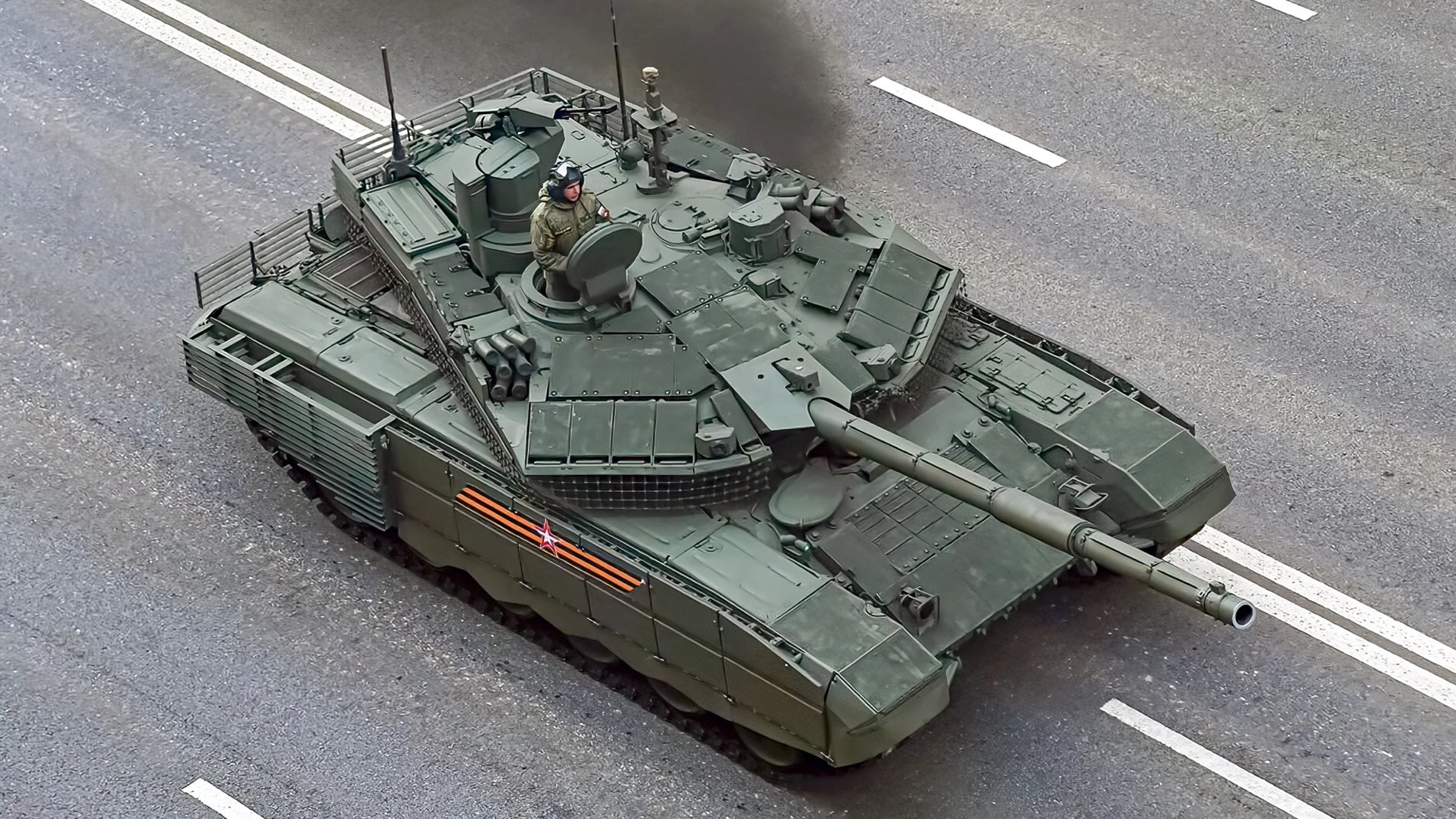
Russian journalists reporting on the confrontation indicated that Ukrainian troops witnessed several of their drones destroyed by Arena-M in mid-air before the sheer volume of incoming craft breached the defense.
Donetsk Oblast, located in eastern Ukraine's industrial Donbas region, has been a major focus of heavy combat since Russia launched its full-scale invasion of Ukraine in February 2022. The T-72B3A is an upgraded version of the Soviet-designed T-72 main battle tank, modified by Russian defense manufacturers with enhanced armor packages and targeting systems.
Evolution of Russian Tank Protections
The engagement took place more than four years after the Russian intervention in Ukraine began, a conflict marked by rapid technological adaptations as unmanned aerial vehicles have increasingly replaced heavy armor as the primary strike weapon on the battlefield.
To protect armored vehicles against aerial strikes, Russian forces initially introduced physical armor in the form of metal protection cages, a tactic that Ukrainian troops subsequently replicated. Russian engineers later fitted tanks with metal spikes and various improvised shielding, though the added structure impaired vehicle mobility and restricted the rotation of main gun cannons.
Mechanized assaults relying on armored vehicles have been largely neutralized across Ukrainian battlefields, forcing Russian tactics to shift toward infiltration by small groups of infantry soldiers.
Soviet Origins and Modern Drone Challenges
The Arena defensive system was originally developed during the Soviet era to detect and intercept incoming rocket-propelled grenades and anti-tank guided missiles.
Russian engineers began working in 2019 to reincorporate the system onto modern battle tanks, completing live-fire testing in 2021. However, adapting the Arena-M variant to detect small unmanned aerial vehicles has proven to be the system's greatest challenge, as the slow and unpredictable flight paths of small drones leave tanks vulnerable.
The tactical battle also highlights a significant cost asymmetry on the battlefield. A single Ukrainian drone costs approximately 400 dollars, allowing Ukrainian forces to deploy a cluster of more than 12 drones to destroy a Russian armored vehicle worth millions of dollars.

Kremlin Assessment and Future Upgrades
Inside the Kremlin, officials acknowledge the technical limitations demonstrated by Arena-M and are seeking improvements based on additional defensive layers to protect tanks in combat. However, military designers face severe physical constraints, as current tank hulls lack the space required to install additional projectile launchers.
Ukraine's tactical victory leaves Russian forces working to devise a decisive action plan, with the Arena-M system expected to undergo further modifications in the coming months as engineers attempt to address its vulnerabilities.


