An experimental 1971 Eisenhower dollar prototype that previously sold for $264,000 has been returned to auction through online auction house GreatCollections, with bidding set to close on October 18.
Cataloged under the designation Judd-2147, the piece is one of only three known surviving prototypes of the U.S. Mint's first space-themed dollar coin, according to a report by CoinWeek cited by the Times of India.
The coin was discovered on February 15, 2008, at the Long Beach Coin Expo in California. Collector Lee C. Lydston was visiting the convention with his wife Denise when she spotted a vendor selling tubes of Eisenhower dollars composed of 40 percent silver.
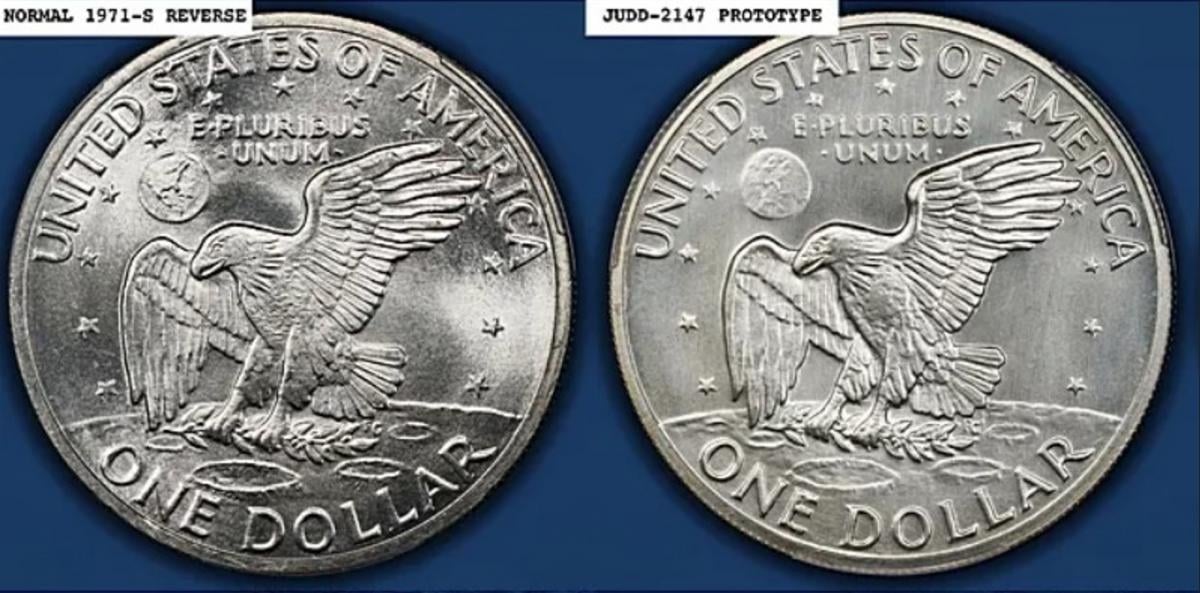
While inspecting one of the tubes, Lydston pulled out a 1971-S dollar that appeared distinct from standard uncirculated and proof coins. The surface exhibited an unusual texture, the strike was exceptionally sharp, and details of the Moon on the reverse did not match regular production issues. Realizing the coin did not correspond to known examples, Lydston purchased it and submitted it for expert examination.
Archive Comparison and Design Differences
Researchers compared the piece with archival material and established that its reverse matched an early 1970 galvanotype held at the Dwight D. Eisenhower Presidential Library and Museum in Abilene, Kansas.
The Eisenhower dollar was produced by the U.S. Mint between 1971 and 1978, featuring the 34th U.S. president on the obverse and an emblem based on the Apollo 11 insignia on the reverse. U.S. Mint Chief Engraver Frank Gasparro originally sculpted detailed craters onto the lunar surface during early development. Many of those fine details were subsequently modified or removed before mass production began.
The prototype displays distinct die polishing lines, uneven borders around certain inscriptions, slight doubling on select design elements, and an unusually heavy strike. Metallurgical testing later confirmed that the coin contains the standard alloy of 40 percent silver and 60 percent copper utilized for collector coins of that era.
Subsequent Finds and Die Variations
Two additional prototype specimens were later uncovered, confirming that two different pairs of dies were used in the experimental production series.
In 2010, collector Charles Chatham bought a second prototype inside an original U.S. Mint "Blue Pack" packaging at an Alabama pawnshop for $10. The coin featured the same prototype reverse die as Lydston's find but used a different obverse die, identifiable by variations in the lettering of the word LIBERTY.
A third prototype surfaced on eBay in 2013, struck from the exact same die pair as the original Lydston discovery. That coin was later assigned a grade of SP66 by the Professional Coin Grading Service.
Professional Coin Grading Service is an independent authentication company that evaluates rare coins, while "Blue Pack" refers to the blue plastic packaging used by the U.S. Mint to distribute silver-clad coins directly to collectors during the 1970s.
The Judd-2147 prototype now being sold online by GreatCollections offers collectors another opportunity to acquire one of the rarest experimental strikes in modern American numismatics before online bidding ends on October 18.