Transport workers and social organisations across four Peruvian regions have staged strikes, rallies, and highway blockades to protest surging diesel prices, higher passenger fares, and the rising cost of living. The demonstrations in Ucayali, Loreto, Arequipa, and Tacna have disrupted regional transit and commodity supplies across the country.
The wave of social unrest opened just 13 days after the start of President Keiko Fujimori's government. Transport operators warned that escalating fuel prices have severely damaged their operating margins, forcing widespread stoppages and road closures.
The main focal points of the mobilization centered on Ucayali and the city of Iquitos, with additional disruptions reaching Bagua and Puno as unions threatened further indefinite strikes.
Ucayali highway and river blockades
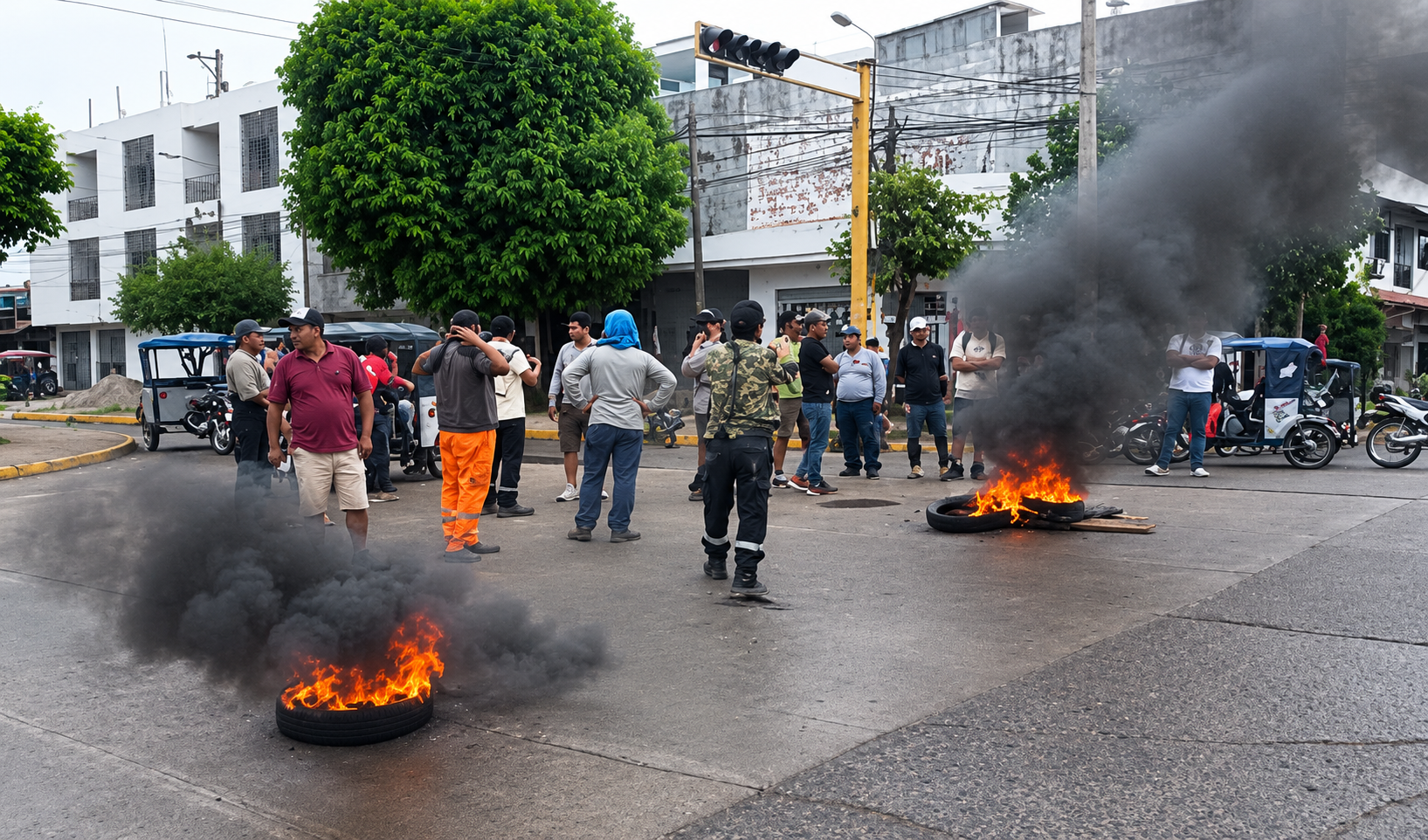
In Pucallpa, transport operators reached the third day of an indefinite strike that has restricted traffic along major highways, urban streets, river waterways, and local fuel distribution routes.
Demonstrators maintained blockades along key stretches of the Federico Basadre highway, the primary land corridor connecting the central Amazonian region of Ucayali with Huánuco, Tingo María, Huancayo, and Lima.
Peru's Ombudsman's Office, the Defensoría del Pueblo, reported travel restrictions across several kilometers of the highway. Urban blockades also restricted traffic within Pucallpa, while river transport ground to a halt on the Tamaya and Iparía rivers. Clashes between protesters and police officers were reported in several areas.
The main grievance remains the sharp increase in fuel prices. Union leaders stated that diesel prices in Ucayali rose from between 11.50 and 12 soles per gallon in March to between 23 and 24 soles per gallon currently.
The blockades have crippled local fuel distribution, leaving service stations inoperative and creating long lines of vehicles. State oil company Petroperú stated that fuel is available at supply points, but tanker trucks cannot navigate the blocked roadways.
The strike has also led to uncollected trash accumulating in streets, delays in removing medical waste from hospitals, and the suspension of in-person school classes across the province of Coronel Portillo.
During a dialogue table with government representatives, transport operators and community groups raised broader demands regarding health services, drinking water, sanitation, and road infrastructure. Union leaders requested that the national government establish a high-level commission with full decision-making power.
Arequipa transport fare dispute
In the southern city of Arequipa, public transport operators demanded an increase in urban bus fares from 1 sol to 1.30 soles to offset rising costs for diesel, engine oil, tires, spare parts, and vehicle maintenance. One driver stated that transit workers were working essentially just to pay for fuel.
On Tuesday, six of the ten transit companies that failed to secure official municipal authorization for the higher fare suspended their operations. The stoppage disrupted public transport across the city and affected roughly 220,000 students, leading to the suspension of in-person classes.
Buses resumed service on Wednesday after receiving notarized notices from the Municipalidad of Arequipa, although trade unions clarified that the strike had not been lifted.
Union representatives met on Wednesday night with Mayor Ruccy Oscco. Municipal authorities announced that dialogue would continue on Thursday with participation from the Defensoría del Pueblo, the Regional Education Management, and the Prefectura. The municipality maintained that transit companies must complete required documentation before adjusting fares.
Protests spread to Tacna, Loreto, and Bagua
In Tacna, the Federación de Transporte carried out a 48-hour strike on August 10 and 11, halting urban and interurban bus services. Transport unions condemned diesel prices reaching up to 25.35 soles per gallon, warning that the cost directly threatens their operations. The Regional Directorate of Education suspended in-person classes in schools during both days.
In Loreto, where regional connectivity relies heavily on river networks, the Defensoría del Pueblo reported a blockade on the Nauta-Iquitos highway. Passenger transport unions, mototaxi drivers, and riverboat operators announced additional protest measures against rising fuel prices that increase travel costs for residents.
Social unrest also extended to Bagua, where Awajún indigenous communities from Wawas, in the district of Imaza, blocked the IV Eje Vial highway. Protesters demanded the immediate resumption of stalled school construction projects and the replacement of a pedestrian bridge destroyed more than a year ago.
Puno deadline and government response
In Puno, transport unions warned of a potential indefinite strike, giving the executive branch a one-month deadline to address fuel prices. With diesel selling between 24.80 and 25 soles per gallon, transport driver Jaime Machaca said operators were literally subsidizing their own work by spending more than 150 soles of their daily earnings on fuel.
Puno transport organizations demanded a government subsidy or the reactivation of a stabilization fund to reduce diesel prices to around 20 soles per gallon. Union leaders scheduled a regional assembly for August 23 to coordinate their position, while the Frente de Organizaciones Populares held a sit-in demonstration against the price hikes.
In May, the government approved a temporary subsidy of 4 soles per gallon for B5 and B20 diesel targeting passenger and cargo carriers to cushion the impact on fares and freight. The subsidy covered fuel purchases made between May 29 and July 29 under specific requirements, but failed to prevent street protests.
Political analyst Andy Philipps told the news outlet that short-term subsidies offer only temporary relief and do not guarantee sustained price reductions. Philipps advocated for expanding natural gas infrastructure, converting commercial vehicles to natural gas, and overhauling the national energy matrix.
Philipps noted that public transit pricing has long been a top regional issue in southern departments such as Arequipa, Moquegua, and Tacna, where fares in some cities have doubled due to fuel costs. He warned that short-term subsidies solve nothing fundamental and expressed doubt over whether the government would pursue structural energy reforms given its short-term extractivist approach.
The executive branch announced the reactivation of the Fuel Price Stabilization Fund, known as FEPC, alongside a temporary subsidy for the Amazon region. However, ongoing protests demonstrate that fuel price increases have triggered a wider wave of regional demands over the cost of living.