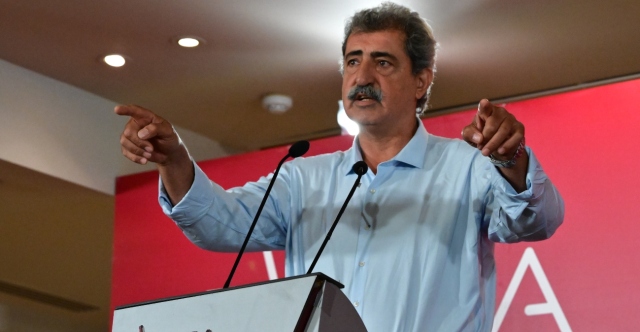
Greek lawmaker Pavlos Polakis has published a six-pillar political manifesto proposing a new progressive majority and governing strategy for the left, days after leaving open a bid for the leadership of SYRIZA Progressive Alliance.
The social media publication outlines a programmatic framework designed to unite labor, small businesses, farmers, youth, and citizens reliant on public goods into a broad social and political bloc.
Polakis stated that the central question facing the nation is not simply who will govern, but who will gain power through a new administration.
He added that a progressive majority must be built around a shared program with clear social references rather than a collection of party leaders named in a press release, offering a clear criticism of former party leader Alexis Tsipras.
Polakis argued that a governing left must transform state institutions, regain public control over strategic assets, redistribute economic and political power, and create new avenues for citizen participation.
Programmatic framework and theoretical foundations
The manifesto presents its six key pillars as a contribution to the political program established at SYRIZA's 2022 congress and re-articulated at its fifth congress.
Rather than presenting a simple list of policy promises, the document outlines an integrated plan covering bailout reversals, judicial reform, state decentralization, social welfare expansion, productive economic restructuring, and a multidimensional foreign policy.
Polakis framed his proposal using the political theory of Marxist scholar Nikos Poulantzas, who defined the state as the material condensation of a balance of forces among competing social classes.
Under this theoretical model, social contradictions are embedded directly within state legislation, public administration, judicial rulings, and economic policy rather than existing purely outside the state.
The manifesto contends that state power is transformed both from within state institutions and across society simultaneously during periods of political change.
Reversal of bailout policies and economic reform
The first pillar calls for the gradual repeal of core bailout legislation and neoliberal reforms enacted by the ruling New Democracy government.
Key proposals focus on restoring labor and social rights, regulating private debt, protecting primary residences, restoring public control over the Public Power Corporation, creating a public banking sector, and reforming public asset management.
Polakis noted that reversing austerity laws does not mean returning to pre-2010 conditions, as international bailouts fundamentally altered relations between labor and capital while transferring authority from elected bodies to financial markets and creditors.
The plan targets a broad social base, including wage earners, pensioners, small business owners seeking bank credit, farmers facing high input costs, young people excluded from housing, and indebted households.
Implementation would begin with immediate measures to safeguard homes, restructure debt, enforce collective bargaining, control energy assets, and launch public financial tools before expanding into broader structural reforms.
Judicial independence and institutional transparency
The second pillar focuses on judicial reform, government transparency, and restoring public trust in state institutions.
Drawing on Poulantzas's concept of authoritarian statism, the text warns of a trend where executive power concentrates decision-making while oversight mechanisms deteriorate, turning parliament into a body that merely validates pre-made decisions.
The document highlights concerns regarding the concentration of executive authority, wiretapping controversies, the use of Predator spyware, secrecy invocations, conflicts with independent regulatory bodies, non-transparent public contracts, and extensive direct contract assignments.
Polakis criticized the current selection process for top judicial appointments, slow trial schedules, and perceptions of selective legal protection that favor financial elites over working citizens.
Proposed remedies include revising how supreme court leaders are chosen, strengthening judicial independence, accelerating trial proceedings, fortifying independent authorities, enforcing contract transparency, and protecting journalists and whistleblowers.
Decentralization and local government reform
The third pillar outlines state transformation through the decentralization of power and financial resources to local government bodies.
The manifesto characterizes the current state structure as overly centralized toward society yet weak against organized financial interests, concentrating authority at the top while shifting operational burdens downward.
Polakis asserted that local autonomy requires permanent funding, technical capacity, and direct accountability, cautioning that transferring responsibilities without adequate resources amounts to administrative abandonment.
Aligning with Poulantzas's framework for democratic socialism, the strategy combines internal state reforms with external direct democracy initiatives.
Specific measures include participatory budgeting, local referendums, social oversight of public utilities, energy communities, and institutional mechanisms giving workers and residents direct input on policy decisions.
Expansion of universal social welfare rights
The fourth pillar sets out a strong social state covering healthcare, public education, social housing, workplace protection, fair pensions, and care services for children, the elderly, the chronically ill, and disabled people.
The proposal seeks to shift social welfare from a selective relief system into a framework of universal, guaranteed social rights essential for genuine personal freedom.
The manifesto takes a firm stance on higher education, pledging to defend Article 16 of the Greek Constitution, which mandates public university education.
Polakis criticized political compromises that claim to support Article 16 while accepting the Pierrakakis law on private universities, arguing that such positions permit the bypassing of constitutional protections.
Productive economic model and national sovereignty
The fifth pillar advocates replacing Greece's current reliance on mass tourism, real estate, imports, consumption, and low-wage labor with a high value-added productive model.
The strategy prioritizes primary agriculture, industrial manufacturing, scientific research, technology, pharmaceutical production, and defense industries to shift the economic balance away from financial concentration.
To support this shift, the plan calls for regaining state control of the Public Power Corporation and establishing a public banking pillar with at least one state-controlled commercial bank.
Polakis revisited proposals to reclaim state control over the National Bank of Greece as a financing vehicle for left-wing economic policy, emphasizing that public ownership requires professional management, strict transparency, and public accountability.
The sixth pillar addresses foreign policy, asserting that patriotism belongs to the left and calling for a multidimensional international strategy rooted in international law.
Polakis stated that Greece must act as an equal ally within the European Union, defend its sovereign rights, support the Republic of Cyprus, and build ties across the Balkans, the Mediterranean, and emerging global powers without blindly endorsing third-party policies.