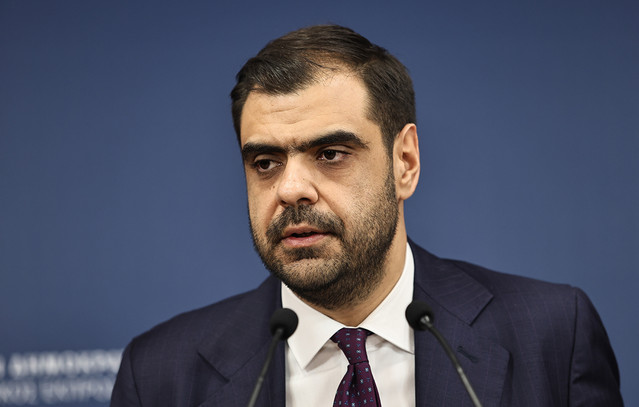
Greek Deputy Minister to the Prime Minister and Government Spokesperson Pavlos Marinakis has announced that he will step down from his position on the day elections are officially called to stand as a candidate in the Northern Sector of Athens.
Speaking in an interview on the Unformal vidcast produced by the newspaper Political, Marinakis explained that political offices carry inherent expiration dates and should not be treated as a lifelong career.
Marinakis stated that he would resign his spokesperson post upon the formal election announcement following a decision by Prime Minister Kyriakos Mitsotakis to place him on the ballot in Northern Athens. He described the role of government spokesperson as an electric chair, warning that a single misstep, flawed wording, or incorrect briefing from a ministry could harm an entire administration and undermine the trust of the prime minister.
Before entering government leadership, Marinakis maintained an active legal practice, a profession he continues to keep open. He noted that practicing law is in some ways more demanding than politics because it directly impacts an individual life, where a lawyer preparation and a client cooperation decide the outcome of a case. He added that politicians who aim to spend 20, 30, or 40 years in office lose their usefulness to the public.
Plans for Northern Athens candidacy
Reflecting on his personal evolution, Marinakis acknowledged that dealing with real world challenges had led him to reconsider several past certainties. He said that life had taught him to soften his stance on matters where he once held rigid views, emphasizing that people should gain firsthand experience and gather proper information before forming firm opinions.
Growing up in the western Greek city of Patras, Marinakis developed a strong passion for basketball that was ultimately cut short by injuries. He recalled that although he preferred playing on the perimeter to shoot, his height meant coaches consistently positioned him inside the key to fight under the basket.
Turning to the atmosphere in national politics, Marinakis criticized the rising level of hostility in public debate both inside and outside parliament. He pointed to the expansion of social media platforms and aggressive reactions from political opponents as factors turning public exchanges into a mudslinging match.
Marinakis admitted that he had previously found himself in difficult positions when forced to defend controversial statements made by government colleagues in an improper tone. He stressed that tone is a fundamental component of political messaging, noting that how a politician addresses citizens who do not know them personally is just as vital as the content of the message.
Press scrutiny and the Tempi anniversary
Regarding his working relationship with journalists, Marinakis praised the majority of political reporters while condemning a small minority that uses selective video editing to exploit social media algorithms. He argued that deliberate snippet editing distorts facts and undermines constructive public discourse.
As an example of public deception, Marinakis highlighted coverage surrounding the second anniversary of the Tempi train disaster between January and March 2025. He stated that an invisible thread of misinformation was deployed during that period, turning non-political television broadcasts into media courtrooms while distracting from the legitimate judicial investigation needed to assign strict accountability.
Defending his record on transparency, Marinakis noted that he has never refused to answer questions from reporters during his time in office. He revealed that he has conducted more than 45 formal press briefings during his tenure, with each session running longer than an hour.
Government reforms and economic challenges
Marinakis emphasized that he has never hidden during difficult moments, stating that he and several ruling New Democracy party lawmakers have consistently faced the public with honest arguments. He noted that his relationship with Prime Minister Kyriakos Mitsotakis is built on complete frankness, warning that an inner circle of courtiers who only offer praise is the most damaging thing a leader can face.
Addressing the ongoing cost of living crisis, Marinakis warned that government figures who only celebrate economic successes alienate struggling citizens. However, he added that opposition parties that focus exclusively on negative economic indicators remain stagnant in public opinion polls as a result.
The spokesperson highlighted several ongoing structural reforms, including a 95 percent increase in foreign direct investment, upgrades to civil protection, the digital state initiative, measures against sports fan violence, and the restoration of order on university campuses. He also cited the transfer of the OPEKEPE agricultural payments agency to the AADE independent revenue authority, while acknowledging candidly that political costs had previously delayed necessary changes to farming subsidies.
Political opposition and historical memory
Commenting on the political return of former Prime Minister Alexis Tsipras, Marinakis stated that the move creates no anxiety inside the Maximos Mansion government headquarters. He argued that the re-emergence of the former Syriza leader serves as a helpful reminder to self-employed workers who remember the tax and pension burdens imposed under the Tsipras-Katrougalos legislation.
Marinakis also responded to criticism from the Communist Party of Greece (KKE) over a video he posted marking the European Day of Remembrance for Victims of Nazism and Stalinism. He rejected claims of bias, questioning how anyone could differentiate between authoritarian regimes that murdered millions of people based solely on whether their political color was red or black.
Concluding his remarks, Marinakis condemned historical distortion by elements of the political left while offering self-criticism regarding his own center-right political tradition. He admitted that his political side bore great responsibility for allowing one extreme to enjoy political immunity for decades while turning a blind eye to its atrocities, concluding that society must stop ignoring obvious historical truths to move forward.