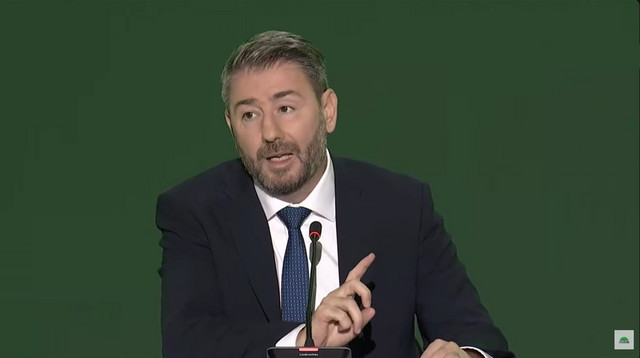
Nikos Androulakis, the leader of the Greek opposition party PASOK-Movement for Change, held a wide-ranging press conference in Thessaloniki as part of the 90th Thessaloniki International Fair, laying out his party's economic and social program along with its costs, while attacking Prime Minister Kyriakos Mitsotakis over the government's economic policy.
Androulakis said his party's proposals form a documented, specific and costed program. He said it had rained in Thessaloniki the day before, and joked that it certainly had not rained billions, a jab at the government's spending announcements.
The Thessaloniki International Fair is Greece's largest trade fair, and its September edition is traditionally used by the prime minister and the leader of the main opposition party to set out economic policy for the year ahead. PASOK, once Greece's dominant socialist party, is now the country's leading opposition force against Mitsotakis's New Democracy government.
Housing plan questioned
Savvas Goulopoulos, a journalist with the outlet Newsbeast, asked Androulakis about Greece's homeownership rate falling below the European Union average, the thousands of closed properties across the country, including 520,000 in the Attica region alone, and the underfinancing of the housing market by banks. He asked how a PASOK government would fix the market and what incentives it would introduce.
Androulakis said he had warned since 2022 that housing would become Greece's biggest social problem. He said property costs had risen sharply compared with what Greek households can afford, leaving even people in solid jobs afraid they would never own a home, while others could not start families, remained living with their parents, or cut spending on their children's education to cover rent.
He said PASOK would make housing a priority from its first day in government, calling for new city plans and infrastructure to expand supply, limits on the real estate market, and rules on short-term rentals. He said pressure from PASOK had already pushed the Golden Visa investment threshold in Athens up from 250,000 to 800,000 euros, but that some investors had exploited a gap in the legislation to buy industrial buildings and other properties at the lower threshold before converting their use. He said the threshold had stayed at 400,000 euros on islands such as Syros, which lack water supply and health infrastructure, while it stood at 800,000 euros in Crete, which has that infrastructure.
Under a PASOK government, he said, municipalities in high-pressure housing areas would carry out capacity studies to set limits on how many short-term rental properties are allowed and how large they can be. He said the party would offer incentives to reopen closed buildings and apartments for low-cost social rent, and would introduce rules capping rent increases. Anyone renewing a Golden Visa, he added, would be barred from renting that property short-term and would instead have to live in it themselves or rent it out long-term.
13th pension and 13th salary
Androulakis said PASOK's pledge to bring back a 13th pension payment would be phased in over two stages, with the first installment in 2027 and the second in 2030. He put the fiscal cost of the second installment at 840 million euros. He said a promised 13th salary would also be introduced gradually, at a total cost of 1.27 billion euros. He put the cost of restoring the EKAS benefit for low-income pensioners, a group he said had been hit hard by rising prices, at 540 million euros.
Tax and VAT proposals
On tax policy, Androulakis said scrapping the solidarity levy would be fiscally neutral. He said indexing income tax brackets to inflation, so that rises in nominal income do not push people into higher tax bands, would cost 400 million euros over four years. He described as fiscally neutral a proposal to double the VAT exemption threshold for the self-employed and small businesses, from 10,000 to 20,000 euros in annual turnover. On VAT for basic goods, he said PASOK was not proposing a permanent, across-the-board cut, but rather the option to reduce it during periods when price rises intensify.
Androulakis said PASOK had not come to Thessaloniki to hand out the surplus generated by the government's policy. He said the party wanted a different growth model, one that would produce a healthier economy and distribute the benefits of growth more fairly, rather than letting growth become a field for speculation and the accumulation of wealth by the powerful at society's expense.
PASOK's electoral target
Androulakis said PASOK's goal was to finish first in the next election, not second. He argued that under Greece's current electoral law, finishing first is the only route to forming a government capable of delivering real political change, rather than simply swapping which party holds power. He named corruption, clientelism, impunity, lack of transparency and declining trust in the political system as the central problems the country faces, saying they called for a bold and radical change.
Rules out deal with New Democracy
Androulakis ruled out any government cooperation between PASOK and New Democracy, saying the position would hold even if Mitsotakis were not the one holding the premiership in a hypothetical joint administration. He cited a unanimous decision by 5,000 delegates at a PASOK party conference and said the strategy would not change because it reflects the party's values.
He accused the government of failing to sufficiently respect the country's institutions, the constitution, the judiciary and parliamentary principles, and said its policies favored the creation of what he called an oligarchic caste. Asked whether PASOK might work with former prime minister Antonis Samaras if he launched a new party, Androulakis said any such move would concern New Democracy, not PASOK.
Social state and foreign policy
Androulakis set out plans to overhaul the National Health System and public education, to establish clear rules for genuinely non-state, non-profit universities, and to address private debt and inequalities in access to education and healthcare. He warned that widening social inequality risked reinforcing the belief among many citizens that they are not represented by the political system, and said he would fight to make the social state strong and fair for everyone, so that no citizen feels left behind.
He said Greece would not go without a government after the election, adding that it is up to voters to decide, through their ballots, which government takes office. He dismissed the government's framing of a choice between Mitsotakis and chaos as a communication tactic, and described its comparison between Mitsotakis and Turkish President Recep Tayyip Erdogan as a sign of the government's arrogance.
On foreign affairs, Androulakis said PASOK does not accept lessons from the government, pointing to Cyprus's accession to the European Union despite the unresolved Cyprus problem as the most important national achievement since Greece's return to democracy in the 1970s. He renewed his call for a new architecture governing European Union relations with Turkey and disputed the government's description of calm relations with Ankara, calling it a communication construct. He said any upgrade to the EU-Turkey customs union should come with specific clauses and sanctions covering violations of Greek and Cypriot sovereign rights.
Political independence
Androulakis said PASOK's independence from economic centers of power and business interests was essential if the party is to deliver its program, saying it could keep its promises because it has no dependencies. He accused the government of favoring banks, oligopolies, investment funds and the real estate sector through weak regulation, pointing to the Golden Visa scheme, rising rents, the expansion of private healthcare, and gaps in debt relief and protection for people's primary homes.
He said political autonomy was not just a slogan but a matter of identity for himself and for PASOK. He concluded by saying changing Greece's political and economic model would require strong institutions, transparency, accountability and clear rules across every area of economic and social life.