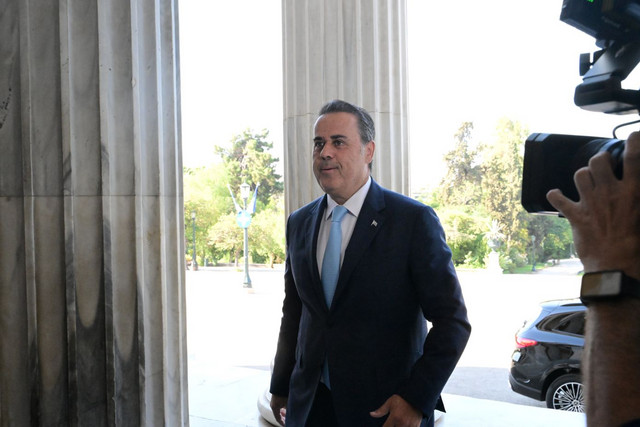
Greek Environment and Energy Minister Stavros Papastavrou said the recovery effort for Western Attica following last week's major wildfire has already begun, presenting a restoration plan at a press conference. He said the next day does not start today, because it has already started, noting that relevant agencies are already in the field preparing the first interventions.
Papastavrou opened by paying tribute to the five firefighters who died during the wildfires of the past week, saying the state owes it to them to honor their sacrifice and continue protecting the country's forest ecosystems. He described the past week as especially difficult, with large fire fronts breaking out one after another from Crete to Voiotia and Western Attica under extremely unfavorable weather conditions.
On Crete, he said, fire directly threatened the island's only palm forest at Preveli, but coordinated firefighting operations saved nearly all of it: of roughly 30 stremmata, only about 3.5 were affected. In Voiotia, firefighting forces fought a multi-day battle against two major fires with repeated flare-ups. He also singled out the fire at Poikilo Oros, where prevention works under the AntiNERO program helped limit the fire's spread and protect built-up areas and critical infrastructure.
Scale of the damage in Western Attica
Papastavrou called the large fire that began in Voiotia and spread into Western Attica a particularly serious environmental disaster. He said the total perimeter of the affected area is roughly 113,000 stremmata, of which about 95,000 lie within the Attica Region. He clarified this does not mean the entire area burned, since the perimeter includes different land categories, and significant sections of forest vegetation were saved and will be mapped in detail.
He said protecting soil and downstream areas from the hazards that follow a major fire is now the top priority. Mapping work is already underway to complete the necessary studies and select sites for erosion-control and initial flood-protection works, aimed at holding soil and debris in place and limiting flood risk during winter. Papastavrou committed to starting the first works by September 15 and completing them by the end of the year, recalling that a similar timeline was successfully applied in 2025 across 14 fire-affected areas of the country.
Funding for restoration works
Piraeus Bank will act as "Restoration Contractor," financing the necessary studies and works worth 1.5 million euros, Papastavrou said. He also cited a 25 million euro donation from HELLENiQ ENERGY to support restoration actions following this year's fires, with particular emphasis on Western Attica. He said such private contributions complement public funds under the Restoration Contractor institution, through which more than 60 projects worth over 46 million euros have already been carried out or scheduled.
He added that the Green Fund is activating 25 million euros for forestry works covering mountain water management and flood protection in Attica, with resources going to the Attica Region for projects in Vilia, Gerania, Varympompi, Afidnes and Kryoneri.
Reforestation orders and monitoring
Papastavrou said the affected area will be mandatorily declared a reforestation zone within the next 30 days. The ministry will systematically monitor the natural regeneration of ecosystems, particularly in areas repeatedly hit by fires. He said natural regeneration is the main recovery mechanism for Greek forests but requires continuous protection, scientific monitoring and targeted interventions where needed.
Prevention and the AntiNERO program
Papastavrou said 667 million euros has been allocated since 2022 through the AntiNERO program, which the European Commission has recognized as an example of effective European investment in forest protection against the climate crisis. Responding to a question from the Athens-Macedonian News Agency, he said effective forest protection rests on four pillars: prevention, immediate fire detection, effective coordination among all involved agencies, and rapid restoration of burned areas.
He said Greece needs more AntiNERO and more prevention, noting that the Forest Service went nearly 20 years without new hires, effectively losing a generation of forestry staff and the ability to pass on experience and know-how to younger colleagues. That understaffing, he said, made it harder to cover large forest areas and carry out preventive work. He called for more prevention projects, stronger early-detection systems, acknowledging Civil Protection's contribution, tighter coordination among responsible agencies, and faster restoration after each disaster, adding that programs like AntiNERO should be strengthened further and serve as a model for other countries.
Papastavrou said the climate crisis makes it certain Greece will keep facing large fires. He said the country cannot assume there will be no more big fires, but can systematically reduce risk, strengthen forest resilience and restore affected areas quickly and scientifically. For Western Attica, he repeated the ministry's commitment to starting protection works immediately, keeping to the timeline, monitoring ecosystem recovery and continuing prevention work, saying the country's forests are a structural part of its identity and a legacy for future generations.
Private power networks under review
Papastavrou said the time has come to revise the institutional framework governing private electrical networks and close any gaps. He said the incentives that were needed in 2006 to encourage these networks no longer apply today, and that the government will move toward a stricter regulatory framework.
Agencies involved in the response
Papastavrou praised the cooperation of all agencies involved in fighting the fire, saying the Forest Service, forestry departments, the General Directorate of Forests, the Fire Service, Civil Protection, the Region, municipalities, the Armed Forces, volunteers and Forest Work Cooperatives were in the field from the first moment, helping with firefighting operations, removing dangerous burned trees and restoring access to affected areas. Machinery from prevention-works contractors and the army was also deployed, while site inspections, satellite mapping and restoration preparations began immediately.
Secretary General for Forests Stathis Stathopoulos said AntiNERO is the largest program ever implemented in Greece, and that damage in Western Attica would have been far worse without the roughly 20 million euros allocated for fire protection in the area. He said forest policy since 2022 has found resources and delivered projects, and pledged that the ministry and Forest Service would do everything possible to keep all project timelines on track and stand by those carrying out the work, adding that residents of Western Attica will not be left on their own. He said he was optimistic about eventually securing increased EU funding for prevention, resilience and equipment.
Vangelis Gkountoufas, General Director of Forests and Forest Environment at the Environment Ministry, said the recent fire started in Voiotia and moved into Western Attica with great speed. He described the quality characteristics of the burned areas and detailed the 20 million euros in fire-protection works carried out in the area under AntiNERO, saying that without them far more areas would have been at risk given the fire's intensity and behavior.
Immediate steps by the ministry
Gkountoufas listed the ministry's immediate actions, including decisions to log burned roadside vegetation, bans on hunting and grazing, permits for residents to collect firewood, cooperation on collecting and caring for injured wildlife, drafting and approving studies for erosion-control works, immediate declaration of areas as reforestation zones, and immediate hiring of staff. Planned works include erosion-control interventions, mountain flood-control projects, reforestation of the burned land through natural or artificial methods, and mountain water-management works.