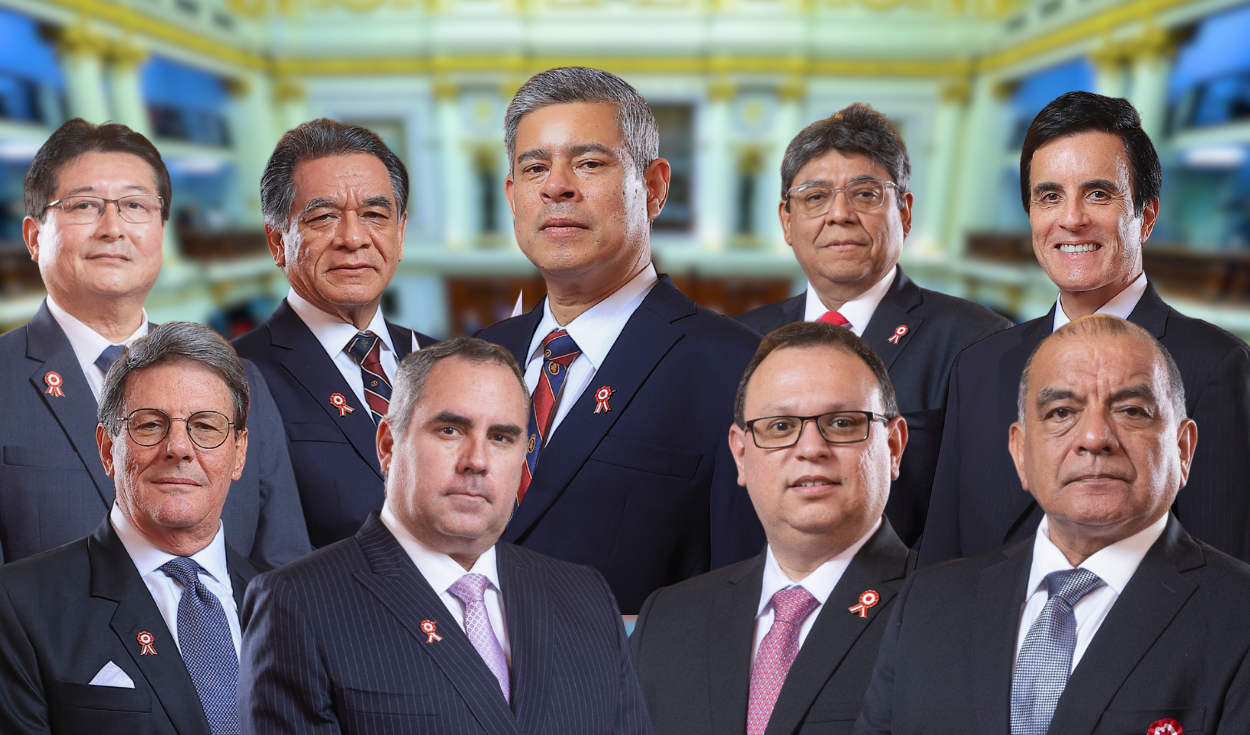
Nine ministers in Peruvian President Keiko Fujimori's cabinet have been summoned to appear before Congress within the first weeks of her government, through interpellation motions and requests to inform filed in the Chamber of Deputies and the Senate. The list includes Defense Minister Rafael Belaunde and seven other ministers, all asked to account for their management of their portfolios.
The cabinet, headed by Prime Minister Luis Galarreta, was formed less than a month ago. The reasons behind the summonses vary widely: one minister must explain his ties to a mining company, another must justify why the Executive is seeking to have a law benefiting retired teachers declared unconstitutional, and a third group of four ministers was summoned jointly over the social crisis in the Ucayali region.
Two different congressional mechanisms
There is an important difference between the two tools Congress used. An interpellation, which only the Chamber of Deputies can activate, requires the vote of one third of eligible congress members before the minister appears in the plenary. An invitation to inform, used by the Senate, does not go through that filter and is approved directly through a floor motion.
Outside this list of nine, one additional case has not yet been formalized. The Juntos por el Peru bench announced it is preparing an interpellation against Interior Minister Cesar Astudillo, though it has not yet filed the motion with the plenary.
Belaunde faces questions over mining company ties
The motion against Belaunde was filed on August 14 by a group of deputies led by Marino Lavado Valdivia. Its 43 questions focus on campaign contributions he received from Evangelina Arias de Sologuren, president of the board of Minera Poderosa, before he took over the Defense Ministry. The deputies also want him to explain the use of the armed forces in Pataz province, an area under successive states of emergency because of illegal mining.
For Belaunde to appear in the plenary, the motion first needs the backing of one third of eligible deputies, after which a date for his appearance would be set. The questionnaire also asks about possible agreements between the Defense Ministry and the mining company, and the technical basis for a change in the area's security scheme, which shifted from military control to the Unified Command of Pataz, known as CUPAZ.
A possible second motion against Astudillo
Deputy Anali Marquez, of Juntos por el Peru, announced that her bench is preparing an interpellation motion against Interior Minister Cesar Astudillo over his refusal to remove National Police commander general Oscar Arriola. Sources cited by La Republica said the document would begin circulating from Monday, with a commitment from bloc lawmakers to back the initiative given the country's rising crime.
Vinelli must explain agriculture ministry overhaul
Agrarian Development and Irrigation Minister Marco Antonio Vinelli was invited by Senator Andres Ramos to answer 32 questions in a motion filed on August 19. It covers six areas: family farming, water security, financing, fertilizers, preparation for El Nino, and the ministry's own reorganization.
Much of the questionnaire centers on the Apurimac region, where irrigation gaps and low access to farm credit persist. Senators asked for details on strategic water projects such as the Chicha River hydraulic system and on stalled public works nationwide, along with figures on the AGROPERU Fund and actual coverage under the Catastrophic Agricultural Insurance program.
The other main focus is Supreme Decree No. 008-2026-MIDAGRI, which ordered a 120-day reorganization of the ministry. Lawmakers want to know what weaknesses justified the measure and which agencies, such as SENASA or AGRO RURAL, could be merged or restructured. The motion also demands that the reorganization not disrupt services for family farmers while it is underway.
Cuba questioned over teachers' pension law
The invitation to Economy and Finance Minister Elmer Cuba has a different origin. Law No. 32581 guarantees retired and inactive teachers a pension equal to the pay of the first teaching salary scale. The Executive had 90 days to issue regulations for the law, and that deadline passed without the Finance Ministry acting.
While that failure remained unexplained, Cuba stated publicly that the law is one of four the Executive intends to challenge before the Constitutional Court. Senators called that combination contradictory, since the same ministry that failed to regulate the law is now trying to overturn it in court. The motion, driven by Senator Ramos, demands that Cuba back up his position with technical and legal reports rather than statements to the press.
The questionnaire asks whether the Council of Ministers agreed to file the legal challenge and whether the Executive considered gradual implementation before discarding the law. Senators also requested the actuarial report behind the fiscal cost the Finance Ministry has calculated, which has not been made public.
Espa summoned over Shield of the Americas
Senator Ruth Luque, of the Ahora Nacion bench, pushed the invitation to Foreign Minister Alfonso Carlos Espa y Garces-Alvear after President Fujimori herself revealed she had asked United States Secretary of State Marco Rubio to include Peru in the Shield of the Americas mechanism. The regional coalition was promoted by the administration of Donald Trump with the declared aim of fighting organized crime and drug trafficking.
The problem, according to the motion approved on August 4, is that neither the president nor the foreign minister specified the legal scope of that membership. The seven-question document asks whether Peru's entry would require congressional approval through a legislative resolution or whether the Executive plans to formalize it another way, and whether the arrangement would mean foreign military personnel entering national territory.
Senators also raised a question about sovereignty, demanding that Espa explain how Peru will ensure its international obligations, including those under the Organization of American States and the Andean Community, do not conflict with commitments required by the new U.S.-led military mechanism.
Four ministers face questions over Ucayali crisis
A single motion, driven by Senator Silvana Robles, summoned four authorities at once: Prime Minister Luis Galarreta, Energy and Mines Minister Guillermo Shinno, Transport Minister Rafael Rey Rey, and Education Minister Jose Antonio Chang. The reason is the wave of protests and roadblocks on the Federico Basadre highway, the route connecting Ucayali with the rest of the country.
Each ministry must answer for a different front of the unrest. Shinno must explain the rise in fuel prices in the region, Rey Rey must report on the state of road infrastructure, and Chang must account for complaints against the Local Education Management Unit of Ucayali and violent incidents recorded at the National University of Ucayali since May.
As head of the cabinet, Galarreta must explain the Executive's coordinated response to a conflict the motion itself describes as multisectoral. Senators want to know what dialogue mechanisms have been activated with social organizations in the region and what timeline the government has for addressing the demands before the protests escalate further.