Instituto MRV&CO, the nonprofit arm of Brazilian homebuilder MRV&CO, has applied a methodology known as Social Return on Investment (SROI) to measure the long-term effects of its education programs, finding that every 1 real invested generated as much as 3.36 reais in social value.
The calculation was carried out as the institute marked ten years of operation. It found that the Seu Filho, Nosso Futuro program, which supports the school development of employees' children, returned 2.73 reais in social value for every real invested, a 173% ratio. The Educar para Transformar program, which backs civil society projects through a public call for proposals, returned 3.36 reais per real invested, a 236% ratio.
Telling activity apart from real impact
Measuring whether a social program actually changes people's lives requires going beyond counting immediate deliverables, such as the number of classes given or kits distributed, according to the methodology described. Evaluators instead track medium- and long-term shifts in income, schooling, autonomy and well-being among the people reached.
Evaluation literature separates this into three layers: outputs, the immediate operational effort, such as running a hundred workshops or serving five hundred young people; outcomes, which look at whether behaviour changed or new skills were gained; and impact, which checks for broader, lasting transformation, such as entry into the job market or lower school dropout rates.
What is Theory of Change?
To link planning with evaluation, many organisations use the Theory of Change, an approach systematised in the 1990s by researchers including Carol Weiss in partnership with the Aspen Institute. It works as a logical map that starts from the intended long-term goal and works backward to define which inputs, financial, human and physical, along with which activities and intermediate outputs, are needed to reach that transformation.
By spelling out cause-and-effect assumptions, the Theory of Change guides the choice of specific metrics for each stage of a project and allows course correction when an action fails to produce the expected effect.
In education initiatives, measurement typically balances quantitative indicators, such as literacy rates, school retention, scores on tests like Brazil's IDEB, changes in average family income and the share of participants placed in formal jobs or running their own businesses, with qualitative indicators gathered through interviews and listening groups, covering community ties, sense of belonging, collective decision-making and participants' self-esteem.
Because educational and socioeconomic change rarely takes hold in the short term, evaluators track results over time, generally in windows of six months, one year, three years or five years after activities end, to check whether benefits hold up without continued support. They also typically record a baseline before a project starts and, where possible, compare results against a similar group that did not take part.
How the SROI calculation works
SROI translates social, environmental and economic benefits into comparable monetary values, using financial proxies drawn from consultations with stakeholders. To avoid overstating results, the calculation applies correction factors that discount what would have happened anyway (deadweight), what resulted from other institutions' work (attribution), and the natural fading of effects over time (drop-off). The final ratio shows how much social value was generated for each monetary unit invested.
Social investment in real estate
Large companies in real estate and construction have increasingly set up nonprofit institutes or foundations to run their private social investment separately from their commercial operations. Unlike one-off donations, this structure allows for multi-year planning, technical criteria for choosing partnerships and periodic accountability, as is the case with Instituto MRV&CO.
The institute carries out MRV&CO's social responsibility work. It is structured as an autonomous nonprofit funded entirely by the group, applies governance and transparency standards including audited financial statements and internal controls, and has its annual funding plan approved by the group's board of directors and executive leadership.
Using recognised evaluation standards, including the Global Reporting Initiative guidelines, and submitting data to independent audits also works as a safeguard against so-called social washing, where corporate communication highlights superficial social actions without proof of results. Doing so strengthens both the social and governance pillars of a company's ESG agenda.
Instituto MRV&CO's track record
Founded in 2014, Instituto MRV&CO focuses on education and tracks its programs through performance indicators and public annual reports. Its work is organised into four fronts: Educar para Transformar, Seu Filho Nosso Futuro, the MRV Volunteers corporate volunteering program, and Instituto iungo, which focuses on continuing training for education professionals. The institute also co-manages Escola Nota 10, a literacy program for company employees.
Since 2014, the institute has invested more than R$51.6 million in social actions, reaching 1,001,757 people directly and more than 2.8 million direct and indirect beneficiaries, an estimate based on the average Brazilian family size reported by the IBGE statistics agency. Employees have contributed more than 27,000 volunteer hours. In 2025 alone, contributions totalled R$3.23 million, reaching 28,851 people directly with 2,716 volunteer hours logged.
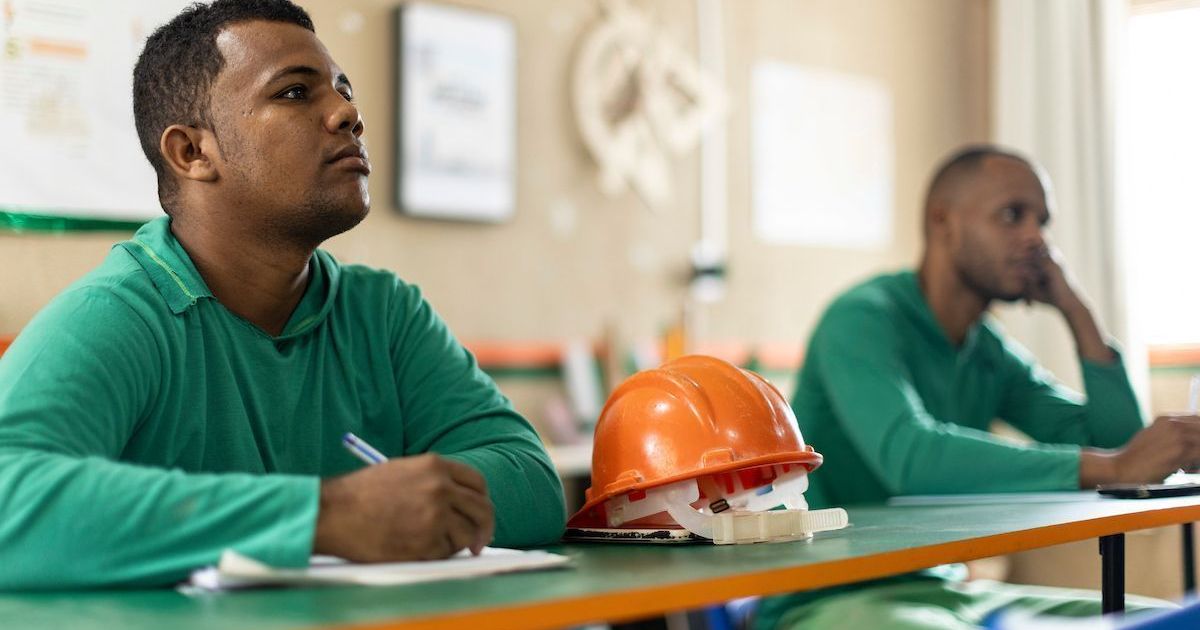
The Escola Nota 10 program, launched in 2011, sets up classrooms inside construction sites to offer Portuguese, maths and specific training to employees during working hours, preparing them for certification through the federal Encceja exam. More than 7,000 workers have been reached by the program so far.
Test yourself
What methodology did Instituto MRV&CO use to measure the social return of its programs?
How much social value did the Educar para Transformar program return for every real invested?
How much has Instituto MRV&CO invested in social actions since 2014?
Have your say
Should companies be required to publish independently audited reports on the social impact of their programs?