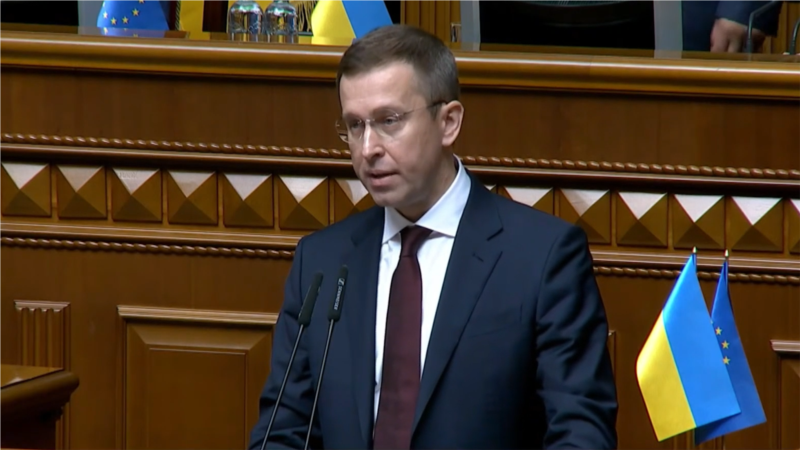
Ukrainian Prime Minister Serhiy Koretsky announced that a Russian strike on Bucha district in Kyiv region triggered fires and ammunition explosions on August 28.
The attack struck warehouse facilities in Bucha district during an overnight barrage, igniting fires that were accompanied by continuous secondary detonations across the area.
Emergency services dispatched firefighting crews and rescue teams to contain the blazes while conducting urgent operations to shield and rescue affected residents.
Koretsky confirmed that emergency personnel were carrying out urgent measures to protect citizens and evacuate them from high-risk zones if necessary, deploying all required resources to manage the aftermath.
Kyiv Regional Military Administration head Tymur Tkachenko reported early on August 29 that the Russian attack resulted in fatalities, though exact casualty figures remained unconfirmed as emergency teams continued searching the site.
Tkachenko added that emergency responders successfully evacuated over 200 people from the immediate danger zone, including several children, after one casualty was initially reported injured on the prior evening.
The Ukrainian Air Force reported that Russian forces launched two missiles and 267 strike drones across the country during the overnight assault.
Evacuations and highway closures
In response to the ongoing explosions and safety hazards, Patrol Police Department chief Oleksiy Biloshytskyi ordered the closure of all vehicle traffic along highway M-06 Kyiv-Chop.

The closure spanned both directions between kilometer 15 and kilometer 32 to prevent civilian travel near the active detonation site.
The M-06 highway serves as an essential transport artery connecting the capital city of Kyiv to western Ukraine and the Polish border.

Koretsky sharply criticized defense and local administrators for failing to implement safety measures following previous military warehouse explosions in the region.
Koretsky stated that the tragic event in Vyshneve had clearly not served as a lesson, warning that repeating identical security mistakes in the fifth year of the full-scale invasion constituted criminal negligence.

The prime minister demanded an immediate and rigorous investigation from law enforcement agencies, insisting that every responsible official must face severe punishment to prevent future incidents.
Precedent of the Vyshneve defense site explosion
Koretsky referred to a major tragedy on the night of July 6, 2026, when Russian missiles struck an armaments enterprise in Vyshneve, a suburban town located just southwest of Kyiv.

The July strike detonated stored military munitions near dense residential neighborhoods, killing nine civilians and injuring more than 50 others.
Following the July disaster, the Security Service of Ukraine arrested the general director and the production deputy director of the defense enterprise for unlawfully storing ammunition in close proximity to residential homes.

State defense conglomerate Ukroboronprom subsequently dismissed the factory executives responsible for munitions storage after preliminary government inspections revealed grave protocol breaches.
Ukroboronprom operates as Ukraine's primary state-owned defense manufacturing entity, managing military production facilities across the nation.

Devastation and local recovery efforts
The July 6 blast wave and secondary firestorm damaged 253 private residential homes in Vyshneve and completely destroyed 91 houses.
A week after the disaster, National Guard soldiers patrolled the ruined streets of Vyshneve to secure property and preserve public order.

Fearing rain and deteriorating weather conditions, many displaced residents began manually repairing damaged roofs and sealing blown-out windows without waiting for official assessment commissions.
Displaced families posted notices across town fences searching for pets lost during the initial shockwaves and chaos of the explosions.

Shelter struggles and delay in official aid
Resident Natalia stood near her incinerated home holding only a bundle of identity documents that she routinely carried into bomb shelters.
Natalia explained that residents were left guessing about their future without homes or belongings, receiving essential food and clothes from volunteer organizations rather than state agencies.

Interviews with Vyshneve residents whose homes were destroyed showed that all were staying with friends or relatives, as municipal authorities failed to offer temporary housing assistance.
Resident Viktoria noted beside her burnt house that only her dog and charred vehicle survived, criticizing local authorities for a total lack of organization.

Resident Nina stated that city council services provided only a few sheets of plywood and plastic sheeting for repairs, leaving her family to rebuild their roof using materials bought by friends.
Local homeowners expressed anger that explosive materials were stored inside a residential sector without public knowledge or warning.

Personal loss and ongoing civilian concerns
Resident Oleksandr described how his mother, Valentyna Pavlivna, died on the steps of their home because she relied on a walker and could not escape the rapidly spreading fire.
Oleksandr recalled being at his apartment when his mother phoned to report the fire, after which a neighbor advised him that saving her was impossible because the scene had turned into armageddon.
While Oleksandr's two dogs, Dina and Lucky, survived the inferno, local residents voiced concern that official attention would wane over time and government promises of assistance would remain unfulfilled.
Wider pattern of Russian strikes across Ukraine
Russian military forces continue to launch systematic long-range bombardment against Ukrainian civilian infrastructure across all regions using strike drones, cruise missiles, guided glide bombs, and rocket artillery.
Ukrainian authorities and international human rights organizations qualify these repeated bombardments as war crimes, emphasizing their deliberate and targeted nature.
International legal analysts note that strikes targeting vital civilian utilities like electricity, heating, water supply, and health facilities to inflict unlivable conditions exhibit characteristics of genocidal actions.
Russian government officials deny that the Russian armed forces deliberately target civilian infrastructure, maintain that military operations target only military assets, and reject allegations of civilian casualties.