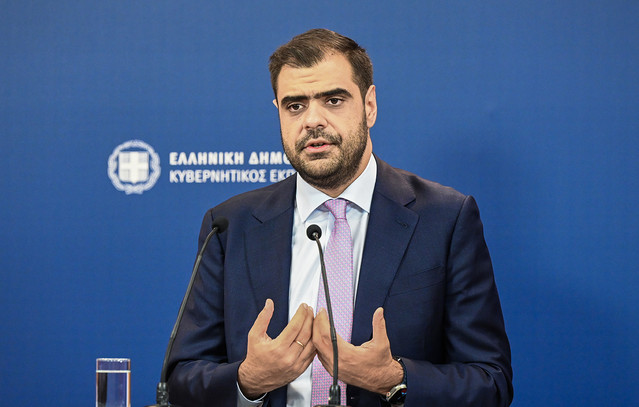
Greece will provide 100 percent state coverage for residential storm damage on the island of Crete, Deputy Minister to the Prime Minister and Government Spokesman Pavlos Marinakis announced on Monday.
Speaking during an interview on Radio Crete 101.5 FM, Marinakis said the Government Committee for State Aid would convene at 16:00 to finalize a comprehensive package of financial relief for residents, business owners, and local authorities affected by recent severe weather across the island.
The emergency package includes temporary suspensions of tax and social security obligations alongside a freeze on property foreclosures. Municipalities and the regional authority have been given a 15 day deadline to complete damage assessments and submit formal funding requests, while government inspectors have already launched on site audits.
State assistance will be organized across three main areas covering residential property, commercial businesses, and regional infrastructure. Marinakis said that once a local municipality submits a complete and valid application, funding allocations will be dispatched within 10 days.
Under the official damage assessment criteria, state support for affected homes will cover 100 percent of estimated losses, with payouts delivered within 15 days of receiving complete documentation. Compensation for commercial equipment damage will cover 70 percent of estimated losses.
Crete, the largest island in Greece, regularly faces severe weather events and autumn storm cycles in the Mediterranean basin. Responding to public skepticism regarding the speed and execution of state aid, Marinakis acknowledged that previous disaster relief efforts had suffered from administrative errors, failures, and delays, but said the government rejected both idealization and total cynicism. He cited the structural reorganization of Civil Protection, the operational use of the 112 emergency alert system, and streamlined state aid procedures as measures designed to prevent past mistakes.
Party Unity and Political Opposition
Marinakis also commented on internal political dynamics following the anniversary event of the ruling New Democracy party, addressing the absence of three former party leaders. He stated that former Prime Minister Antonis Samaras had been expelled from the party, calling the development unpleasant but unavoidable. He noted that former leader Kostas Karamanlis chooses which events to attend without taking action to harm the party, while Vangelis Meimarakis was absent due to official commitments in the European Parliament and the European People's Party.
New Democracy, founded as a center right political party in 1974, currently holds a parliamentary majority in the Hellenic Parliament under Prime Minister Kyriakos Mitsotakis. Commenting on independent lawmakers joining the main opposition party PASOK, Marinakis said political leaders make their own selections, though he observed that individuals previously associated with populist rhetoric were now joining PASOK. He added that voters would decide which party secures second place, accusing political opponents Nikos Androulakis and former Prime Minister Alexis Tsipras of relying on unfunded promises and total obstruction.
Fiscal Constraints and Tax Reductions
Addressing public calls for reductions in value added tax and special consumption taxes on fuel and goods, Marinakis stated that the government has implemented 83 tax and insurance contribution cuts to date. He added that planned interventions for 2027 will bring the total number of tax reductions to 91.
As a member of the Eurozone, Greece operates under European Union spending rules and strict fiscal ceilings managed by the European Commission in Brussels. Marinakis explained that any additional emergency tax measures remain constrained by European spending caps, adding that extraordinary relief interventions would require formal authorization from the European Commission to be excluded from budget deficit calculations.
United States Strategic Partnership
Turning to international affairs, Marinakis highlighted the political and symbolic weight of an upcoming official visit to Athens by United States Secretary of State Marco Rubio. He stated that strategic cooperation and bilateral relations between Greece and the United States have reached their highest historical point.
Greece has increasingly positioned itself as an energy gateway for Southeastern Europe, hosting major infrastructure projects including offshore natural gas exploration involving American energy corporations ExxonMobil and Chevron. The strategic partnership also encompasses the Vertical Corridor gas route, which facilitates natural gas transport from Greek ports into Central and Eastern Europe. Marinakis said Secretary Rubio will complete a full schedule led by Foreign Minister Giorgos Gerapetritis, culminating in a meeting with Prime Minister Kyriakos Mitsotakis.