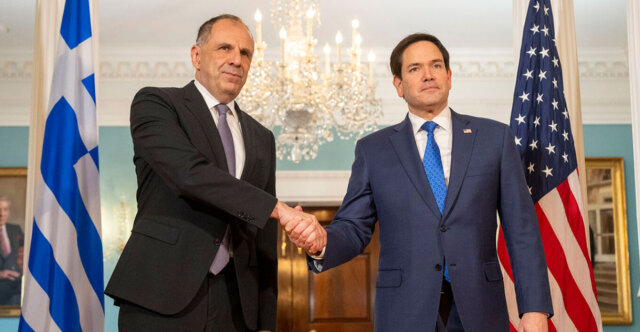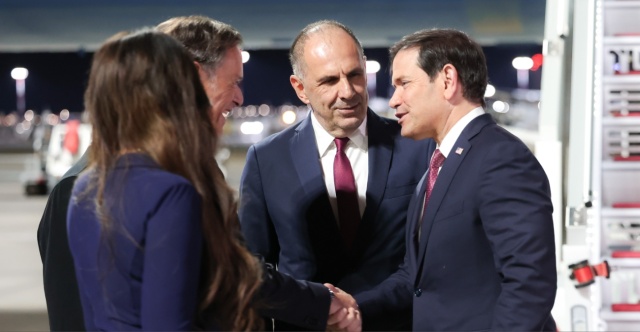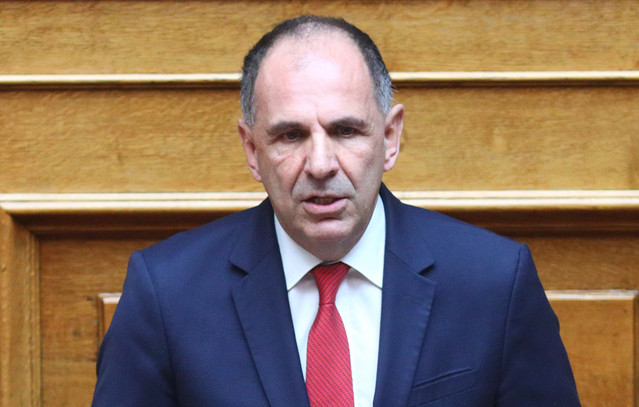
Greek Foreign Minister George Gerapetritis defended the government strategy on Turkish relations in parliament in Athens on Thursday, rejecting opposition claims that ministers are ignoring growing Aegean tensions.
The debate followed warnings from Course of Freedom lawmaker Alexandros Kazamias that recent Turkish plans to establish two marine parks in the Aegean Sea and Eastern Mediterranean have pushed bilateral relations to a critical turning point.
Gerapetritis confirmed that Greece has lodged a formal note verbale with Turkey, setting out detailed legal arguments to show that the proposed parks violate international law and hold no binding force.
Greece and Turkey, neighboring NATO allies, have experienced decades of dispute over maritime boundaries, territorial waters, and continental shelf rights in the Aegean Sea. The proposed Turkish environmental parks target international waters around the easternmost Greek island of Kastellorizo and between the northern Aegean islands of Samothrace and Lemnos, overlapping areas claimed as the Greek continental shelf.
Turkish marine park proposals
Kazamias called on the minister during parliamentary scrutiny to explain how the government planned to prevent Turkey from establishing marine parks over Greece's continental shelf. He noted that opposition MPs had raised concerns since May and pointed to a surge in Turkish airspace violations during the first half of 2026.
The opposition lawmaker criticized government responses advising the public not to worry because Turkish announcements carry no standing under international law. Kazamias said telling citizens to sleep peacefully reflected a failure to grasp the anxiety felt by the Greek public over unpredictable consequences in regional relations.
Gerapetritis responded by reiterating that the Turkish government's domestic legislation establishing the two marine parks violates international law and the EU acquis, the body of common rights and obligations binding all European Union member states. He added that European institutions were alerted immediately after Ankara made its intentions public, and indicated that Greece intends to take further measures.
Communication channels and naval diplomacy
Addressing the broader relationship, Gerapetritis said the Greek government firmly believes in maintaining open communication channels with Turkey, even with countries where fundamental legal disagreements exist, in order to reduce tension and prevent crises.
The minister acknowledged that it would be naive to expect Turkey to abandon positions developed over decades during bilateral dialogue. However, he stressed that current Turkish reactions stem from Greece taking active initiatives on the ground for the first time to defend its sovereignty and sovereign rights.
Gerapetritis argued that previous opposition warnings regarding regional security had not materialized as claimed. He noted that F-35 stealth fighter jets had not been delivered to Turkey, nor had a long-discussed Turkish bill defining maritime zones been presented to parliament.
Regarding the environmental parks, Gerapetritis stated that while the Turkish proposals list geographic coordinates in international waters above the Greek continental shelf rather than explicit regulatory restrictions, Greece remains actively engaged and legally prepared to counter any infringement.
Migration control and Aegean stability
In response to opposition criticism, Gerapetritis drew comparisons with 2015, when Course of Freedom leader Zoe Konstantopoulou served as Speaker of Parliament and a prominent member of the ruling SYRIZA coalition. He contrasted current conditions with the migration crisis that saw 1.5 million irregular migrants cross the Aegean in 2015 and 2016.
The minister stated that irregular border crossings from the east have now been reduced almost to zero, replaced by large-scale tourist traffic from Turkey that benefits island economies. He asserted that scenes from infamous migrant camps such as Moria on Lesbos and Idomeni near the northern border belong to the past because the current administration knows how to manage international crises effectively.
Kazamias rejected the comparison, pointing out that the controversial 2019 Turkish-Libyan maritime memorandum establishing contested exclusive economic zones was signed under the current government, creating practical complications on the ground despite its illegality under international law.
The opposition MP added that while F-35 jets have not been transferred to Turkey, legislation reflecting Ankara's expansive Blue Homeland maritime doctrine remains on its way to the Turkish parliament, arguing that the government's relaxed posture was unjustified.
Resignation of foreign policy adviser
The debate intensified when Kazamias brought up the recent resignation of the prime minister's foreign affairs adviser, which occurred shortly after Turkey announced the marine park plans. Kazamias cited media reports alleging that the adviser stepped down due to a lack of clear strategy in managing Greek-Turkish relations while ministers maintained claims of calm waters.
Gerapetritis strongly rejected the MP's remarks, questioning whether Kazamias had seen any official statement from the adviser regarding the motives for his departure. The foreign minister described the opposition claims as baseless and unfounded, accusing Kazamias of raising unsubstantiated media reports solely to create political impressions in parliament.