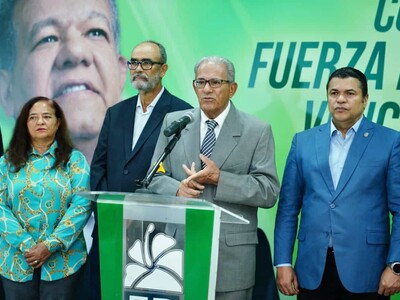
Dominican Republic opposition party Fuerza del Pueblo has demanded full transparency from the government over roadworks near Los Jardines del Norte in Santo Domingo.
Speaking at a press conference on Thursday, the party's environment secretary, Paíno Abreu, called on officials to clarify the project's scope, environmental impact, and legal compliance along Avenida Los Próceres.

The party urged President Luis Abinader to instruct the Ministry of Public Works to publish all technical documents and halt unpermitted work near the National Botanical Garden.
Fuerza del Pueblo is a major Dominican opposition political party founded in 2019 by former President Leonel Fernández. The Ministry of Public Works and Communications is the national cabinet department responsible for state infrastructure and highway development.
Environmental risks and community concerns
Abreu explained that the construction is taking place directly in front of the National Botanical Garden along Avenida Los Próceres. He noted that the Land Use Plan of the National District classifies this location as part of the capital city's protected system of open spaces.
The National Botanical Garden Dr. Rafael M. Moscoso is a major ecological reserve in Santo Domingo, established to preserve endemic Caribbean plant species and tropical flora within the Distrito Nacional urban core.
According to Abreu, the area performs crucial environmental functions for Santo Domingo. He stated that the green corridor provides thermal regulation, aquifer recharge, carbon capture, biodiversity conservation, and air quality improvement.
Residents of the Los Jardines del Norte neighborhood do not know the true scope of the project, Abreu said. He added that local families are worried about potential damage to Crisantemos Park and Los Limones Park, which serve as two of the sector's main green spaces.
Studies cited by the local community indicate that the two parks house at least 132 species of flora and fauna. Abreu warned that unmonitored road widening could threaten this local biodiversity.
Withheld documents and nocturnal excavation
Community members organized under the movement Convergencia Jardinera have formally requested documentation from the Ministry of Public Works. Abreu stated that residents asked for soil studies, structural blueprints, environmental licenses, execution schedules, total budget details, and the name of the contracted construction firm.
However, the ministry provided only budget figures while withholding design blueprints and technical specifications. Abreu noted that the party considers these restricted documents essential for understanding the true design and scale of the project.
Concerns among residents escalated after construction crews began excavations near Crisantemos Park. Abreu recalled that community representatives met with government officials during 2025 to discuss the project.
Dialogue broke down when heavy machinery entered the site unannounced to begin digging during the night, Abreu stated. He criticized the decision to start work without prior notice to the community.
Legal requirements and calls for presidential action
Abreu asserted that doubts persist regarding whether an environmental impact assessment was ever conducted or an official permit issued. He stressed that authorities failed to hold mandatory public hearings required under Dominican law.
General Law 64-00 on Environment and Natural Resources, enacted in August 2000, establishes the legal framework for environmental protection in the Dominican Republic. The law mandates public consultations and environmental impact licenses for infrastructure projects that alter local ecosystems.
Because these public hearings were skipped, Fuerza del Pueblo maintains that the road project lacks the social license required for works directly impacting urban neighborhoods.
Abreu stated that transparency must be a fundamental principle in all public works involving shared environmental heritage. Restricting technical information creates distrust, limits citizen rights, and prevents consensus between authorities and local communities, he added.
The opposition official also highlighted community complaints regarding potential violations of Decree 183-93, which established the Santo Domingo Green Belt. He added that the project may conflict with Municipal Ordinance No. 18-2025 and a resolution by the Chamber of Deputies, the lower house of the Dominican Congress, which recommended protecting surrounding green spaces.
On behalf of Fuerza del Pueblo, Abreu called on President Luis Abinader to order the Ministry of Public Works to deliver a full public explanation, release all technical and environmental documents, and review project plans alongside neighborhood residents.
The party also demanded that the government enforce municipal and environmental laws, clear up uncertainty regarding permits, and ensure that major public infrastructure projects respect environmental heritage and community participation.