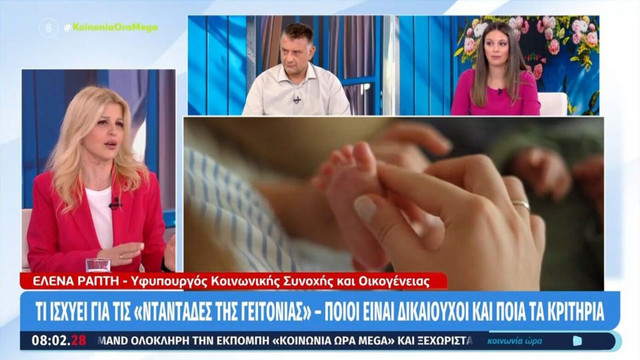
Greek Deputy Minister Elena Rapti has detailed expanded rules for the Neighborhood Nannies childcare program alongside a new initiative targeting date rape drugs. Speaking on the MEGA television network show Koinonia Ora MEGA on Thursday morning, Rapti outlined eligibility criteria and financial support designed to help mothers return to the workforce.
The Ministry of Social Cohesion and Family handles social welfare, demographic policy and gender equality initiatives in Greece. Rapti explained that the Neighborhood Nannies project aims to ensure equal workplace opportunities for mothers following the birth of a child, allowing them to retain employment without requiring fathers to leave their jobs.
The program caters to families with infants aged between two months and two and a half years. Mothers with one child qualify if their annual individual income does not exceed 24,000 euros. The income limit rises to 27,000 euros for mothers with two children, while mothers with three or more children face no income restrictions at all.
Financial subsidies differ based on employment status. Working mothers employed full-time receive 500 euros per month, while those working part-time receive 300 euros per month. Student mothers receive 300 euros per month to complete their studies and enter the job market. Unemployed mothers receive 300 euros monthly for three months to attend job interviews and secure employment.
Interest in the scheme has grown among both young parents and grandparents. Rapti noted that grandmothers and grandfathers have been among the first to register as prospective caregivers for their grandchildren.
Caregiver requirements and pay limits
The program serves a dual purpose by creating paid employment with social insurance coverage for caregivers. Caregivers may look after up to three infants simultaneously, which allows their monthly earnings to reach up to 1,500 euros.
Applicants for caregiver positions must hold a certificate of compulsory education, which corresponds to a lower secondary school diploma. For older applicants, including grandparents who finished school up to 1980, a primary school completion certificate is accepted.
All prospective caregivers must complete an online child care seminar and an infant first aid course. First aid training is available free of charge through the Hellenic Red Cross or EKAB, Greece's national emergency medical service, as well as certified private organizations.
Applicants must also submit medical certificates from a psychiatrist, a dermatologist and an internist. Further requirements include a criminal record copy, a solemn declaration, and sworn statements confirming no active criminal prosecution or outstanding arrest warrants.
Application figures and program expansion
The Neighborhood Nannies initiative will continue operating for at least another two and a half years. The coverage period matches the eligibility window for infants from two months old until they reach two and a half years of age.
Ministry data shows more than 2,500 caregiver applications and over 5,000 beneficiary applications have received approval. Approximately 1,050 agreements have been signed so far, with officials aiming to reach 4,500 signed contracts nationwide.
Full application details and registration guidelines remain available on the official government web portal at ntantades.gov.gr.
Campaign against date rape drugs
Rapti also announced a national awareness campaign following reports of date rape drugs identified through ministry counseling centers. At one center, 11 out of 15 reported rape victims stated that they had been incapacitated by spiked drinks.
Most victims were female university students who met perpetrators at university or entertainment venues. After drinking one or two beverages, the women lost consciousness and suffered sexual abuse without physical violence, leaving them with fragmented memories of the event.
The deputy minister stressed that liquid or powder narcotics dropped into drinks suppress the central nervous system and violate consent. Because victims lose physical control, they cannot offer consent or defend themselves against assault.
While the awareness drive targets young people aged 15 to 25, Rapti urged the public to stay vigilant. Anyone experiencing sudden dizziness, nausea or weakness while out should alert a trusted friend, inform venue staff, and avoid leaving with strangers.
In emergencies, individuals can contact the 166 medical emergency line, the 100 police hotline, or the ministry's 15900 violence support helpline for immediate assistance.
School competitions and university programs
The ministry is partnering with the Ministry of Education to launch a school competition where students will design campaign posters and messages. Rapti noted that teenagers respond better to self-created messaging than to adult instructions.
Work has also begun with university gender equality committees to deploy campaign materials at the start of the academic year under the European Armadillo project. The initiative involves 17 organizations across 11 countries, with Greece taking the lead coordinating role.
National Center for Scientific Research Demokritos manages the Greek portion of the initiative under the slogan The Vibe Stays Safe. NCSR Demokritos is Greece's largest multidisciplinary research center, headquartered in Agia Paraskevi.
The university campaign uses youth-oriented language to reinforce that nightlife must remain safe, individuals must retain control, and neither silence nor physical incapacity equals consent.
Greece maintains a national network of 47 counseling centers offering free support to victims of gender-based and domestic violence. Women in abusive relationships can call the 15900 helpline for confidential guidance from specialized staff.
The centers provide free psychological counseling, career guidance for women re-entering the workforce, and complete legal defense. Rapti confirmed that the ministry covers all court fees and legal expenses for victims seeking justice.