


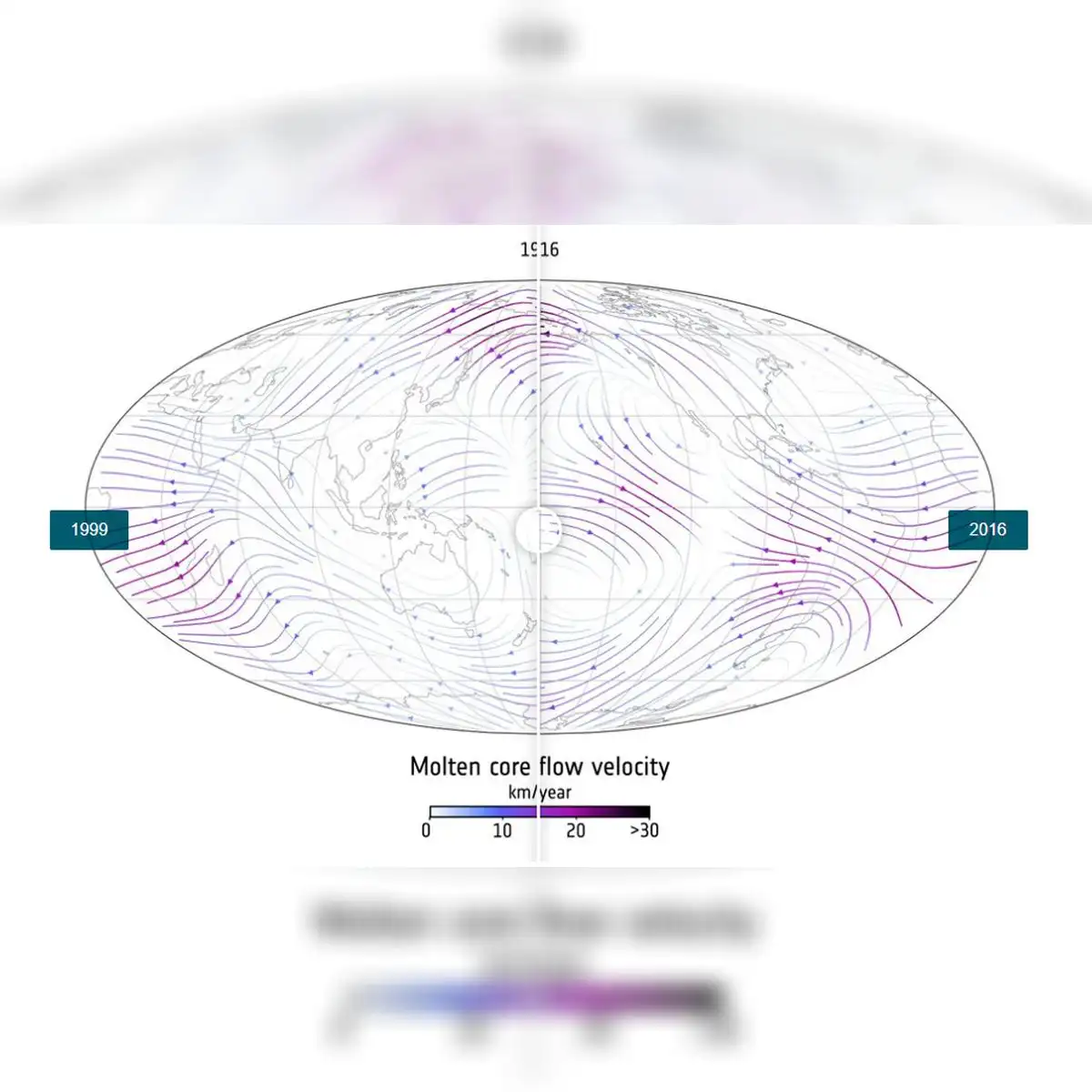
An international team of scientists discovered that a massive stream of liquid iron in Earth's outer core unexpectedly reversed direction under the Pacific Ocean. Analyzing data collected between 1997 and 2025 by satellites and ground observatories, researchers identified that the liquid iron current shifted trajectory around 2010. The findings, published in the Journal of Studies of Earth's Deep Interior, offer new clues about dynamic processes occurring roughly 2,200 kilometers below the surface that generate the planet's magnetic field.
The study combined measurements from the European Space Agency Swarm and CryoSat missions, as well as the CHAMP and Ørsted satellites. Data showed that a large region of molten iron shifted from moving slowly westward to moving forcefully eastward. Scientists cannot yet explain what caused the sudden change in the core's circulation.

Satellite Observations of the Deep Interior
Because Earth's core lies beyond the reach of direct instruments, researchers track internal movements by studying variations in the magnetic field. The European Space Agency launched the Swarm satellites into orbit in 2013 equipped with high-precision magnetometers to record subtle changes in the natural shield.
By comparing space measurements with surface records, specialists reconstructed liquid iron flow at the boundary between the core and the mantle. The satellite records revealed wave-shaped accelerations and dynamic structures that earlier, less precise observations had missed. Researchers linked the shift under the Pacific to other magnetic events, including a rapid alteration of magnetic field behavior known as the 2017 geomagnetic jerk.
Scientific Debates Over Core Flow Reversal
Scientific models had indicated for decades that outer core currents remained relatively stable while moving predominantly westward. The new findings demonstrate that this long-term stability can break in specific regions. Frederik Dahl Madsen, a researcher at the University of Edinburgh and lead author of the study, said the large-scale flow reversal under the Pacific raises new questions about deep Earth dynamics. He said scientists want to determine whether the shift is a short-term fluctuation, part of a repeating oscillation, or a new steady state for core circulation.
Madsen noted that continuous tracking will be essential to follow how the flow evolves. He added that the team's model shows the strong eastward movement began losing force starting in 2020. Madsen also suggested the change could relate to inner core modifications detected through geodetic and seismological studies, though he emphasized that potential link requires further research.
Impact on the Terrestrial Geodynamo
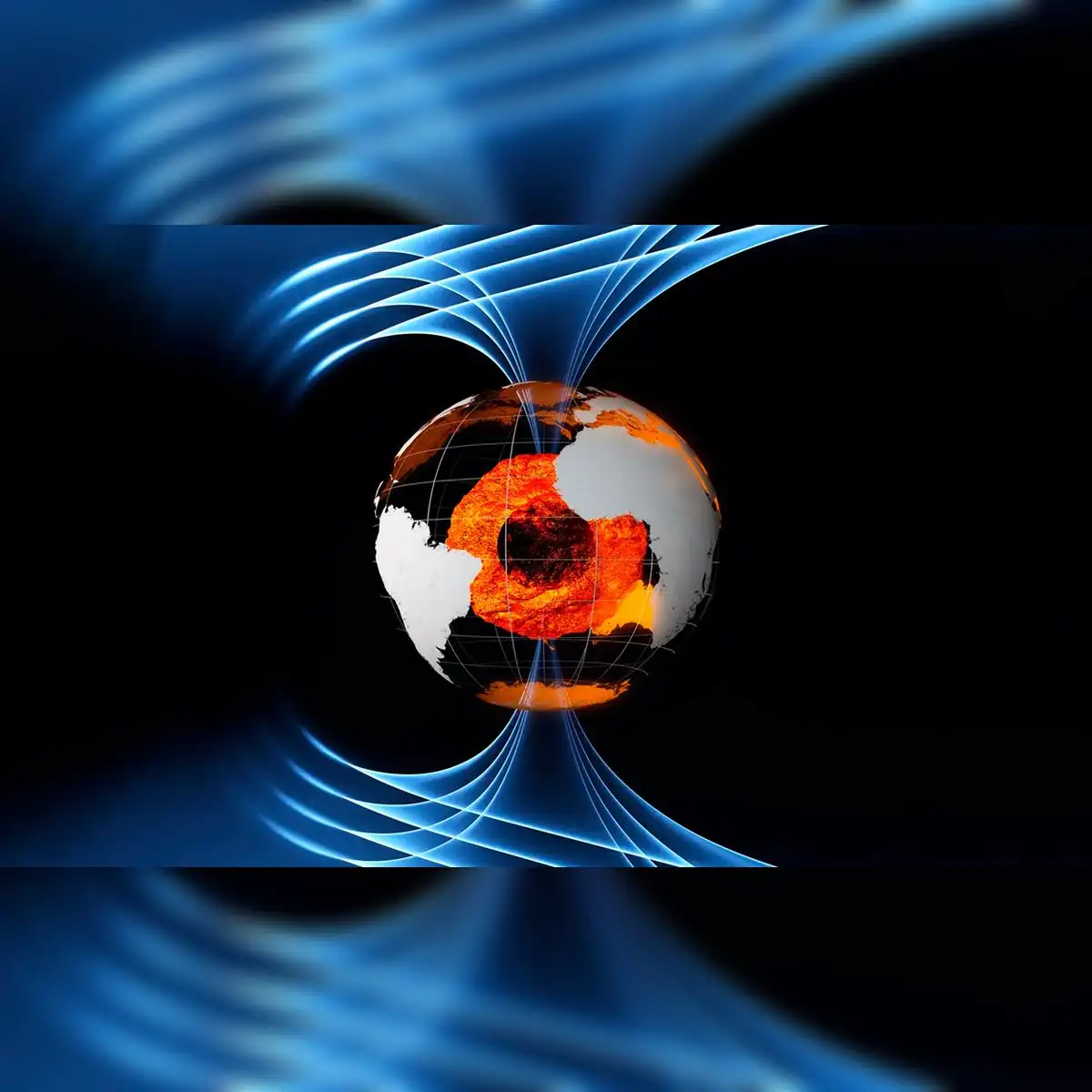
Movement within the liquid iron outer core drives the terrestrial geodynamo, which creates the magnetic shield protecting Earth from charged solar particles. Without that natural barrier, the atmosphere and technological infrastructure would experience greater exposure to solar radiation.
European Space Agency Swarm mission scientist Elisabetta Iorfida said the study demonstrates that regional changes in the core can develop in barely a decade. She added that the results will help scientists investigate interactions between the outer core, inner core, and lower mantle at the critical core-mantle boundary.
The authors emphasized that these deep internal changes pose no danger to human populations or the climate. However, accurate knowledge of core evolution remains vital for improving magnetic field models, refining navigation systems, and understanding the planet's internal workings.



