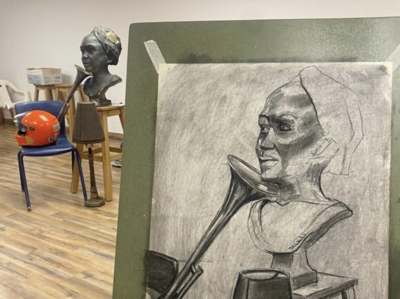
The fear of the blank page and the misconception that drawing is a purely innate talent or exclusive to established artists are holding adults back from vital cognitive benefits, according to visual artist and educator Luiggy Morales.
Writing from Santo Domingo, Morales said the common claim of not knowing how to draw is a form of self-sabotage. This mindset creates high expectations of what a good drawing should look like, forgetting that every expert began at that same starting point.
Drawing is simply interpreting what is seen on paper, Morales said. He noted that illustrating a daily object like a television merely requires drawing several rectangles organised in a space. With daily practice and the release of fear, this basic visual language becomes more complex and detailed.
Humans are neurologically coded for drawing and have an innate impulse toward graphic expression. Long before children can read, write, or articulate their first words, drawing serves as their primary vehicle of communication.
While popularly dismissed as simple hobbies or unconscious scribbles, children's drawings are direct projections of cognitive and emotional development. Every stroke, shape, and colour choice is brain activity seeking to exteriorise a desire, an idea, or a fear.
Because of this, early plastic expression transcends art to become an invaluable clinical and diagnostic tool for pediatric psychology, allowing specialists to understand what non-verbal children are thinking and feeling.
Cognitive impact
As people grow and enter adult daily life, they often abandon childhood habits like playing, reading, and drawing. Just as not reading causes problems in an individual's development and not playing negatively affects physical evolution, not drawing affects people cognitively.
Abandoning the practice limits creativity, affects the development of fine motor skills, and impairs the interpretation of and relationship with space.
This spatial intelligence was introduced in psychologist Howard Gardner's Theory of Multiple Intelligences. Drawing is not just making shapes, but a continuous exercise in mental mapping and understanding proportion, depth, and perspective. When practice stops, this spatial acuity decreases.

The drawing effect
Drawing is a deep cognitive workout that experts have named the drawing effect.
A pioneering 2016 study led by researcher Jeffrey D. Wammes at the University of Waterloo, published in the Quarterly Journal of Experimental Psychology, scientifically proved that drawing information significantly improves retention and memory. The practice vastly outperforms traditional strategies like observing images or writing repetitively.
Five keys to improve
Morales, a cultural manager and visual arts teacher who graduated from the Altos de Chavon School of Design and holds a postgraduate degree in Culture and Communication from FLACSO, offered five tips to learn to draw.
He noted that his professional background spans film, photography, sculpture, and muralism, but he now focuses on pedagogy and passing knowledge to new generations.
The first piece of advice is to educate the eye before the hand, as observation makes up 80 percent of drawing. Artistic drawing is more about observing how shapes interact than the physical act of tracing. Rather than processing an object by its name, students should visually break it down into lines, angles, basic geometric proportions, and negative spaces.
Second, artists must master fundamental volumes. Everything seen can be interpreted with basic geometric elements before moving to details. The foundation of any figure, from a human body to an urban landscape, lies in the sphere, cube, cylinder, and cone. Students should ensure they can convincingly structure and rotate these three-dimensional shapes on paper before attempting complex textures.
Third, Morales advised prioritising gesture and fluidity over detail. A sketch must be fluid to interpret the movement that a body follows. Tracing with ease quickly captures a subject's energy and posture. The movement should originate from the shoulder and elbow, using most of the body, rather than just the wrist. Fine details must always be left for the final phase once the structure is solid.
Fourth, understanding the behaviour of value and light is required to achieve volume and depth through tonal contrast and good interpretation of light and shadow. Artists should study how light wraps around shapes by consistently identifying five key zones: direct light, mid-tone, core shadow, reflected light, and cast shadow.
Finally, the sketchbook should be used as a laboratory rather than a gallery. Muscle memory and a visual library are developed through constant repetition until exhaustion. A sketchbook must be a dirty workspace full of quick natural studies, annotations, and mistakes, free from the pressure of creating finished pieces.