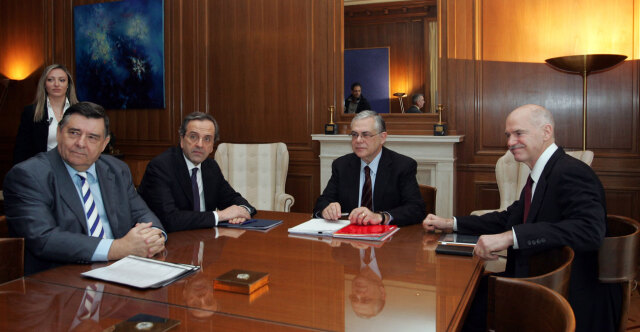
Former Greek deputy minister Christos Triantopoulos and four senior state officials have been ordered to stand trial before a Special Court over allegations that they intentionally altered the scene of the fatal Tempi train crash in central Greece.
A 203-page ruling issued by the Special Court Judicial Council on ministerial liability found that all five defendants acted with intent and under a common decision to interfere unlawfully with the site of the rail disaster between March 2 and March 8, 2023.
Judges concluded that the officials acted in breach of their duty without seeking the consent or approval of competent judicial authorities, aiming to obstruct ongoing investigations that were establishing criminal liabilities for specific individuals.
Judicial council findings
The Judicial Council stated that the deliberate modification of the crash site was designed to impede the collection of vital physical evidence and improperly intervene in the ongoing preliminary investigation.
According to the court document, the defendants acted both to cause harm to the state and the proper functioning of justice, and to provide an illegal moral benefit to those responsible for the crash by preventing the timely and substantial use of evidence at the crime scene.
The ruling noted that these actions occurred while forensic searches were still actively underway for findings, traces, and missing victims. To date, train passenger Erietta Molcho remains officially missing following the collision.
Judges found that the removal of material and ground alterations deprived victims and their families of critical evidence required to exercise their legal rights before civil and criminal courts, including biological material needed for victim identification.
Defendants and official roles
Christos Triantopoulos, son of Georgios, was serving as Deputy Minister to the Prime Minister, having been appointed under Presidential Decree 56/2021. He had been assigned duties regarding state aid and disaster recovery under Prime Minister Decision 138/13.12.2021.
Following the disaster, Prime Minister Office head Ioannis Mpratakos tasked Triantopoulos with monitoring and coordinating the actions of competent agencies at the crash scene after the practical activation of the fourth updated edition of the Civil Protection Secretariat Special Plan for Human Casualty Management.
Kostas Agorastos, son of Anastasios, was the governor of Thessaly at the time and was responsible for coordinating local site operations under the same casualty management plan.
Vasilis Papageorgiou, son of Panagiotis, served as the former General Secretary of Civil Protection, holding coordinating authority at the disaster site under the emergency response framework.
Agapios Charakopoulos, son of Pantelis, was the police director of Larissa and police commander responsible for the incident scene, tasked with maintaining order, managing traffic, and securing the site to preserve evidence for investigators.
Evangelos Falaras, son of Angelos, served as Fire Service operations coordinator for Central Greece and Thessaly. The ruling highlighted that his official authority was strictly limited to extracting trapped passengers and recovering bodies.
Illegal removal of crash evidence
The council emphasized that all five officials were bound by Article 251 of the Code of Criminal Procedure, which grants exclusive authority to judicial investigators for gathering and preserving evidence.
Heavy machinery and trucks provided by the Technical Service of the Region of Thessaly were restricted by law solely for cleaning and leveling ground surrounding the accident area, with all other uses prohibited.
Despite these legal restrictions, Fire Service coordinator Evangelos Falaras instructed contractor Athanasios Pandremmenos, manager of Athanasios Pandremmenos and Co OE, to haul away material from the site.
Contractors removed at least 300 cubic meters of soil, aggregate materials, and train wreckage. The four other co-defendants failed to take any action to stop the removal, despite having a specific legal obligation to do so.
The removed material contained passenger personal effects, train carriage debris, mechanical system components, and biological material that was essential for identifying crash victims.
Paving of the disaster scene
The Judicial Council detailed a second phase of site tampering carried out between March 4 and March 8, 2023, specifically involving Triantopoulos and former governor Agorastos.
Initial operational clearing had removed grass, bushes, and mud to stabilize ground above an underground natural gas pipeline, fulfilling the original purpose of deploying regional machinery to allow rescue cranes to position safely.
After judicial authorities had already launched investigations into the crash, Agorastos ordered contractor Pandremmenos to lay down gravel, specifically materials 3A and E4, and pave a section of the ground with crushed asphalt.
Triantopoulos failed to intervene or prevent the paving, despite his legal duty as government coordinator at the scene. Judges ruled that covering the area in gravel and asphalt obstructed investigative work and endangered the preservation of crime scene evidence.
Case separation and rejected motions
As part of its ruling, the Judicial Council rejected a motion submitted by Triantopoulos requesting a further primary investigation to re-examine his political supervisor, Ioannis Mpratakos, under oath.
The council also ordered the separation of the case file regarding the four non-ministerial co-defendants, transferring their files to the Prosecutor of First Instance of Larissa for further legal action concerning breach of duty charges in Larissa and Tempi.
Background to the Tempi train crash
The Tempi train crash occurred on February 28, 2023, when a high-speed passenger train collided head-on with a freight train near the Tempi Valley in central Greece, leaving 57 people dead and dozens injured.
The disaster is the deadliest rail accident in Greek history, sparking nationwide protests and intense legal scrutiny over infrastructure maintenance, signaling failures, and administrative accountability.
Larissa, located in the Thessaly region, serves as the regional judicial hub where initial emergency responses and local evidentiary inquiries were directed following the tragedy.
Under Greek law, allegations against serving or former government ministers regarding actions taken during their tenure are referred to a Special Court tribunal, while non-ministerial public officials are tried through standard local criminal courts.