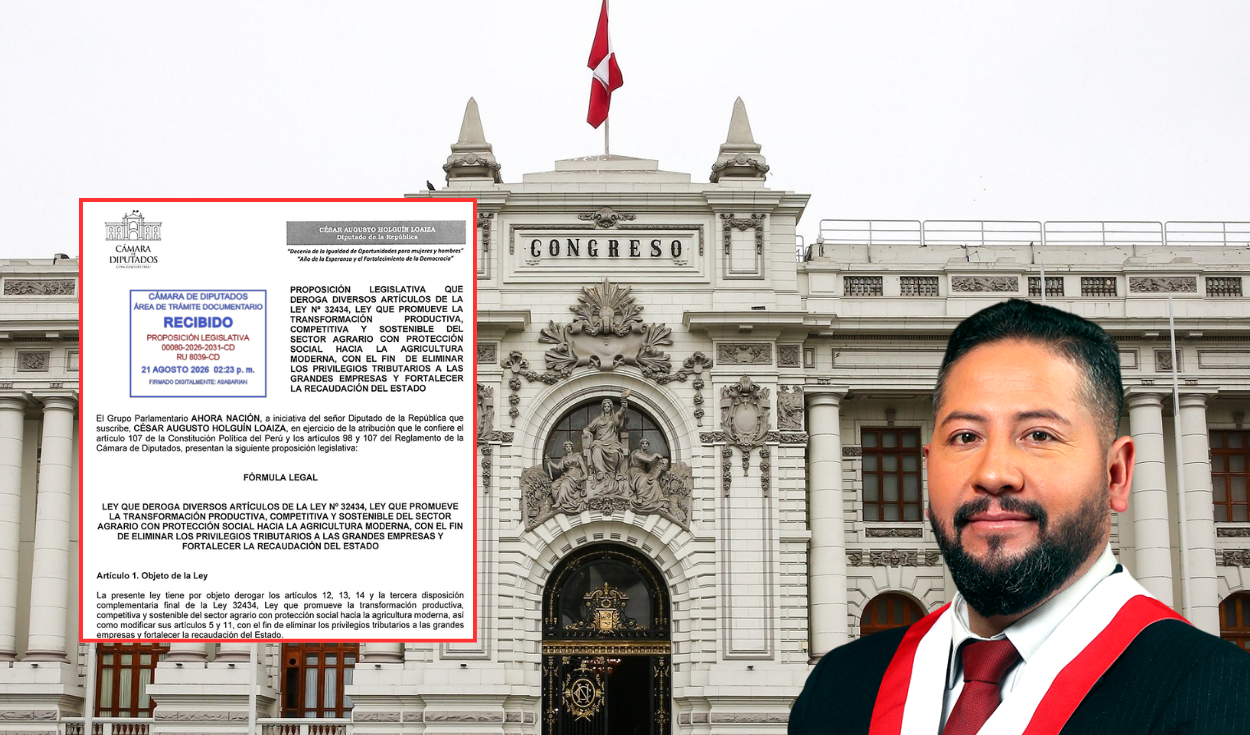
Peruvian lawmaker César Holguín of the Ahora Nación party has submitted a bill in Congress to repeal tax breaks for large agricultural exporters.
Holguín, who serves as spokesman for the parliamentary group, announced the initiative on social media. The proposal seeks to overturn the controversial measure known as the Chlimper 2.0 Law, which grants major tax concessions to big agribusinesses.

Under the current law, large agro-exporting companies pay a reduced income tax rate of 15 percent, down from the standard corporate rate of 29.5 percent. This special tax regime applies for a ten-year period from 2026 through 2035, after which rates are scheduled to return to 29.5 percent starting in 2036.
Critics estimate that the tax relief will cost the national treasury 20 billion soles in lost revenue. Holguín stated that the state currently fails to collect 1.17 billion soles each year because of the legislation.
Objections to corporate tax breaks
Holguín called for an end to tax benefits for big business in a statement posted on social media. He said the bill fulfills his parliamentary group's commitment to Peru by aiming to strip away economic privileges enjoyed by large corporations.
The lawmaker argued that the measure directly damages the national budget while essential public services remain underfunded. He noted that the treasury loses massive sums that could instead be used to narrow social gaps across the country.
Holguín said it was unacceptable that tax privileges allowing big agribusiness to withhold 1.17 billion soles annually remain in effect while the state lacks resources for healthcare, education, security, and public works.
The Peruvian state relies on corporate income tax revenue collected by the national tax authority to fund public infrastructure and social programs. Peru's single-chamber legislature, the Congress of the Republic, regularly debates tax policy surrounding the country's export sectors.
Deductions and investment incentives
Beyond the lower tax rate, the legislation includes provisions allowing agribusinesses to recover capital investments rapidly. Companies can apply an annual 20 percent tax rebate on water and irrigation works constructed or acquired for crops between 2026 and 2035.
The law also establishes an incentive for companies that purchase produce from registered small-scale farmers. Agribusinesses buying from these growers receive an additional 25 percent tax deduction on the value of those purchases, provided the discount does not exceed 10 percent of their total accounting expenses.
The measure, officially designated as the New Agrarian Law, was enacted in September 2025 during the administration of President Dina Boluarte, who assumed office in December 2022.
Congressional vote breakdown
Congress passed the legislation on August 14, 2025. The Plenary of Congress approved the bill with 43 votes in favor, 32 votes against, and 17 abstentions.
Support for the law came primarily from right-wing and center-right congressional groups:
- Fuerza Popular: 19 votes in favor, 0 against, 0 abstentions
- Alianza para el Progreso: 9 votes in favor, 2 against, 1 abstention
- Somos Perú: 7 votes in favor, 0 against, 1 abstention
- Honor y Democracia: 3 votes in favor, 1 against, 1 abstention
- Avanza País - Partido de Integración Social: 2 votes in favor, 0 against, 0 abstentions
- Acción Popular: 1 vote in favor, 1 against, 0 abstentions
- No Agrupados (unaffiliated): 1 vote in favor, 3 against, 0 abstentions
Opposition to the bill was centered among left-leaning parliamentary groups:
- Podemos Perú: 0 votes in favor, 9 against, 0 abstentions
- Juntos por el Perú - Voces del Pueblo: 0 votes in favor, 7 against, 1 abstention
- Bancada Socialista: 0 votes in favor, 5 against, 0 abstentions
- Bloque Democrático Popular: 0 votes in favor, 4 against, 0 abstentions
Two parliamentary blocks abstained completely during the vote:
- Perú Libre: 0 votes in favor, 0 against, 6 abstentions
- Renovación Popular: 0 votes in favor, 0 against, 6 abstentions