

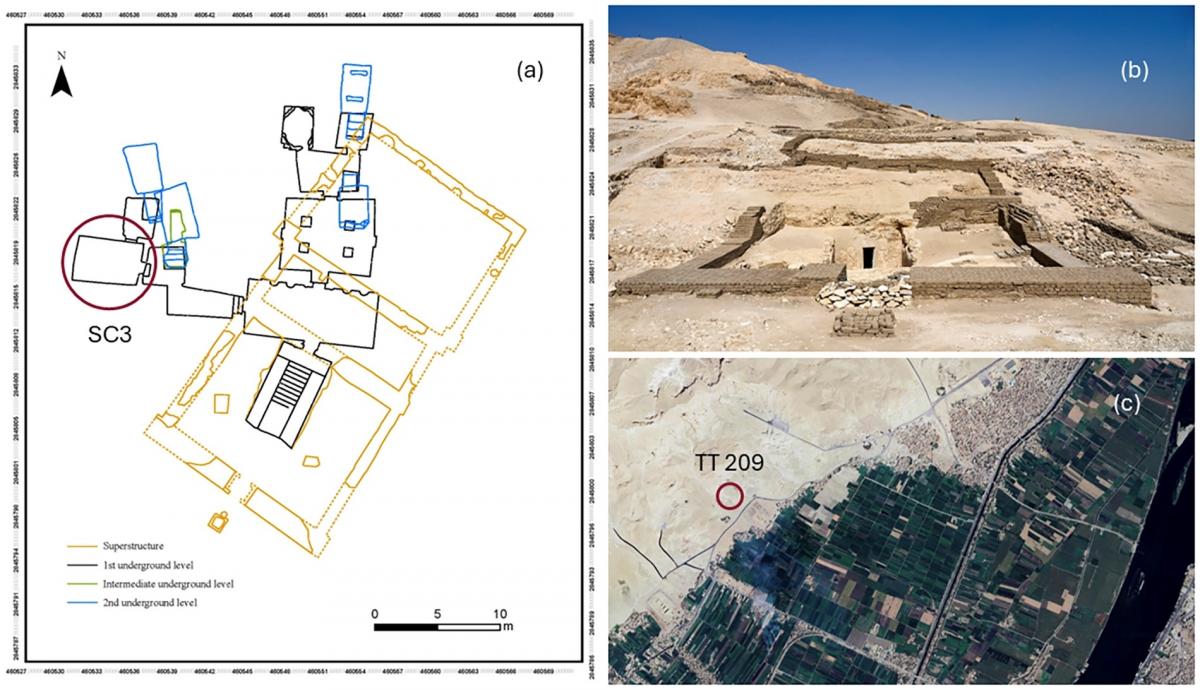
Archaeologists have discovered the remains of 16 mummified people and a mummified dog inside a 2,700-year-old tomb in the Theban Necropolis in Egypt, according to a report by The Daily Galaxy.
Researchers also identified the dismembered remains of at least four other individuals in the third chamber of Theban Tomb 209, located across the Nile river from Luxor.
The mummified dog was found resting on top of two of the human mummies.
Theban Tomb 209 is part of a massive funerary complex set among more than 400 tombs from different eras of ancient Egyptian history. The necropolis sits on the west bank of the Nile, opposite the ancient city of Thebes, and served as a ritual burial ground for pharaohs and nobles for centuries.
A team of scientists from the University of La Laguna in Spain recorded the location, orientation and physical relationship of every body in the third chamber. The findings were published in the journal Frontiers in Environmental Archaeology.
Changing funerary customs
The chamber was first built during the Twenty-fifth Dynasty, between 754 and 656 BC. This was a period when pharaohs from the Kingdom of Kush, in modern-day Sudan, ruled over Egypt.
The tomb remained active until it was abandoned during the Ptolemaic era between 305 and 30 BC, after Alexander the Great conquered Egypt and installed a Greek ruling dynasty.
The contents of the chamber span nearly 700 years of continuous but irregular use. Researchers said it offers a useful example of how burial customs actually changed on the ground, rather than how they were recorded in official religious texts.
The team uncovered nine distinct burials during that period, ranging from single individuals to groups buried alongside objects.
The arrangement of the remains appeared to be a chaotic cluster at first glance. However, researchers said closer inspection revealed a sophisticated and deliberate funerary practice that evolved over centuries, rather than the result of neglect.
Wealth and imported goods
The earliest burials belonged to people of high social standing, said Miguel Ángel Molinero Polo, a professor of Egyptology at the University of La Laguna.
He said their status was confirmed by the enormous expense of the items that accompanied them into the afterlife.
These individuals were placed in coffins spaced well apart from one another. They were provided with funerary nets, protective amulets and imported goods, including Phoenician amphorae that were found beside the bodies. Amphorae were clay vessels commonly used to transport wine and oil across the Mediterranean.
Space in the chamber became scarce by the end of the Twenty-fifth Dynasty and throughout the Persian period, from about 680 to 404 BC. The Persian period began when the Achaemenid Empire conquered Egypt.
New burials were placed wherever space could be found. The posture of the bodies also changed during this time, with some of the later individuals buried with one arm folded instead of fully extended.
Stacked bodies
The most obvious sign of changing customs was a shift to vertical arrangements. Instead of being laid side by side, bodies were increasingly stacked directly on top of each other beginning in the Persian period.
Two-thirds of the burials in the chamber from that point onward were arranged this way.
Molinero Polo said the bodies buried in a vertical position lacked coffins but were carefully mummified. He said they were also associated with vertically placed vessels, pointing to a specific ritual that was absent in earlier stages of the tomb's use.
The scientists concluded that the stacking was not a sign that original funerary customs were breaking down.
Instead, they said the layers reflected an active spatial logic. Each new body was placed with consideration for who and what was already inside the chamber.
Mummified dog
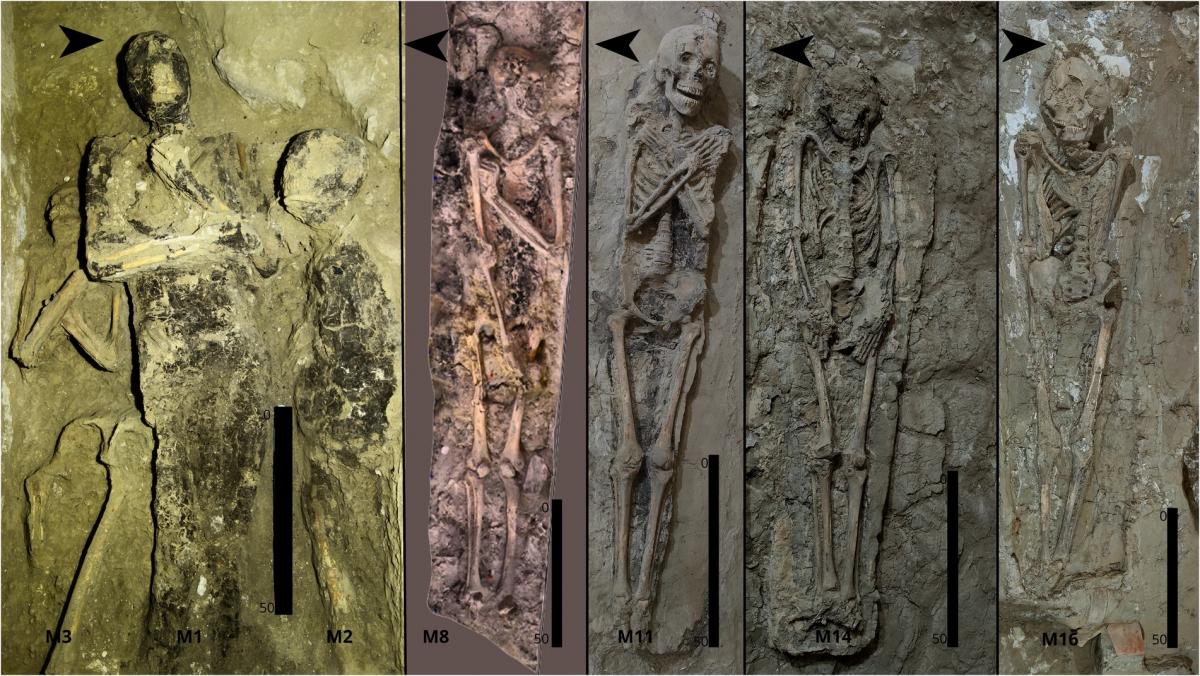
The most striking arrangement was found in the southeast part of the chamber and dates to the Ptolemaic period. Four mummies were stacked vertically with a mummified dog resting on top.
The animal was found directly over the remains of a man and a woman.
Jared Carballo-Pérez, the first author of the study, said this detail was particularly striking.
He said the placement could indicate a close connection between the people and the animal, an idea he felt was quite easy to agree with.
Carballo-Pérez said the arrangement could also reflect a further shift in ritual practice where the animal took on the role of a psychopomp, a symbolic helper on the journey to the afterlife. In many mythologies, psychopomps are spirits, deities or animals responsible for guiding the souls of the dead to the underworld.
The burial site was shaped by centuries of damage before it was excavated.
Researchers noted that numerous floods, fires and repeated intrusions affected the preservation of the remains. This prevented archaeologists from establishing a precise timeline for some of the burials or fully understanding the reasons behind the burial choices.


