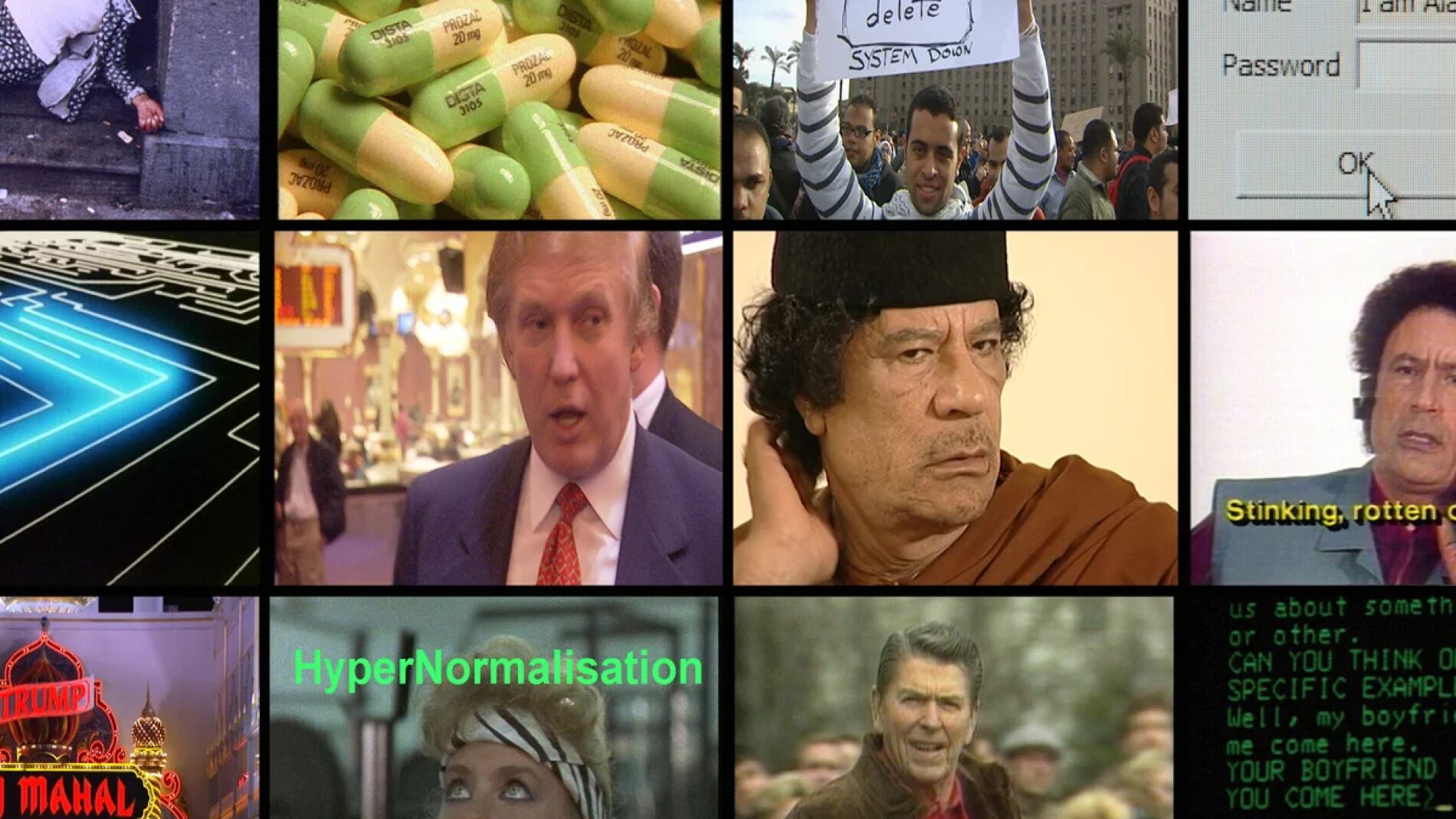
Adam Curtis's landmark BBC documentary HyperNormalisation marks ten years since detailing how political paralysis spread from the Soviet Union to Western society.
The film drew its core thesis from the concept of hypernormalisation, a term coined by anthropologist Alexei Yurchak in his 2004 book Everything Was Forever, Until It Was No More, published by Princeton University Press. Yurchak described a state in which citizens and leaders alike knew the Soviet system was failing, yet everyone pretended it would endure indefinitely because no one could picture an alternative.
According to Yurchak, this phenomenon stemmed from a core dysfunction in late Soviet life. Citizens were expected to be enlightened and independent while simultaneously participating in endless party rituals, repeating prescribed ideological slogans, and endorsing party decisions controlled by the party apparatus that had little connection to an independent spirit or experimentation.
Yurchak identified three main characteristics of hypernormalisation: an accepted collective falsehood that everything was going well, an inability to imagine alternative futures, and the construction of simplified narratives to simulate solving complex problems.
From Soviet decay to Western politics
While Yurchak's study gained strong academic prestige, Curtis popularized the term for a global audience through his nearly three-hour BBC documentary. Curtis argued that the social stagnation seen in the final years of communist Russia was repeating itself across Western nations around the turn of the millennium.
Curtis drew on examples from New York, Middle East conflicts, and consumer individualism to portray political leaders incapable of guiding society toward a better future. The film opens with an analysis of Middle Eastern conflicts before examining the 1986 decision by Western powers to bomb Libya. Curtis explained that targeting Libyan leader Muammar Gaddafi was chosen because it was less risky than confronting Syria under Hafez al-Assad.
Curtis combined hard political analysis with sociocultural context. He highlighted the narcissism of Patti Smith's punk music, the sci-fi warnings of the Strugatsky brothers whose 1972 novel Roadside Picnic covertly satirised Soviet decay, and the broad public impact of the arrival of the Internet. He also pointed to progressive figures like actress Jane Fonda, who shifted from attempting to change the world to focusing on body modification through aerobic exercise.
Designing an artificial reality
Describing his motivation for the film, Curtis stated that powerful institutions including governments and corporations had designed an artificial, simplified reality since the 1970s to replace the complex real world.
In the film's opening narration, Curtis noted that people were living in a strange era marked by unpredictable events such as suicide bombings, refugee waves, Donald Trump, Vladimir Putin, and Brexit in the United Kingdom. He said leaders seemed incapable of handling these challenges and lacked any vision for a different or better future.
The documentary also displayed strong visual and musical aesthetics. Curtis credited himself as editor rather than director because all visual footage was retrieved from the Internet. Music producer Gavin Miller assembled a soundtrack combining dark ambient, analogue electronics, post-punk harshness, and classical pieces, featuring work by Brian Eno, Burial, Nine Inch Nails, Suicide, and Dmitri Shostakovich. The documentary remains available on YouTube, including versions with Spanish subtitles.
Corruption and the Paradise Papers
In November 2017, Curtis visited Madrid to participate in a retrospective dedicated to his work at the Reina Sofía Museum of Contemporary Art. Speaking to journalist Héctor G. Barnés amid the international Paradise Papers financial leak, Curtis addressed the ongoing relevance of his documentary.
Curtis explained to Barnés that society accepts widespread corruption as normal because people feel they lack any alternative. He noted that even individuals who consider themselves honest become complicit by accepting corrupt systems as normal.
Comparing contemporary Western society to the late Soviet Union, Curtis said citizens in both eras recognized that figures in major industries were stealing from them, yet accepted it because the political system had no vision of an alternative future and focused solely on maintaining its own stability.
Cultural legacy and paradox
Reflecting on the documentary in 2024, Spanish cultural critic, essayist, and art curator Iván de la Nuez analyzed why the academic essay and documentary resonated so strongly with the general public.
De la Nuez explained that Yurchak examined everyday life alongside historical texts without framing the Cold War as a binary struggle between an evil communist system and a good Western one. He described the Soviet experience as one half of a modern partnership that fell first, but whose collapse would eventually drag down its capitalist partner.
De la Nuez concluded that hypernormalisation remains a fertile concept for understanding the respective crises of communism, capitalism, and the modern post-democratic world, demonstrating that genuine critical thought requires examining paradoxes.