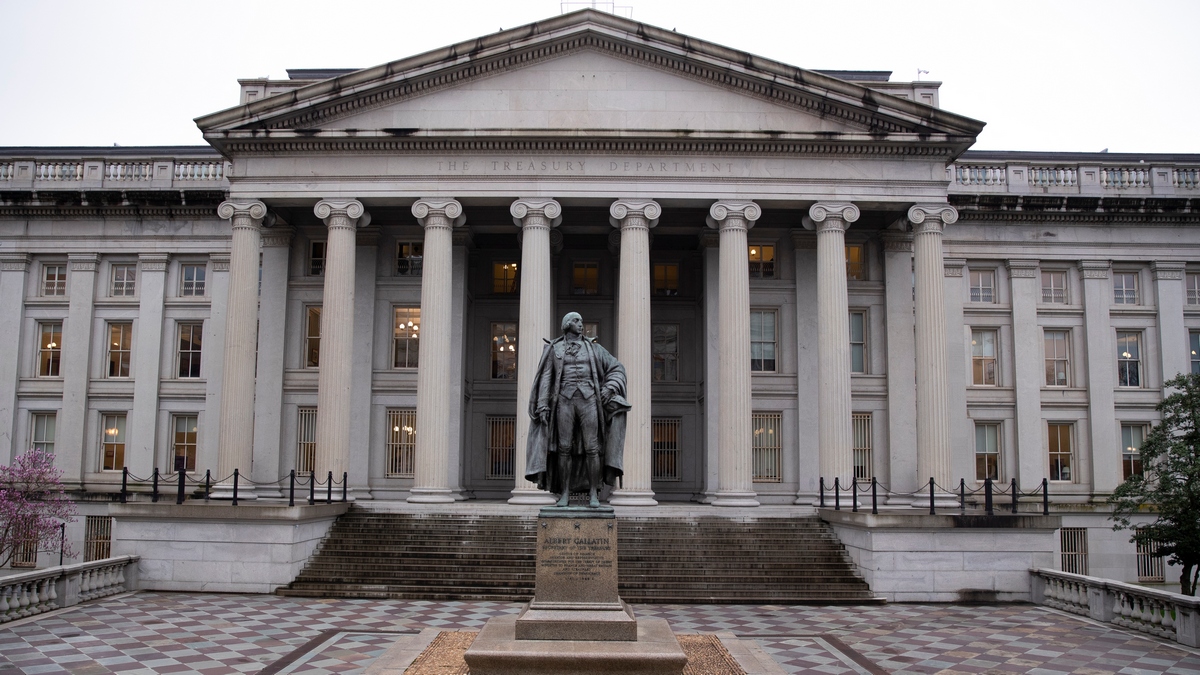
The total federal national debt of the United States has crossed $40 trillion for the first time, according to data released by the US Treasury.
Figures published by the department showed that overall debt reached $40.05 trillion as of August 18. The historic milestone comes as government spending continues to outpace tax receipts across the federal budget.
The United States Department of the Treasury is responsible for managing government finances, collecting revenues, and issuing debt securities to cover federal expenditure. Public borrowing expands whenever annual government spending exceeds revenue, adding to the accumulated national debt stock.
The pace of government borrowing has accelerated sharply over the past decade. CNBC reported that the national debt stood at $19.4 trillion 10 years ago, before rising to $30 trillion four and a half years ago.
According to data reported by the Financial Times, the federal debt expanded by $3 trillion over the past year alone. Outside the peak of the coronavirus pandemic, that increase represents the fastest annual growth rate of government debt in American history.
Budget deficits and pandemic spending
In its latest monthly financial report, the US Treasury recorded a budget deficit of $432.3 billion for the month of July. The figure represents the highest single monthly budget deficit recorded by the federal government since March 2021.
Federal deficits have widened in recent years following extensive economic stimulus measures enacted during the COVID-19 pandemic. Since the start of 2026, the overall budget deficit is approaching $1.8 trillion, marking a significant increase compared to the corresponding period last year.
A budget deficit occurs when federal government outlays exceed annual revenues, requiring the Treasury to issue new debt instruments to finance the shortfall. Expanded spending programmes and rising borrowing costs have contributed to the expanding gap between government receipts and expenditure.
Financial market pressures and Treasury yields
Yields on US Treasury bonds have climbed sharply since late June, reaching levels not recorded since the 2008 global financial crisis. During that 2008 crisis, severe market strain prompted the Federal Reserve, the central bank of the United States, to cut its benchmark interest rate to near zero to support the banking system.
US Treasuries function as the foundational benchmark asset for global financial markets, serving as a standard reference rate for borrowing worldwide. Financial analysts note that if investors systematically demand higher yields to hold American debt, borrowing costs could rise globally while heightening market volatility and putting downward pressure on the dollar.
Rising interest rates increase the federal government's debt service obligations, requiring larger interest payments on outstanding debt and putting further strain on annual budget allocations.
Federal bond buybacks and auction results
Growing concerns over debt levels and market stability have drawn attention from policymakers in Washington. On August 19, ahead of the official debt figures being published, the US Treasury announced that it would double its planned buybacks of long-term government bonds in an attempt to curb a recent market sell-off.
The announcement followed a debt sale on August 13, when the US government auctioned $25 billion of 30-year Treasury bonds. The bonds were sold at the highest yield recorded at a 30-year bond auction in 25 years.
Government bond auctions allow the Treasury to raise funds from domestic and international investors. When demand weakens, the government must offer higher interest rates to attract buyers, increasing the overall cost of long-term federal borrowing.
Tariff impacts and budget resolutions
Economic policy decisions have also added to discussions surrounding national debt management. Analysis by the Kiel Institute for the World Economy indicated that tariff policies introduced by Donald Trump are weighing on the domestic economy.
According to calculations by the Germany-based economic research institute, foreign exporters absorbed only about 4 percent of the tariff burden. The remaining 96 percent of the cost was borne directly by American importers and consumers.
To maintain government operations amid fiscal pressures, the US Senate passed a temporary budget resolution on August 8 to prevent a federal shutdown ahead of upcoming midterm elections.
The legislative measure followed fiscal disruptions earlier in the year, when the United States experienced a government shutdown at the start of 2026. That shutdown occurred just 11 weeks after the conclusion of a prior 43-day funding lapse that ran from October 1 to November 14, 2025, leaving hundreds of thousands of federal workers without salaries for several weeks.