The term "banana republic" was born not in a classroom but in a fugitive's notebook. Columnist José Luis Taveras traces the phrase to William Sydney Porter, the writer known as O. Henry, who coined it while hiding from American justice in Honduras in the late nineteenth century.
Porter (1862-1910), a pharmacist and journalist, was accused of embezzling funds after a forensic audit at the First National Bank in Austin, Texas, where he worked as a cashier. He fled by train to New Orleans and then by ship to Honduras, which at the time had no extradition treaty with the United States.
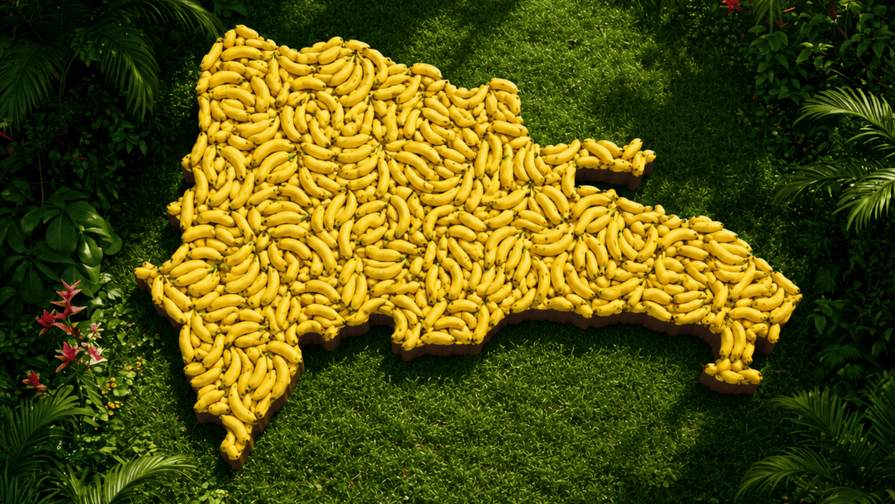
The hardship of that self-imposed exile produced his first short-story collection, Cabbages and Kings (1904), in which Porter used the phrase "banana republic" to satirize a tropical country with an unstable economy, dependent on a single export commodity and controlled by foreign corporate interests. His fictional stand-in for Honduras was a place he called Anchuria.
The metaphor spread through the twentieth century, Taveras writes. It began as satire aimed at fruit-company fiefdoms but broadened over time to describe any country marked by corruption, favoritism, and the absence of judicial independence, regardless of whether it actually produces bananas. In 1978, the couple Mel and Patricia Ziegler named a California clothing store after the concept; it is now a global brand owned by Gap Inc.
Latin America carried the label through decades of military dictatorships in the 1950s, 1960s, and 1970s, Taveras notes. Some countries in the region have since built institutions of apparent maturity, though he describes that democracy as stitched together from patches and exposed to authoritarian pressure.
A democracy without its socioeconomic foundation
The Dominican Republic began a more consistent democratic experiment in 1996, Taveras argues, but an authoritarian culture persists in everyday governance, in deep mistrust of political parties, and in growing voter apathy. Neither the political parties nor the economic elites appear alarmed by these warning signs, he writes, at a moment when politics as spectacle is attracting improvised leaders whose main credentials are fame, fan bases, or marketing reach.
Taveras draws a sharp distinction between political democracy and socioeconomic democracy, arguing that the latter has not yet taken hold. Successive governments from four different parties have shied away from the structural reforms he considers necessary: redefining the rules of income distribution, reducing economic concentration, building an equitable tax system, expanding social security coverage, and raising wages to reduce the informal economy.
Instead, he writes, citizens have been conditioned to measure progress by tourist arrivals, economic growth rates, homicide comparisons with neighboring countries, and anti-corruption rankings. The governing logic treats those numbers as sufficient cause for optimism and re-election. The real benchmarks, in his view, remain exchange rates, interest rates, consumer price indexes, gross domestic product, and the balance of payments.
Despite new towers, highways, and consumption habits, Taveras concludes, the Dominican Republic still lacks enough reasons to erase what he calls the shameful tattoo of the banana republic from its democracy.