

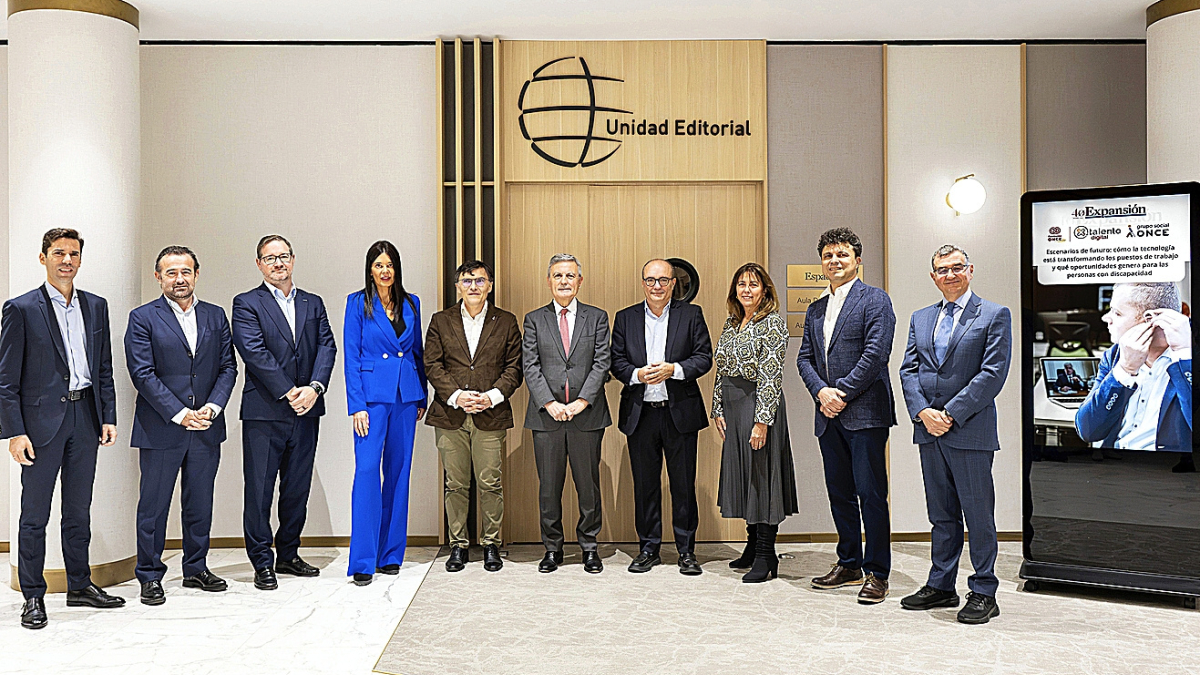
Business leaders and disability advocates met at an event organized by the Spanish newspaper EXPANSIÓN to discuss how technological change, including artificial intelligence, could create new job opportunities for people with disabilities. The discussion brought together the Advisory Council of Por Talento Digital, an initiative focused on digital talent and disability inclusion.
Rosa García, who chairs the council, opened the event by saying that building increasingly innovative and inclusive companies would require all available talent, including that of people with disabilities.
Alberto Durán, executive vice president of Fundación ONCE, said traditional physical barriers are often eased by technology. He linked inclusion to competitiveness, saying that a company with the best talent and the most diverse workforce would be far more competitive. Fundación ONCE is a Spanish foundation, linked to the National Organisation of the Blind of Spain (ONCE), that works to promote employment for people with disabilities.
The panel began by addressing corporate culture and change management. Laurent Perea, chief executive of Capgemini, the French multinational IT services and consulting firm, said the shift required a reinvention of the way people work. He said this needed oversight on ethics, cybersecurity and costs, alongside a culture open to growth, calling it a major opportunity for transformation that went beyond business and into society.
Pedro Saura, president of Correos y Telégrafos, Spain's state postal operator, said his company was set to undergo one of the biggest digital transformations of any organisation. He said its strategy followed a model of "humanist management," built on people who solve problems, manage teams and treat others with respect, combining management skill with ethics. Saura said this approach would define the jobs of the future.
The jobs of the future
Artificial intelligence is expected to heavily influence changes in the world of work, including the professional development of people with disabilities. David Alonso, vice president and head of mobile experience at Samsung Electronics Iberia, said technology must come to remove barriers rather than widen them. He said he was confident AI would help eliminate physical barriers and allow the potential of people with disabilities to be put to use.
On the risk of algorithmic bias, Rosa García said it was important for AI systems to be required by regulation to explain their selection processes. She called for safeguards showing that new technologies put everyone in a similar position, and urged companies to hire the best talent while leaving prejudice behind.
Alberto Durán said that, thanks to technology, people with disabilities can now access jobs that were previously closed to them, citing examples such as refurbishing mobile phones or caring for the elderly. He said these workers also stand out for their ability to overcome difficulties in a period of rapid change. He added that a shortfall in formal training needs to be made up through training in the skills the market demands, and said Fundación ONCE relies on companies to specify what training people need to find quality jobs.
According to DigitalES's 2026 Emerging Jobs Report, demand is growing for hybrid profiles that combine technical and personal skills. Miguel Sánchez Galindo, director general of DigitalES, said Spain's technology sector needs to bring in a million new professionals, and said the challenge was to ensure people with disabilities are better represented among them, including through greater promotion of technical vocations in that group.
Experiences of inclusion
Silvia Leal, an international expert on technology trends, said this was an exciting moment marked by a huge reduction in accessibility barriers. She told people with disabilities that this was the time to push forward, calling it an era of second chances. She said achieving a fair transformation still faced two challenges: changing algorithms and working with the media. Leal predicted that the deepest changes to jobs over the next five years would come from applying AI to other technologies, such as humanoid robots and immersive experiences.
Sharing hiring experiences, Jorge Jiménez, director general of Viewnext, said that at his company there is no distinction between employees with and without disabilities once they join, since all have the same opportunities. Víctor López-Barrantes, director general of NTT DATA, said the biggest challenge is genuine integration: once a person with a disability joins a team, the rest of the team has to learn to work with them. López-Barrantes said a person can only truly develop their career once they feel integrated into the project.
Incentives for hiring
Francisco Hortigüela, president of Ametic, pointed to training grants as one incentive, but focused mainly on the need for greater awareness among human resources departments of initiatives such as Por Talento Digital. He said companies are looking for diversity and new ways of thinking, and that people with disabilities bring a great deal to that search.


