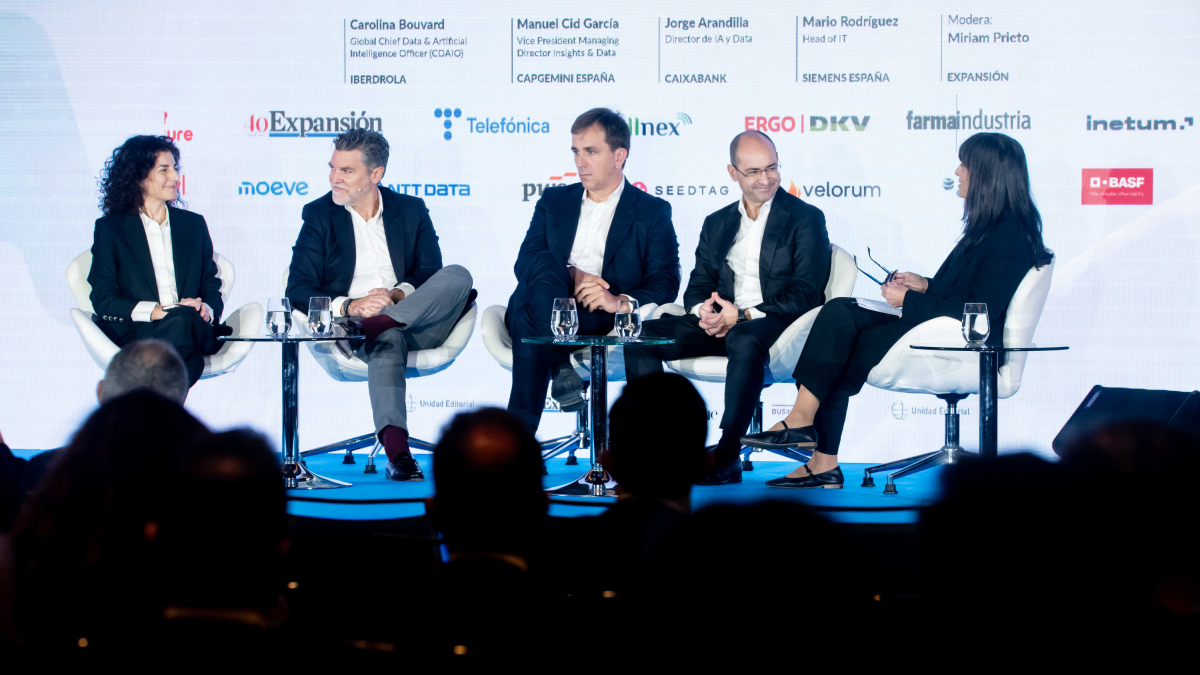
Executives from CaixaBank, Iberdrola, Siemens España and Capgemini España said businesses are entering a new phase of artificial intelligence built around autonomous agents, moving beyond the generative AI tools that have spread through companies over the past four years.
The discussion took place at a panel in Madrid, part of the fourth edition of EXPANSIÓN's Inteligencia Artificial y Nuevas Tecnologías conference, and was moderated by Miriam Prieto. Panellists included Manuel Cid, executive vice president and director of analytics and data at Capgemini España; Jorge Arandilla, director of artificial intelligence and data at CaixaBank; Carolina Bouvard, global director of data and artificial intelligence at Iberdrola; and Mario Rodríguez, IT director at Siemens España.
Agents that can execute tasks
The panellists agreed that companies see the greatest returns when AI is built into core operations rather than used simply to answer questions. Cid said firms achieve high value once they stop using the technology only to respond to queries and instead embed it in real business processes, pointing to examples such as conversational banking, analysis in customer service centres, simulation of B2B commercial negotiations, and predictive risk management in supply chains.
Arandilla said CaixaBank has prioritised deploying fully automated agents in critical areas such as cybersecurity and fraud prevention, using AI to defend against AI itself, while also rethinking key business processes and keeping human contact in branches as a strategic priority.
Bouvard said the transformation requires redesigning operations from end to end and combining AI with other technologies. With around 500 agents already running, she said Iberdrola's focus is not on improving isolated tasks but on reimagining entire processes, with measurable impact in areas such as documentation management for new power supplies, specialised commercial customer service and maintenance optimisation in power generation.
Rodríguez said industrial AI delivers its greatest potential in factories when combined with digital twins and simulation software, which allow products and plants to be designed virtually before they are built. He added that this approach also helps scarce specialists, such as automation engineers, through dedicated AI agents.
Barriers to scaling up
The panellists said moving from proof-of-concept projects to large-scale deployment still faces significant technical and organisational obstacles. Cid said scaling up requires resolving data fragmentation through semantic layers, ensuring interoperability with legacy systems, controlling the economic sustainability of token consumption, and defining the level of technological sovereignty each organisation wants to maintain.
Arandilla said these challenges are compounded by the need to transform technology architectures that have traditionally been divided into silos so they become compatible with agents, adding that this process must be accompanied by precise leadership that defines exactly what to execute and how, to avoid projects stalling as mere pilots.
On the industrial side, Rodríguez said the challenge is ensuring strict data governance that allows companies to train reliable models and achieve deterministic, rather than merely probabilistic, results, in order to avoid critical errors on the factory floor.
Ethics and human leadership
The panel closed by focusing on ethics and the role of people as the technology advances. Bouvard said that for reliable deployment in critical infrastructure, it is non-negotiable to have responsible AI certified under international standards, backed by adoption programmes that close the gap between the pace of technological change and human learning, placing professionals in a role of judgement and oversight.
The executives agreed that the future of work will depend on professionals able to coordinate and govern teams of autonomous agents without losing strategic control.
Capgemini is a French multinational consulting and technology services firm. CaixaBank is one of Spain's largest retail banks. Iberdrola is a Spanish multinational electric utility company. Siemens is a German industrial and technology conglomerate with operations across manufacturing, energy and automation.
Test yourself
Roughly how many AI agents does Iberdrola currently have running, according to Carolina Bouvard?
Where did the panel discussion on agentic AI take place?
Which area did CaixaBank prioritise for fully automated AI agents, according to Jorge Arandilla?
Have your say
Should companies prioritize speed of AI agent adoption or strict governance and certification first?
Where it happened
Madrid, Spain