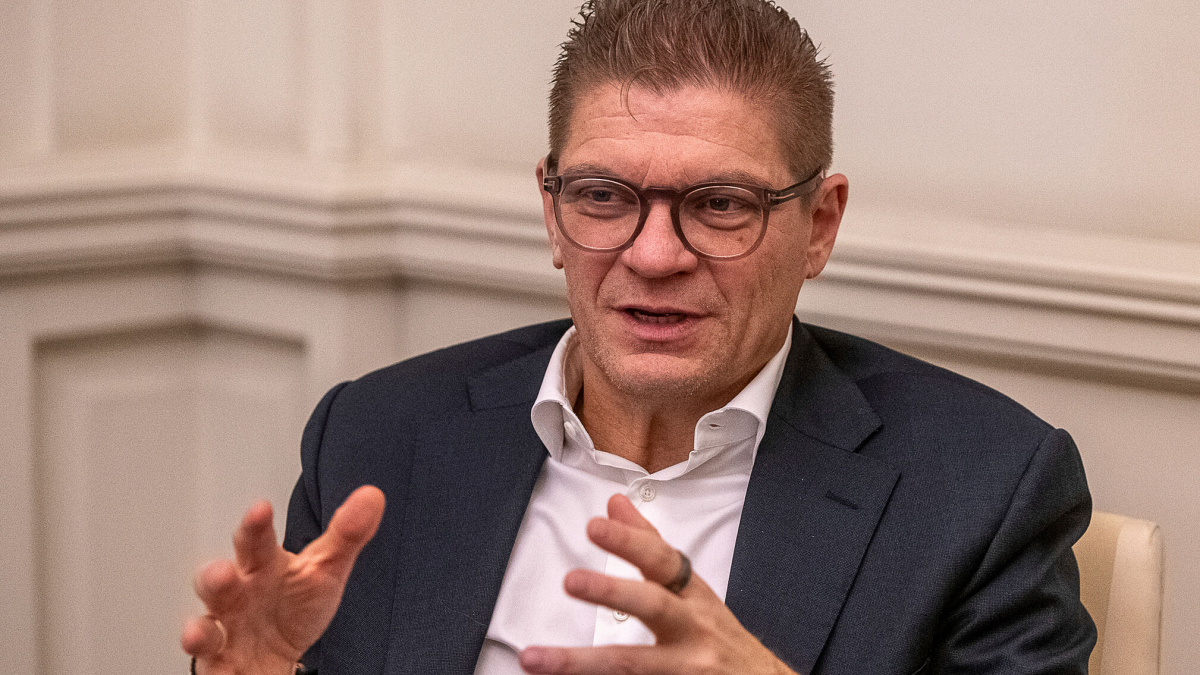
Bjørn Sibbern, chief executive of the Swiss exchange group SIX, said he expects Spain to have several hundred exchange-traded funds (ETFs) listed within the next few years, up from just six today. SIX owns Bolsas y Mercados Españoles (BME), the operator of the Spanish stock exchange.
Sibbern, who took over as SIX's chief executive in January 2024, said trading volumes in Spain rose 24.3% last year and are growing even faster in 2026, by close to 30%. He said SIX's market share in Spanish equity trading has climbed from around 52% to 56%, with some order flow returning to the exchange from alternative trading venues.
Aquis platform and European ambitions
Sibbern said SIX expects an additional boost of 10% to 15% in volumes once BME moves onto the same trading platform as Aquis, a venue based in the United Kingdom that gives access to 16 markets. He said that integration should be operational between the second and third quarter of 2028.
Combining trading activity across Spain, Switzerland and Aquis's 16 markets should allow SIX to raise its share of European equity trading from more than 15% currently to above 20% in the coming years, Sibbern said. He added that the group's ambition is to exceed that level and become one of the leading operators in European equity trading, if not the largest.
Listings and BME's performance
Sibbern said BME has let SIX shift from being a purely Swiss company to a more European and international group. He said last year was extraordinary for the Spanish exchange and that this year has also been strong for new listings, with 16 so far, three on the main market and 13 on the BME Growth and BME Scaleup segments. He said he still expects more deals before the year ends and that SIX is forecasting around 20 listings in total for 2026, similar to recent years.
Sibbern said BME is probably one of the most successful exchanges in Europe for new listings in recent years, citing its ability to attract small-capitalization companies, a trend he said is not seen with the same intensity on other European exchanges. He said SIX has a solid pipeline of deals for 2027 but does not typically issue forecasts for a year still that far out.
Why fewer companies are going public
Asked why Spain struggles to attract companies to its main listed market, Sibbern said the Spanish exchange is taking a more active approach than some of its peers. He said the United States has also seen a decline in listed companies for years, as businesses now take between five and ten years longer to go public because they have access to alternative funding sources such as private capital.
Sibbern said Europe as a whole, not just Spain, could do more to encourage retail investor participation, both in trading and in new listings. He pointed to Spain's planned savings and investment account as a key tool for attracting retail investment flows, saying a tax-friendly investment account that simplifies reporting obligations would be an important push toward getting more citizens to invest in shares and ETFs. He cited Sweden's experience with a similar account as a major success that Spain could follow.
Growing the ETF market
Sibbern said the savings and investment account should help drive the expected development of Spain's ETF market, both through new listings and higher trading volumes. Spain currently has only six listed ETFs, compared with more than 2,000 in Switzerland, which he described as an efficient way for retail investors to diversify portfolios at low cost.
He said SIX's role is to make it easier for ETF issuers, whether large international banks or Spanish institutions, to launch products based on whatever underlying assets they consider suitable, by providing the trading platform, distribution and conditions needed for investors to trade them simply and cheaply. He said Spanish banks are doing excellent work assessing what is best for their clients, including retail investors, and predicted a significant rise in both the number of ETF products and the entities issuing them, including products linked to small companies, index-tracking funds, and thematic products tied to areas such as cybersecurity or crypto assets.
Fixed income and European competitiveness
Sibbern said BME is already an important growth driver for SIX and highlighted fixed income as an area that does not always get enough attention, saying SIX is working to bring back bond listings that have traditionally been carried out in Luxembourg or Dublin.
On consolidation among European exchanges, Sibbern said Europe needs to improve its competitiveness through simpler regulation and by avoiding excessive burdens on listed companies and market infrastructure providers compared with their U.S. competitors. He said listing in Spain or Switzerland is often cheaper than in the United States and can achieve similar liquidity levels, with good analyst coverage and access to a local investor base, whereas companies that list in the U.S. do not necessarily gain access to a local investor base. He said it can sometimes be better to be a big fish in a Spanish or Swiss market than a small fish in the United States.
Tokenization and a new AI hire
On the tokenization of shares, Sibbern said SIX is being cautious. He said SIX has already tokenized more than ten bond issuances but that current market demand is not massive, as the industry is still searching for the perfect use case and the real benefits of tokenizing shares, bonds or structured products. He said SIX evaluates clients' real needs without rushing to be first, moving forward only when there is a clear, jointly validated benefit, and that it works with clients to identify real use cases rather than imposing the technology, adding that tokenization today is largely experimental.
Sibbern also said SIX is investing resources in developing better products and services and improving efficiency through artificial intelligence, which he said has applications across all of its business areas, including more efficient use of data and a key role in market surveillance and supervision systems. He said SIX has just hired a new head of artificial intelligence, who will join on December 1 and will lead a team coordinating AI initiatives across SIX from the standpoint of both risks and business opportunities.
What happens next
BME is expected to move onto the same trading platform as Aquis between the second and third quarter of 2028, and SIX's new head of artificial intelligence starts on December 1.
Test yourself
How many ETFs are currently listed on the Spanish stock exchange, according to Sibbern?
By how much did SIX's market share in Spanish equity trading rise?
When does SIX expect the Aquis trading platform integration to become operational?
Have your say
Do you think tax-friendly investment accounts like Spain's planned savings and investment account will boost retail investing?
Where it happened
Madrid, Spain