

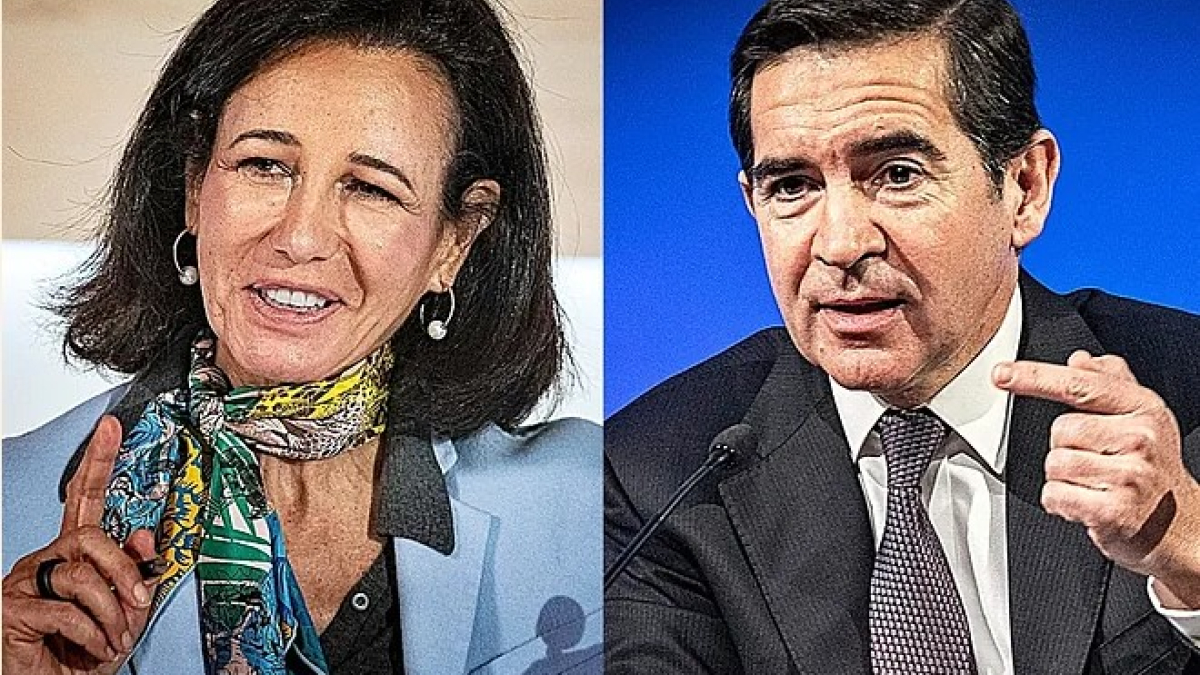
Banco Santander and BBVA have moved to limit their exposure to artificial intelligence financing as investors scrutinise the role global banks play in funding the data centres underpinning the AI boom. Santander says its exposure is below 1% of its total balance sheet, while BBVA says it lends almost exclusively to hyperscalers, the largest AI firms considered to carry the lowest credit risk.
Banks worldwide are facing closer market scrutiny over their dealings with artificial intelligence companies. They are among the biggest financiers of the infrastructure behind the technology and of the data centres that support it, a commitment that runs into the billions. Investors are concerned about a potential collapse that could put the sector at risk.
All of the major lenders are under watch, but the focus falls hardest on those with a strong presence in the United States and significant investment banking activity. Santander and BBVA meet both criteria and have not escaped attention. Analysts have begun questioning the two banks and digging into their figures to establish their real exposure.
Santander's reassurance
Both lenders have played down any risk of impact. Santander's chief executive, Hector Grisi, told an investment banking gathering there was nothing to worry about.
According to the bank, its activity is limited to financing the construction and operation of data centres through project finance, a business it has worked in for years without major losses. Santander was ranked first in the world last year by Infralogic, the Dealogic-owned analysis firm considered the leading authority in the sector, both as a lender and as an adviser on financing deals.
Grisi said that experience now gives the bank an edge in AI data centres, describing it as something Santander knows how to do very well. He said the bank had identified the biggest risk as financing data centres that cannot be completed because of a lack of access to energy, and said Santander was being very cautious to ensure every data-centre operation it backs has the necessary energy supply secured.
Grisi also pointed to the bank's choice of borrowers as a safeguard, saying Santander only works with the strongest clients and the highest credit profiles. He said the bank understood the market's concern but had everything under control.
BBVA's high credit quality
BBVA's argument is almost identical. Its chief executive, Onur Genc, said that 95% of the bank's AI-related financing has gone to hyperscalers with high credit ratings, structured as project finance, an area where BBVA also has a long track record.
Genc said it was an environment that required close attention, but that the bank believed its risks were well controlled.
BBVA has chosen not to disclose its specific exposure to AI data centres and infrastructure. The analysis firm CreditSights has examined the available figures and concluded that the large European banks are out of danger.
CreditSights said the doubts raised about the sustainability of AI investment weigh more heavily on the stock and debt valuations of AI companies themselves, because of investor saturation and the sector's huge capital needs, than on the banks financing it. It said lending to the sector remains low as a share of total loan portfolios, even for the large banks that have been very active as underwriters of AI financing.
A minor role, says the ECB
The European Central Bank reached a similar conclusion. In its latest report on the subject, the ECB said the most significant banks in the eurozone play a relatively minor role in providing direct financing along the AI supply chain.
According to the ECB's data, eurozone banks have an exposure of 62 billion euros, equivalent to 1.2% of their total corporate loan portfolio. That figure covers all companies associated with artificial intelligence, from data centres to semiconductors to software developers.
CreditSights said the one remaining problem is a lack of transparency, since banks are not required to publish figures broken down by sector, meaning some financing could go unreported. The only numbers available are those banks choose to disclose themselves, as Santander has done.
Other lenders have also published their own figures. Deutsche Bank puts its data centre risk at 1.5% of its portfolio, Societe Generale at 1.1% when including everything linked to AI, Credit Agricole at 0.4% and Barclays at 1.6%.
Test yourself
What percentage of its balance sheet does Santander say is exposed to AI financing?
What share of BBVA's AI-related financing went to highly rated hyperscalers?
According to the ECB, how much AI exposure do eurozone banks have in total?
Have your say
Are you concerned about banks' exposure to AI data centre financing?


