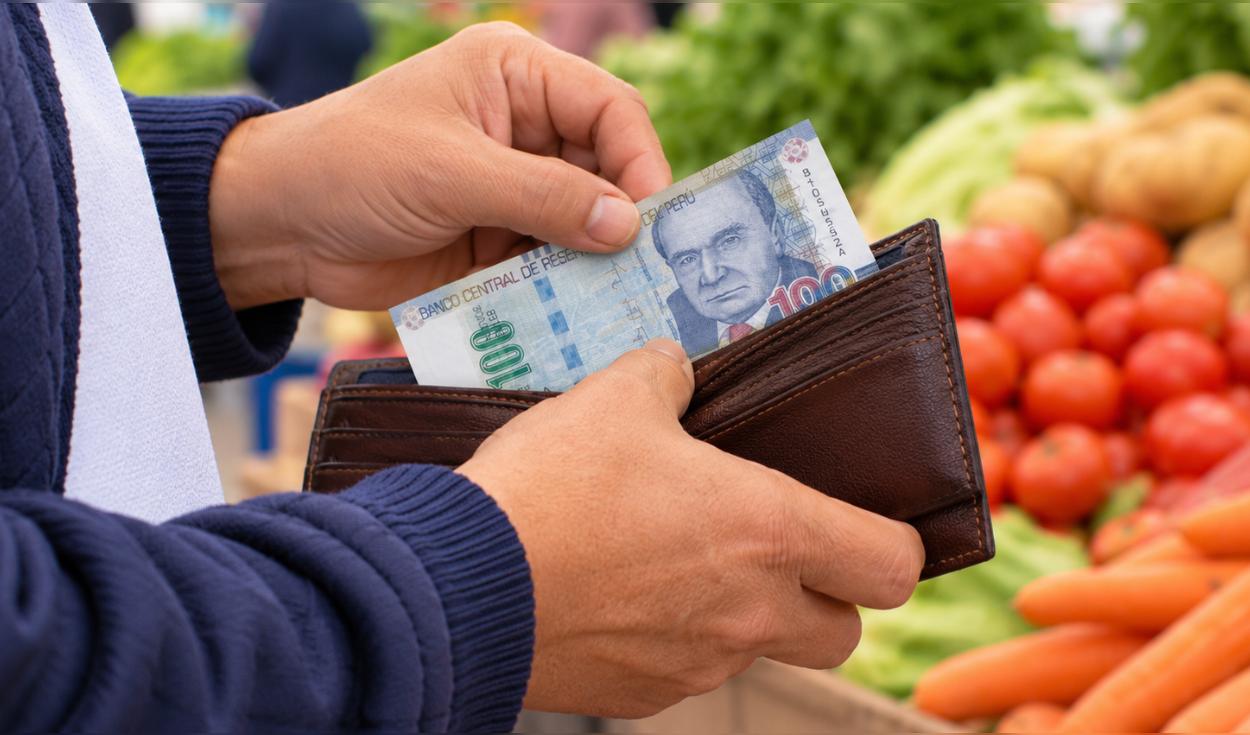
Peru's monthly minimum wage, which rose by S/100 to S/1,230 in October, falls S/618 short of covering the basic consumption basket that the National Institute of Statistics and Informatics (INEI) calculates for a family of four, according to the agency's figures. INEI valued that household basket at S/1,848 for 2025.
The INEI basket covers food along with other goods and services a household needs. The S/1,230 figure is also a gross wage, so workers take home less once pension contributions are deducted.
Fernando Cuadros, an economist and former deputy minister for employment promotion, told the newspaper La República that the government's increase has been insufficient to offset the rising cost of living. He said lower income workers are losing purchasing power and criticised the government for delaying the second stage of the wage increase.
"There is an effect on workers' purchasing power, especially those who earn the least, those who earn the minimum, and the S/100 increase has been insufficient," he said.
Price differences across Lima markets
A visit by La República to the Caquetá market in Lima found notable differences from citywide averages. Chicken sold for S/8 a kilo, below the S/9.89 average the Ministry of Agrarian Development and Irrigation (MIDAGRI) reported for Lima's retail markets between November 5 and 11. Eggs cost S/6.50 against a S/6.86 average, lemons S/3.50 against S/4.83, and yellow potatoes S/6 against S/7.59.
Other products at Caquetá cost more than the Lima average. Rice sold for S/4.50 a kilo, compared with MIDAGRI's S/3.69 for superior-grade rice, while onions cost S/4.80 against S/4.60 for red onions in the official report.
October's sharpest price swings
INEI data show some foods moved sharply in October. Carrots rose 24.56% in metropolitan Lima compared with September, and green peas rose 24.31%. Yellow potatoes climbed 13.54%. Tomatoes fell 6.80% and chicken eggs fell 5.34%, showing that not every item in the basket moved in the same direction.
The market visit also recorded prices for other household staples. Beef for stew cost S/35 a kilo and dorado fillet S/40. Among pantry goods, lentils cost S/6.30 a kilo, wheat S/5.90, sugar S/4, and a litre of oil S/6. Apples reached S/13 a kilo, oranges for juice S/2.80, and five island bananas cost S/3.50.
Second wage increase on hold
The wage adjustment was announced in two stages. The second increase, of S/70, is still pending and would bring the minimum wage to S/1,300. The government has said it will evaluate applying it once it knows the impact of the El Niño weather phenomenon.
Cuadros said waiting until 2027 to complete the adjustment is a mistake, since workers are already losing purchasing power. By his estimate, had the inflation and productivity criteria discussed in the National Labour Council been applied since the end of 2007, the minimum wage should exceed S/1,450 by January 2027.
He said there is a backlog in the minimum wage and that the government should bring forward the pending S/70 increase, which would still only take the minimum to S/1,300, below where it should stand and well below the family basic basket. He proposed advancing the second tranche and considering a larger adjustment that accounts for the accumulated loss of purchasing power from rising food and transport costs.
El Niño threatens lemon, onion and mango prices
Adding to the pressure on incomes is the risk of lower farm output from the El Niño phenomenon. Cuadros warned that flooding on the north coast could damage crop fields, reduce the food supply and hurt the incomes of those working in agriculture.
He named lemon and mango among the exposed products, since their production is concentrated in northern Peru. Lower supply could also raise costs for businesses that use these foods as inputs, such as restaurants.
In the south, the risk comes from a lack of rain and drought that could affect crop and livestock production, with onions and garlic among the products that could be hit if output falls.
"Lemon, for example, is produced in the north, and it can rise in price. In the south, if there's drought, the price of onion and garlic can be affected by the shortage," he said.
Cuadros said the effects could also reach employment, since damage to roads and disruptions to transport would hurt agriculture, tourism, fishing and related services, with consequences for small producers and informal workers.