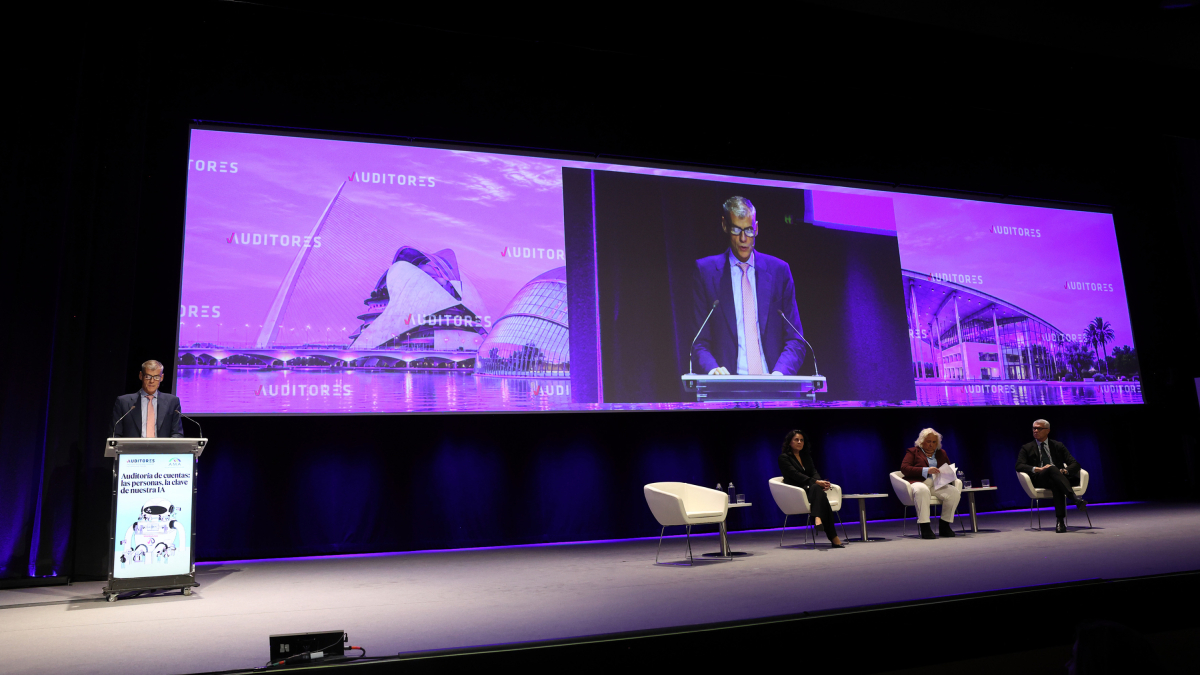
The Institute of Chartered Auditors of Spain (ICJCE) has called on account auditing to take on a "decisive" role in supervising the risks posed by artificial intelligence in business, as the technology spreads rapidly across companies of all sizes.
The institute made the case during the opening of its 27th National Auditing Congress and 35th Arco Mediterraneo Auditing Congress, held in Valencia. At the event, it also unveiled a guide of good practices aimed at small and medium-sized audit firms to help them use artificial intelligence responsibly.
Ten recommendations for auditors
The guide sets out ten recommendations for integrating AI tools into daily audit work. Among them, the institute stresses that an auditor's professional judgment and skepticism cannot be delegated to technology, that the confidentiality of information must be guaranteed, and that any significant result generated by AI must undergo "critical" verification.
The document also calls for evaluating the risks of AI used by the companies being audited themselves, including its impact on internal processes, controls and the reliability of information. According to the ICJCE, the technology can make tasks easier but does not replace professional judgment, the gathering of evidence, or the auditor's responsibility.
Victor Alio, president of the ICJCE, said the ten-point guide was designed so that no firm would act blindly and so that technology would always serve what the profession is and will continue to be: a guarantor of public trust. He added that the organisation must stay tied to its standards, its professional careers and its training and advisory needs.
Few companies have AI policies in place
The auditing body highlighted a lack of control over AI tools across the business world. According to a study by OpenAI, around 40% of small and medium-sized enterprises have no internal policies to regulate AI use, even though adoption of the technology is advancing quickly. Separately, Spain's National Statistics Institute (INE) found that 34% of Spanish companies with ten or more employees used AI in the first quarter of 2026, a rise of 12 percentage points on 2025.
The shift is also being felt within the auditing profession itself. A report backed by the Institute of Accounting and Auditing (ICAC) and the Spanish Association of University Accounting Professors (ASEPUC) found that 62% of auditors use AI tools in their daily work, though only 27% of firms have a defined, comprehensive strategy for doing so. The same study found that adoption among small and medium-sized firms is "much more limited" than at large firms.
Five reforms for the next government
The ICJCE, which represents around 90% of the sector's billing in Spain, used the congress to set out five reforms it considers priorities for the future of the auditing profession.
Chief among them is the creation of an independent supervisor for the sector. The institute wants the ICAC, which currently sits under the Ministry of Economy, to be granted "organic and functional" autonomy, following a model similar to that of the National Securities Market Commission (CNMV) or the National Commission on Markets and Competition (CNMC). Santiago Duran, the ICAC's own president, has also backed this proposal.
The institute is also calling for a review of the administrative burdens placed on auditors and for new obligations that would hinder their work to be avoided.
Sustainability reporting and other demands
Another priority is the approval of a "clear and consistent" regulatory framework for sustainability information. Spain has not yet transposed the EU's Corporate Sustainability Reporting Directive (CSRD) and has until 19 March 2027 to transpose Directive (EU) 2026/470, which reformed the earlier European rules.
The ICJCE believes auditors must keep a central role in verifying this information and warns that reducing the number of companies required to submit it for review could "weaken the system" that guards against greenwashing.
The institute's remaining demands include official recognition for the role of accounting expert in Spain, which still lacks specific regulation, and the development of a regulatory framework that allows the profession to make use of the opportunities AI offers.
Alio said that if Spain's politicians decide at some point to pursue mutual understanding, account auditing is an asset on which future agreements could be built. He pointed to what he described as constructive collaboration already under way between the ICAC, professional corporations, the Spanish Accounting and Business Administration Association (AECA), universities, the CNMV and other players in the auditing sector. He said the profession needs to make the most of this climate to make progress on these long-pending issues.