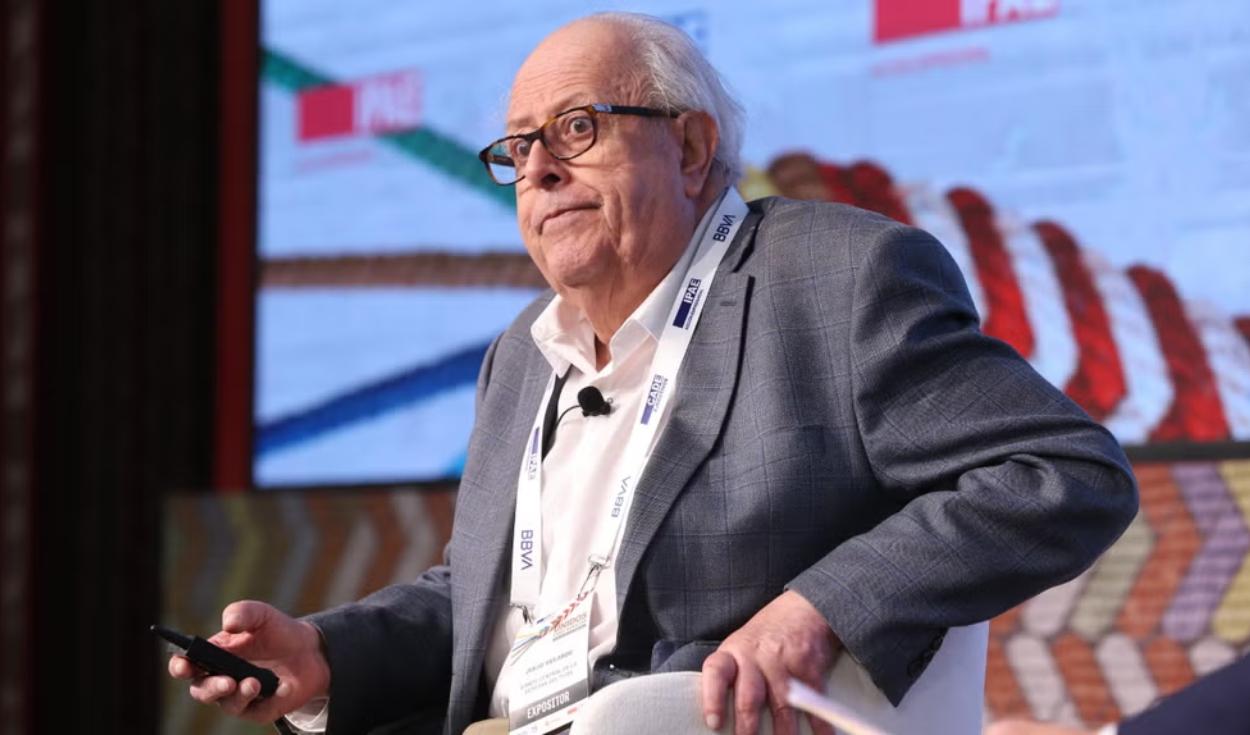
Central Reserve Bank of Peru President Julio Velarde said the political left no longer frightens anyone in the country, pointing to growing economic stability.
Speaking as the keynote presenter at the CADE 2026 business conference, Velarde told executives that Peru now enjoys greater political steadiness than in earlier years. He stated that he sees a stronger perspective for improvement rather than deterioration across the national economy.

Velarde remarked that during meetings abroad with foreign investors, he was repeatedly surprised that delegates still asked whether the government would survive. He argued that removing a sitting head of state is highly improbable under present conditions.
The central bank chief observed that during his leadership of the monetary authority, he has seen 11 presidents and more than 30 economy ministers pass through office. He stressed that this intense institutional volatility had previously dealt severe blows to economic growth.
Regional Politics and Economic Outlook
Velarde compared political dynamics in Peru with broader regional developments across South America. He noted that in Uruguay, left-wing politics does not produce fear among market participants or the public.
He explained that conversations with Brazilian business leaders following the election of President Luiz Inacio Lula da Silva revealed a similar absence of alarm. While acknowledging that certain left-leaning candidates in Peru had previously alarmed investors during past elections, Velarde maintained that the political left in Peru no longer frightens anyone.
Velarde has served as president of the Central Reserve Bank of Peru since 2006. Over two decades, international investors have viewed him as a cornerstone of macroeconomic credibility, maintaining currency stability for the Peruvian sol through repeated political crises. The annual CADE conference, organized by IPAE Accion Empresarial, serves as Peru's primary forum where corporate leaders and public officials debate economic policy.
Inflation Drivers and Monetary Strategy
Addressing inflation, the central bank governor explained that recent consumer price increases stem predominantly from supply bottlenecks rather than excessive consumer demand. He noted that demand-driven inflation has consistently remained below 2 percent, even as household spending stays resilient.
Velarde detailed how global geopolitical friction disrupted local markets, pointing out that an 8 February attack on Iran caused immediate turbulence in international fuel prices. That energy shock pushed Peru's inflation rate to 2.4 percent in March.
Agricultural disruptions reemerged in October as the El Niño weather phenomenon drove up food prices. Velarde noted that unusual wind patterns caused the price of corn to jump by 50 percent during the month.
The central bank is focusing its strategy on preventing these temporary supply shocks from contaminating the wider structure of consumer prices. Velarde warned that raising the benchmark interest rate to 100 percent would not reduce global crude oil prices or resolve agricultural shortages, but would instead plunge the country into a severe domestic recession.
Private Investment and Climate Risks
Turning to macroeconomic activity, Velarde highlighted a solid rebound in capital spending. Private investment expanded by 10 percent, recording its fastest growth rate since 2013, with the sole exception of the post-pandemic rebound in 2021. In addition, revenue from the IGV general sales tax climbed 17.2 percent in October.
However, environmental hazards remain a major challenge for the Andean nation. Velarde warned that the ocean temperature rise caused by the current El Niño phenomenon is the highest recorded in scientific measurements dating back to 1800, which will maintain intense upward pressure on domestic food costs.
El Niño periodically warms equatorial Pacific ocean waters, altering weather patterns and hitting Peruvian agriculture and coastal fisheries. The Central Reserve Bank of Peru operates an inflation-targeting framework that seeks to anchor inflation expectations when such supply disturbances occur.
Credit Ratings and State Inefficiency
Velarde also sounded a warning regarding sovereign credit assessments, pointing to a trend among international rating agencies toward downgrading Peru's credit rating. He stressed that the country must vigorously protect its investment-grade status, which keeps external borrowing costs low for the government and private corporations.
He underlined that Peru retains strong macroeconomic buffers that distinguish it from troubled peers. National public debt remains low at approximately 27 percent of gross domestic product, while central bank international reserves are on track to surpass 100 billion dollars this year.
Looking at long-term fiscal policy, Velarde urged authorities to channel export windfalls generated by favorable terms of trade into healthcare, education, and human capital development. Peru benefits significantly from high global copper and mineral prices, which bolster treasury receipts and export earnings.
Despite these favorable conditions, Velarde closed with a sharp critique of government execution, arguing that public administration continues to squander national potential. He stated that state management in Peru is not merely bad, but appalling.
Test yourself
By how much did private investment grow in Peru according to Central Bank data?
What factor did Velarde identify as driving a 50 percent surge in corn prices in October?
Where does Peru's public debt stand as a share of gross domestic product?
Have your say
Where should Peru prioritize spending its revenue from favorable trade terms?