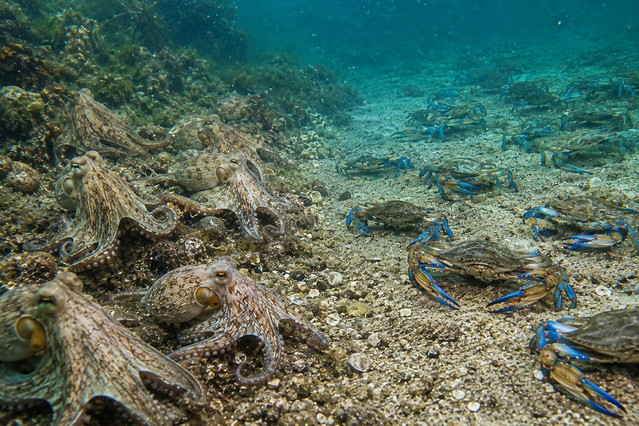
Researchers at the University of Bologna in Italy have released about 130,000 young octopuses into the Adriatic Sea to combat invasive blue crabs. The experimental initiative aims to protect vulnerable shellfish farms and marine fisheries along the northern Italian coast.
The project, named Octo-Blu, is being carried out in collaboration with the regional authorities of Emilia-Romagna. Scientists are relying on the natural predatory instincts of the octopus to curb the rapidly expanding crab population.
Releases of the young octopuses took place during the summer off the coast of Cesenatico and Riccione. Both coastal areas in the Emilia-Romagna region have suffered severe ecological and economic pressure from the spread of the blue crab.
Larval breeding and seabed shelters
The released octopuses are in the earliest stages of their life cycle. Measuring just a few millimeters in length, these newly hatched larvae were placed directly into coastal waters to mature within their natural habitat.
The research team began work on the project in 2024 by raising young octopuses in controlled laboratory environments. After analyzing the survival requirements and growth patterns of the species, scientists progressed to large-scale sea releases.
To improve survival rates, researchers placed artificial shelters on the seabed. These structures provide protection for the tiny larvae during their most vulnerable developmental phase.
The scientific concept relies on the feeding behavior of the common octopus, which regularly preys on crustaceans. Under optimal conditions, a single adult octopus weighing around one kilogram can eat up to four medium-sized blue crabs in a single day.
Boosting a native predator
Scientists behind the trial stress that they are not introducing a foreign organism into the marine environment. Instead, the team is working to bolster an indigenous predator already present in Mediterranean waters.
Antonio Casalini, an aquaculture technical researcher at the University of Bologna, explained that the team is not introducing a new species. He said researchers are working to reinforce the population of a native species that already lives naturally in the Adriatic Sea.
The University of Bologna, founded in 1088, is the oldest university in the Western world and maintains extensive marine research facilities along the Adriatic coastline. The surrounding waters of the Emilia-Romagna region host major shellfish farming beds, particularly for mussels and clams.
Devastating losses for Italian fisheries
The blue crab is native to the eastern coast of the United States, where it forms a commercially valuable fishery. However, the species has become a destructive force in the Mediterranean Sea since its population exploded over the past decade, after first appearing in the region during the last century.
In Italian coastal waters, the invasive crabs tear open fishing nets and devour clams and mussels. These aggressive feeding habits directly threaten businesses dependent on shellfish harvesting.
Reports indicate that hundreds of fishing enterprises along the Italian coast have been forced to suspend operations due to crab damage. Total losses across the sector are estimated in the tens of millions of euros, prompting the Italian government to allocate significant funding toward control measures.
High mortality rates and future outlook
Despite releasing 130,000 octopuses, researchers remain cautious about the expected outcome. The primary challenge is the extreme mortality rate during early development, where larval deaths can reach up to 99.9 percent, leaving only a tiny fraction to reach adulthood.
Gianluca Sarà, a marine ecologist at the University of Palermo who is not involved in the Octo-Blu project, described the initiative as strong and excellent. However, he warned that its actual effect on the ecosystem could ultimately turn out to be completely negligible.
The University of Palermo, located in Sicily, conducts ecological research across the central Mediterranean. Experts generally agree that eradicating the blue crab from the Adriatic is nearly impossible.
Scientists aim instead to reduce blue crab numbers to a level where ecological and financial damage is contained. The octopus releases represent one component of a broader management strategy that also includes intensified commercial fishing of the invasive crab.