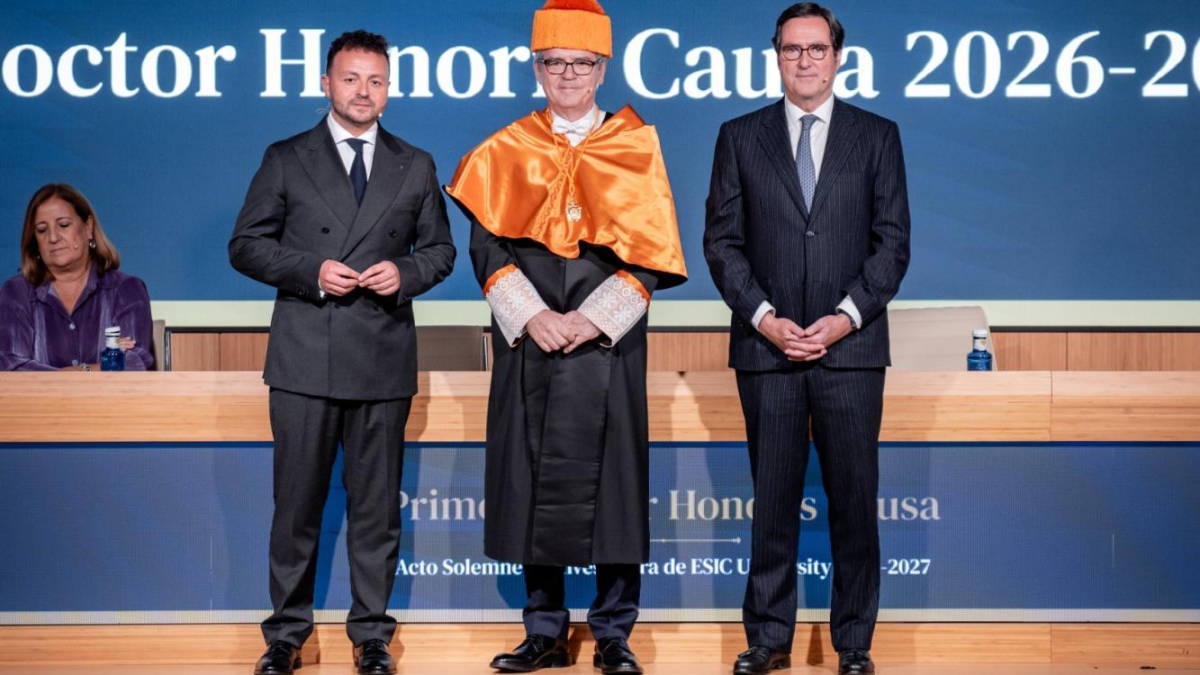
Pablo Isla, chairman of Nestlé and vice-chairman of L'Oréal, was inducted as the first honorary doctor in the history of Esic University. Isla said he was deeply moved and felt honoured by the distinction.
Isla taught at Esic earlier in his career, and his family has long ties to the institution: his father, José María Isla, and his brother, Enrique Isla, were also closely linked to the university.
In his address, Isla said he firmly believes in a set of values: humility, ambition and purpose. He said every business project needs a purpose, and that while companies must be profitable, making money can never be their objective. He added that success is impossible without ambition, a trait he said characterises many company founders through their constant drive to improve. He said humility is equally essential, warning that the decline of any company begins the moment it loses its humility. Isla wove references to Don Quixote into his speech alongside the principles he believes should guide any professional or company.
Antonio Garamendi, president of the CEOE, Spain's main business confederation, acted as Isla's sponsor at the investiture and delivered a tribute. Garamendi said Isla is one of the most brilliant figures Spanish business has produced in recent decades, and someone people look to as an example.
A career across public and private sectors
Garamendi noted that Isla passed Spain's state lawyer examination ranked first in his class, with a score he said has not been matched in the 40 years since. He also highlighted Isla's roles across public administration and private companies including Banco Popular and Altadis, as well as Inditex, where he served first as vice-chairman and chief executive and later as executive chairman. Isla is now chairman of Nestlé and vice-chairman of L'Oréal.
Garamendi said Isla has operated successfully across different and complex fields, standing out in each for his judgment, and pointed to his time leading Inditex as the clearest example. He said sustaining a company's transformation after it has already achieved success requires not only talent but humility, and that while success can be measured, building a career trajectory like Isla's requires coherence, credibility and trust.
Principles of success, according to Pablo Isla
Isla set out a series of principles he considers central to business success:
- Entrepreneurial culture: he said building an entrepreneurial culture is essential, especially in large companies, meaning giving people real responsibility and ensuring they can genuinely make decisions and put forward innovative proposals.
- Staying focused: he said what a company decides not to do can be as important as what it decides to do, warning against trying to cover everything and falling into unnecessary distractions.
- Cutting bureaucracy: he described bureaucracy as an enemy of initiative and entrepreneurship, saying many companies fall into endless rounds of presentations that serve no purpose, when that energy should be saved for competing in the market.
- Short-term focus with long-term vision: he said strategy and execution must be combined, pairing a long-term vision with a clear focus on execution.
- Developing people: he said leaders must be demanding but also help teams grow professionally, describing the company as a shared project, and said a degree of internal competition is healthy only when it serves that common project.
- Transparency and honesty: he said problems should not be hidden but addressed and resolved, in companies and in life.
- Avoiding complacency: he warned that companies cannot live on past achievements, since improving is the only way to stay competitive, noting that many firms once among the most highly valued lost that status by becoming complacent. He said assuming success is guaranteed is a mortal danger.
- An agile, flexible culture: he said tradition and inertia should not be preserved once they have lost their purpose, and that agility and flexibility are especially important in a world shaped by uncertainty over artificial intelligence and a geopolitical environment he expects to persist for years, calling the management of uncertainty a key to business success.
- Ethical behaviour: he described it as a defining trait of good leadership, exercised first at a personal level, then organisationally, and finally in relationships with customers, shareholders and suppliers.
- A culture of effort: he linked this to individual responsibility and everyone giving their best.
Isla concluded by saying all of these principles come together around the two pillars of business success: people and culture.
Test yourself
What honor did Pablo Isla receive from Esic University?
Who sponsored Isla at his investiture ceremony?
According to Garamendi, how did Isla perform in Spain's state lawyer exam?
Have your say
Which of Pablo Isla's principles do you think matters most for business success?
Where it happened
Madrid, Spain