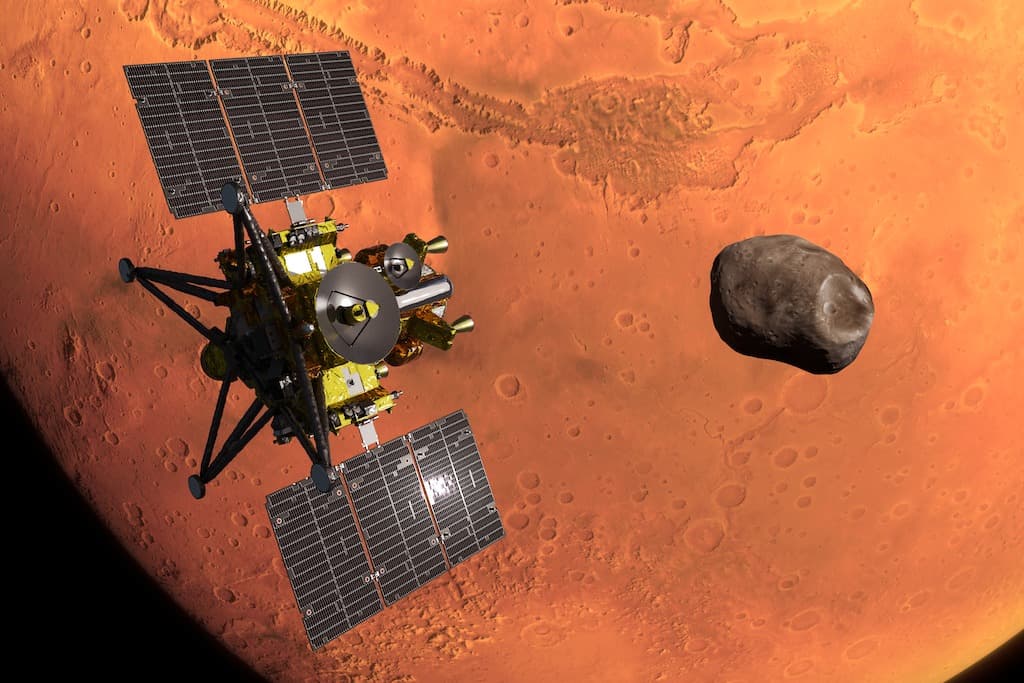
The Japan Aerospace Exploration Agency is preparing to launch its Martian Moons eXploration mission to land a rover on Phobos and return soil samples to Earth. The robotic probe will attempt the first retrieval of material from the Martian system, bringing more than 10 grams of surface regolith back to South Australia in 2031.
Under the current plan, the Martian Moons eXploration (MMX) spacecraft will launch aboard an H3 rocket in 2026, with an October launch window under consideration. The probe is scheduled to reach Mars in 2027, spend roughly three years conducting science operations around the planet's moons, and depart the Martian system in 2030.
JAXA, Japan's national space agency, previously demonstrated asteroid sample-return capability with its Hayabusa missions. Phobos is the larger and innermost of the two natural satellites orbiting Mars, measuring approximately 27 by 22 by 18 kilometres with an irregular shape.
Navigating Low Gravity Around Phobos
Operating around Phobos presents severe navigational challenges due to its extremely weak gravitational field. The surface gravity of Phobos is approximately 0.0057 metres per second squared, which is nearly 1,700 times weaker than Earth's gravity, and the escape velocity is only about 11 metres per second.
Despite the weak gravity, spacecraft and rovers retain their full mass and momentum. A minor steering error could propel the probe far across the moon, wheels can spin without gaining traction, and returning to the surface after a bounce requires a lengthy delay. Phobos completes a full orbit around Mars in just 7 hours and 39 minutes.
To remain close to the fast-moving moon, the MMX spacecraft will enter quasi-satellite orbits. While physically remaining within the gravitational pull of Mars, the probe will match positions with Phobos while navigating the complex combined gravitational forces exerted by both the planet and its moon.
Deploying the IDEFIX Surface Rover
The mission will perform surface exploration as a direct component of its landing sequence rather than through prior orbital survey. MMX carries 11 scientific instruments to measure the shape, gravitational field, topography, surface temperature, and chemical composition of Phobos.
Among these tools, the MIRS infrared spectrometer will search for water-altered minerals, hydrous compounds, and organic materials. Onboard cameras, a laser altimeter, and the MEGANE gamma-neutron instrument will assist engineers in identifying a safe site for both the rover and main spacecraft to operate.
The initial surface touchdown will be made by IDEFIX, a 25-kilogram rover developed by France's CNES (National Centre for Space Studies) and Germany's DLR (German Aerospace Center). The rover will be dropped from a height of several dozen metres without using a tethering system.
Because contact with the surface could cause IDEFIX to bounce or flip over, it is equipped with a self-righting mechanism to stand itself upright on its wheels. IDEFIX is built to operate for 100 days, traveling across the terrain at a speed of only a few millimetres per second while taking images of the surface and wheel tracks, measuring thermal and radiation properties with miniRAD, and analyzing nearby minerals using the RAX spectrometer.
Dual Sampling Systems for Regolith Retrieval
The primary MMX spacecraft will undertake a brief touchdown phase on Phobos, arriving on the surface at local sunrise and lifting off approximately 2.5 hours later before nightfall. Engineers have allocated roughly 90 minutes of this touchdown window strictly for collecting surface samples.
To maximize the chance of success in an unfamiliar surface environment, MMX carries two distinct sampling devices. The C-Sampler, mounted on a 1.5-metre robotic arm, will drive a drill tube more than 2 centimetres into the surface soil. The pneumatic P-Sampler, created in collaboration with NASA and Honeybee Robotics, will release a short burst of compressed gas to blast loose surface particles directly into a collection container.
Dual sampling mechanisms are necessary because the physical properties of Phobos regolith cannot be fully predicted in advance. Furthermore, standard mechanical drilling under microgravity conditions can prove difficult without strong downward friction.
Unlocking the Origin of Martian Moons
Laboratory analysis of the returned material will help scientists determine how Phobos formed. Its dark surface and spectral features resemble carbonaceous asteroids, supporting theories that Mars captured a passing space rock. However, its nearly circular equatorial orbit points toward an alternative theory that Phobos coalesced from planetary debris flung into space by a massive impact on Mars.
In addition to native moon soil, the samples could contain fragments of Mars ejected by past asteroid impacts. On the side of Phobos that permanently faces Mars, the container may also trap traces of oxygen, carbon, nitrogen, and argon ions stripped from the upper atmosphere of Mars over billions of years.
While the mission is not expected to find signs of alien life because organic molecules can form without biological processes, the collected material offers significant insight into cratering history and atmospheric leakage. Upon landing in South Australia, the sealed capsule will be transferred to JAXA's curation center for controlled opening and distribution to international research laboratories.