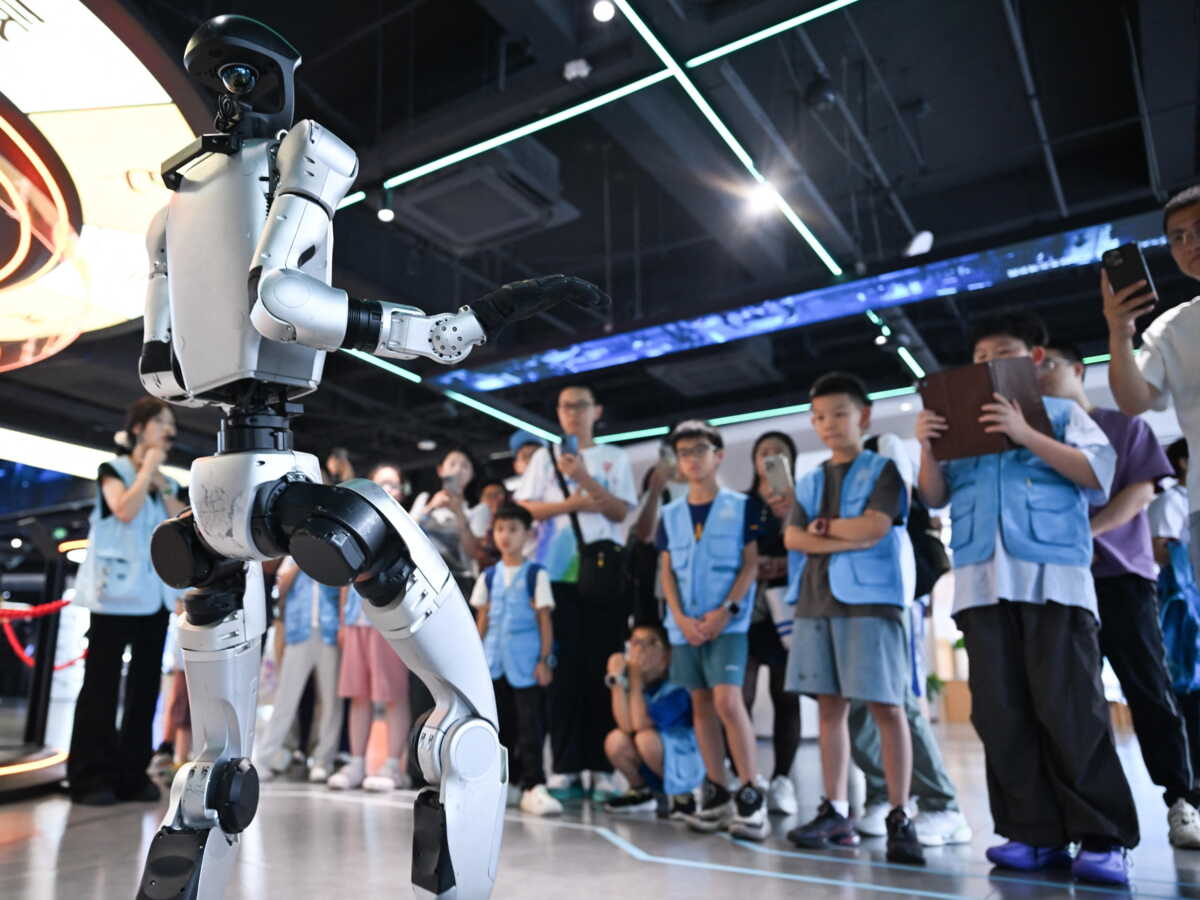
HSBC Asset Management has launched a new exchange-traded fund dedicated to Chinese robotics companies, giving stock market investors a fresh way to bet on one of the fastest-growing segments of global industry.
The HSBC MSCI China Robotics UCITS ETF is listed on Euronext Paris, the main Paris stock exchange, as well as on other European exchanges. It is designed to let investors put money into companies working on the development of robotics and related technologies in China.

The fund is one of several products now competing for investors interested in robotics. Fund managers such as La Financiere de l'Echiquier (LFDE) already offer mutual funds built around the same theme, including one called Echiquier Robots and Humanoids. The HSBC product gives stock investors a listed alternative to that kind of mutual fund.
What the fund tracks
The ETF aims to replicate the performance of the MSCI China All Shares IMI Robotics Select index, which covers companies involved in industrial, non-industrial, autonomous and humanoid robotics. MSCI is one of the world's largest index providers, and its benchmarks are widely used by fund managers to build passive investment products.
The index also gives exposure to the technologies and components that support the rollout of robotics across manufacturing, logistics, healthcare, agriculture and autonomous systems. To qualify, a company must generate at least 50% of its total revenue from robotics-related activities. Manufacturers, equipment suppliers and software developers that support the sector are especially well represented among the holdings.
A fast-growing global market
Christophe Pouchoy, who manages the Echiquier Robots and Humanoids fund at LFDE, said the automated factory of the future already exists, pointing to more than 4.5 million industrial robots now in use worldwide and 540,000 new robots installed in 2024 alone. He said robotics acts as a productivity tool that also offsets the decline in the global workforce, and is transforming sectors ranging from logistics to agriculture.
Pouchoy said the medical robotics market, built up by pioneers such as Intuitive, Stryker and Thermo Fisher, is expected to reach $138.5 billion by 2034. He said the market for autonomous vehicles, including robot-taxis, is estimated at more than $2 trillion by 2040.
Humanoid robots gaining ground
Humanoid robots are expected to number one million worldwide by 2030 and three billion by 2060, according to a report by Bank of America cited by Pouchoy.
Pouchoy said humanoid robots represent a revolution comparable to the arrival of the automobile and have already made their mark on stock markets. He said their growth is one of the key drivers of the wider robotics industry, which is being pushed forward by increasingly powerful artificial intelligence models, batteries and sensors.
China's robotics champions
China has made humanoid robotics a national priority and is home to a growing number of specialist firms, including UBTech Robotics, Agibot, Xiaomi, BYD and Unitree Robotics, a maker of humanoid and quadruped robots that has drawn attention for its public demonstrations.
The new ETF gives investors a way to gain exposure to this group of companies and the wider Chinese robotics supply chain through a single listed fund, rather than buying shares in individual firms directly. As a UCITS fund, it is regulated under European Union rules that allow it to be sold to retail investors across the bloc.
Test yourself
Which exchange, besides other European markets, lists the new HSBC MSCI China Robotics UCITS ETF?
What minimum share of revenue must a company earn from robotics to be included in the index the ETF tracks?
According to the Bank of America report cited in the article, how many humanoid robots are expected worldwide by 2060?
Have your say
Would you consider investing in an ETF focused on Chinese robotics companies?
Where it happened
Paris, France