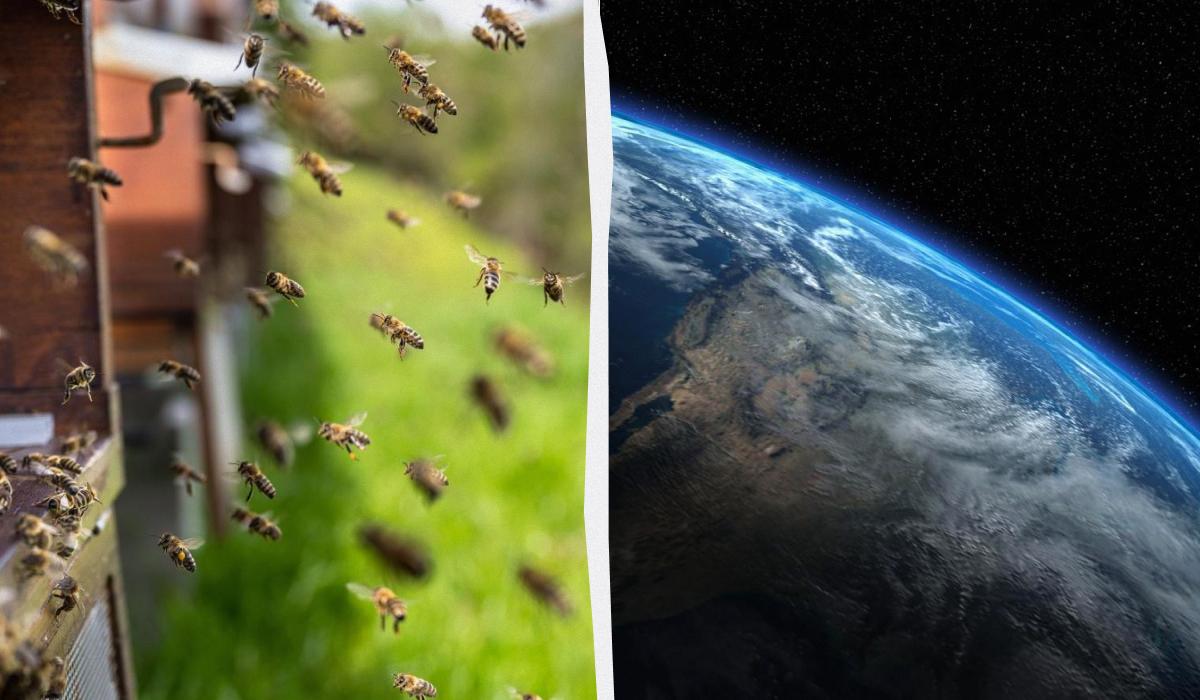
NASA sent 3,300 honeybees into orbit aboard Space Shuttle Challenger from Kennedy Space Center on April 6, 1984, to test honeycomb construction in zero gravity.
The space shuttle landed on April 13, 1984, after a seven-day flight during which the bee colony built roughly 200 square centimeters of normal honeycomb and the queen laid 35 eggs.
The bee colony was not the main payload of the STS-41-C flight. Official NASA mission reports state that the shuttle's primary objectives were deploying a large scientific platform named the Long Duration Exposure Facility and repairing the malfunctioning Solar Maximum satellite.
Instead, the bees traveled as a student experiment inside a dedicated container called the Bee Enclosure Module. The enclosure was manufactured specifically for the flight by the Space and Strategic Avionics division of Honeywell, an American aerospace technology firm.
According to the Smithsonian Institution's National Air and Space Museum in Washington, D.C., the module measured approximately 46 by 12 by 48 centimeters and allowed researchers to monitor colony behavior throughout the flight. Honeywell later donated the module to the Smithsonian, and the same container design was reused in 1985 for a student experiment studying houseflies aboard shuttle mission STS-51-D.
Navigating microgravity without weight
On Earth, honeybees rely on gravity as a physical reference frame when constructing honeycombs. Worker bees typically orient the six-sided hexagonal cells downward toward the ground.
Gravity also serves as a critical landmark for communication within the hive. When a worker bee performs a waggle dance on the vertical surface of a comb to inform nestmates about a food source, the average orientation of its dance relative to gravity encodes the angle between the food source and the position of the Sun.
Removing gravity strips away this entire navigation and communication system. Secondary flight data indicated that about 3,300 bees were on board, though official NASA reports did not specify an exact starting count. When Challenger reached orbit, the lack of gravitational reference points caused initial disorientation as the insects attempted to fly and walk in straight lines.
NASA mission reports noted that the bees quickly adapted to weightlessness as the flight progressed. The insects were soon able to walk, fly, and hover inside their module without major difficulty, and mission video showed that they actually flew faster in microgravity than they usually do on Earth once adapted.
Honeycomb construction and survival rates
Despite the difficult start, the colony maintained operations throughout the flight. By the end of the mission, the bees had constructed about 200 square centimeters of comb, which preliminary analysis showed was normal and comparable to comb built on Earth.
The queen bee laid 35 eggs during the spaceflight, demonstrating that fundamental biological processes within the hive continued in zero gravity. Mission reports indicated that bee mortality during the flight was lower than expected, though an exact death count was not specified.
NASA renamed the flight from STS-13 to STS-41-C shortly before launch, a change reflected in how the mission is cited in scientific literature. A year after the flight, entomologist J. D. Vandenberg led a peer-reviewed study published in the journal Apidologie titled Survival, behavior, and comb construction by honey bees, Apis mellifera, in zero gravity aboard NASA shuttle mission STS-13.
Vandenberg reported that the honeybees adapted their behavior to zero gravity and remained capable of building combs with recognizable hexagonal cells.
Relevance for future deep space exploration
Later research into honeycomb orientation revealed that honeybees can build cells in vertical, horizontal, and intermediate orientations both in microgravity and in natural terrestrial conditions. This finding indicates that gravity is not the primary factor determining cell orientation, making the 1984 findings less surprising in retrospect, though no less significant at the time.
The 1984 experiment remains relevant as space agencies plan longer missions to the Moon and Mars, where growing food and maintaining plant pollinators will become practical necessities for space habitats. The Economic Times reported that the experiment's remarkable findings continue to inform ongoing research into space farming.
A 2025 review published in the journal Frontiers in Physiology, titled Insects in deep space: evaluating the impacts of microgravity on edible and model insect species for spaceflight food system, listed honeybees among insect species deserving further study for potential resilience and viability during long space missions.
While the 1984 Challenger flight did not resolve every question regarding insects in space, it demonstrated that core colony instincts to build and work together remain resilient even when the laws of gravity no longer apply.