

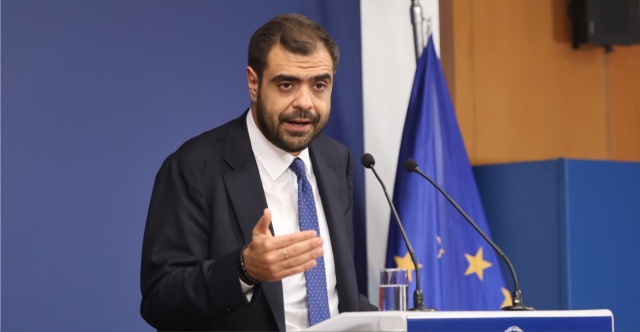
Greek government spokesperson Pavlos Marinakis has announced that parliament passed comprehensive legislation to regulate loan servicers and protect borrowers from aggressive debt enforcement.
The new framework introduces fines of up to 500,000 euros per borrower for debt management companies that break the law, while an approved amendment raises overall penalties to 5 million euros and caps restructuring interest rates at 3 percent for vulnerable debtors.
Speaking at a briefing for political correspondents, Marinakis said several key provisions in the Ministry of National Economy and Finance bill each received more than 200 votes in the 300-seat Hellenic Parliament. He added that the amendment establishing the 3 percent fixed rate and higher fines passed with 212 votes.
Marinakis said that by establishing stricter operational and supervisory rules for servicers, the government is creating a reinforced safety net to protect citizens, ensuring greater transparency, accountability and responsibility in debt management.
Loan servicers manage non-performing loan portfolios that commercial banks sold off following Greece's financial crisis, handling repayments and collateral on behalf of foreign investment funds. Borrowers and consumer groups have frequently complained about aggressive collection tactics, lack of clear information, and difficulties in reaching sustainable repayment plans.
Borrower protections and loan servicer rules
The legislation shields compliant borrowers from forced property executions and introduces an obligation for investment funds to submit a written, viable debt restructuring proposal three months before any auction can take place.
Under the new rules, interest accrual will be automatically suspended whenever a servicer takes longer than 45 days to provide detailed account information to a debtor. The law also establishes a ceiling on interest rates and mandates automatic recalculation of owed amounts without requiring borrowers to take legal action through the courts.
Servicing firms must now undergo an annual independent management audit covering all portfolios backed by Greek state guarantees. They are also required to cooperate formally with the Hellenic Financial Ombudsman to resolve debtor disputes and must publish their annual financial statements and complaints handling data each year.
In addition, lawmakers removed existing time limits on restructuring commercial business loans that carry guarantees from the Greek State or the Hellenic Development Bank Guarantee Fund for Small and Micro Enterprises, easing restructuring access for smaller firms.
Municipal funding package and energy aid
Marinakis also presented a package of six regular measures and two energy interventions to support local government, announced by PrimeME Kyriakos Mitsotakis in Kalamata at the annual regular conference of the Central Union of Municipalities of Greece.
Annual state funding for Greek municipalities has risen from roughly 1.8 billion euros in 2019 to 3 billion euros in 2026, marking an increase of 67 percent. Marinakis said the measures announced by Mitsotakis are designed for immediate implementation across the country.
The immediate measures include a 300 million euro transfer to town halls from the Hellenic Recycling Agency to finance local recycling projects, alongside 240 million euros released within November to settle overdue municipal utility bills owed to power companies.
Local authorities will also receive the option to raise the municipal stayover tax paid by visitors from 0.75 percent to 1 percent, providing town halls with a discretionary local revenue stream.
School repairs and urban infrastructure
The municipal package doubles annual state grants for school building maintenance and allocates 400 million euros over the next four years through the Marietta Giannakou programme, named after the late former education minister, to repair nearly 2,000 schools across Greece.
A further 200 million euros will be allocated annually over the next four years for road paving and roadworks in urban areas. This funding will come from a special municipal levy that can be activated once fuel markets stabilise.
To help councils manage electricity costs, the government allocated 50 million euros to purchase industrial batteries, enabling town halls to store and consume energy generated by local renewable installations. The state also agreed on a debt settlement of up to 60 million euros for remaining municipal power bills in cooperation with Public Power Corporation, Greece's primary electricity supplier, and opened talks to establish a dedicated municipal power tariff once market volatility calms.
Foreign worker permits and migration backlog
Turning to labour and immigration, Marinakis reported early gains from the government's legal migration framework, which took effect earlier in 2026 to address severe labour shortages across domestic industries including agriculture, tourism and construction.
Formal approvals for employer invitations to recruit foreign workers rose from 41,000 in the first nine months of 2025 to 68,000 during the same period in 2026, an increase of 27,000 permits. Authorities also expedited residency applications, checking 65,000 of the 85,000 pending renewal files that existed when the migration legislation passed in February.
Digital healthcare records and provider ratings
Marinakis concluded the briefing by presenting two digital healthcare platforms developed by the Ministry of Health for the National Organization for the Provision of Health Services, known as EOPYY, aimed at cutting bureaucracy and improving patient services.
The new myEOPYY mobile application gives citizens direct digital access to their personal Health Insurance Record, allowing them to monitor insurance coverage, doctor visits, hospital admissions, medical procedures, prescription drugs, and reimbursement claims. Insured users can also manage healthcare requests for dependent children and generate digital collection vouchers for expensive specialized medicines dispensed at state pharmacies.
Marinakis said that 4.6 million social security numbers, known in Greece as AMKA, have already been connected to the personal health record system, with 77 percent of all reimbursement requests over the past month submitted digitally.
Alongside the app, a new Healthcare Provider Evaluation System allows patients to rate the private doctors, diagnostic centres and clinics contracted by EOPYY. Health officials will use the patient ratings to track care quality indicators, identify operational deficiencies, and shape future healthcare reforms centered on patients.


