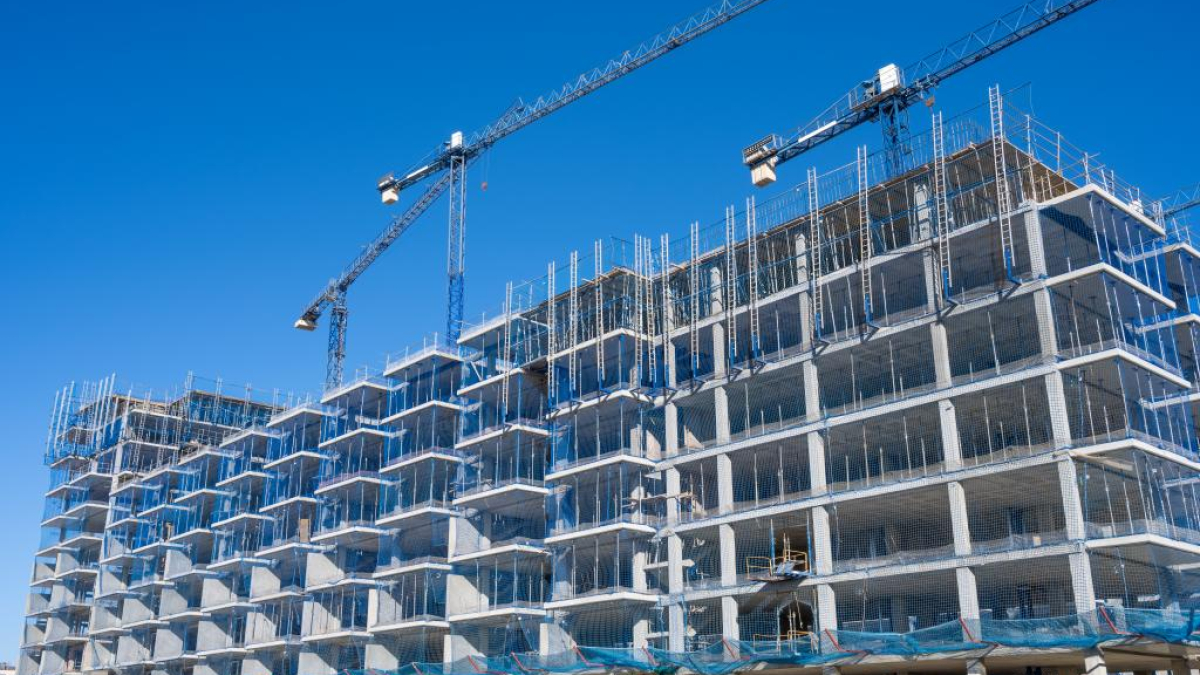
Spain needs an investment of 131,560 million euros, equivalent to 7.8% of the country's 2025 gross domestic product, to build 813,718 homes and close the gap between housing supply and demand, according to a new report from the Association of Real Estate Consultancies (ACI).
The association warned that delaying construction would make the problem far more expensive to fix. If the pace of building does not pick up, the bill could reach 207,167 million euros, 9.7% of GDP, to deliver 1.07 million homes by 2030, and balloon to 287,897 million euros, or 11.2% of projected GDP, for 1.3 million homes by 2035.
The findings come from the report "The Cost of Addressing Spain's Housing Deficit (2026-2035)," which examined the investment needed to close the gap between household formation and new housing output across Spain's 17 autonomous regions.
ACI said that acting quickly would reduce the average annual effort needed over 2026-2035 to below the roughly 1.1% of GDP that delay would require. In the short term, the association pointed to around 215,000 homes that already have planning permission or building certification but have not yet been delivered. If those homes reached the market quickly, the current deficit would fall to 598,785 units and the investment required would drop to 96,017 million euros, or 5.7% of GDP.
Where the shortfall is concentrated
The report found that the housing gap is heavily concentrated in a handful of regions. The Valencia region, Catalonia, Andalusia and Madrid together account for 67% of the total number of homes needed nationwide.
- Valencia region: 160,390 homes (19.7% of the deficit)
- Catalonia: 143,827 homes (17.7%)
- Andalusia: 125,322 homes (15.4%)
- Madrid: 117,699 homes (14.5%)
- Murcia: 41,526 homes (5.1%)
- Castilla-La Mancha: 38,308 homes (4.7%)
- Canary Islands: 36,302 homes (4.5%)
- Galicia: 32,323 homes (4%)
- Castile and León: 25,987 homes (3.2%)
- Aragón: 24,882 homes (3.1%)
- Basque Country: 19,185 homes (2.4%)
- Balearic Islands: 15,807 homes (1.9%)
- Extremadura: 7,708 homes (0.9%)
- Asturias: 7,560 homes (0.9%)
- Cantabria: 7,435 homes (0.9%)
- Navarre: 5,243 homes (0.6%)
- La Rioja: 4,214 homes (0.5%)
If the imbalance is not corrected, the Valencia region and Catalonia alone would account for around 574,000 homes of deficit by 2035, 44% of the national total, the report found.
Investment needed by region
The ranking changes when measured by investment required, reflecting how much land prices vary between regions. Catalonia has the greatest need, at 31,566 million euros, or 1.87% of GDP, followed by the Valencia region at 20,089 million euros (1.19%), Madrid at 19,994 million euros (1.18%) and Andalusia at 18,120 million euros (1.07%).
A second tier includes the Balearic Islands at 7,704 million euros (0.46% of GDP), the Canary Islands at 5,977 million euros (0.35%), Castilla-La Mancha at 4,714 million euros (0.28%), Galicia at 4,710 million euros (0.28%) and Murcia at 4,513 million euros (0.27%).
The Basque Country needs 3,352 million euros (0.20% of GDP), almost identical to Castile and León at 3,351 million euros (0.20%), followed by Aragón at 3,081 million euros (0.18%). The regions with the smallest investment needs are Cantabria at 1,264 million euros (0.07%), Asturias at 1,020 million euros (0.06%), Extremadura at 891 million euros (0.05%), Navarre at 717 million euros (0.04%) and La Rioja at 497 million euros (0.03%).
Why land costs drive the gap
ACI calculated the investment figures by adding the average cost of materials and construction work to land prices and other promotion costs, such as builder contracts, technical fees, and local and regional taxes including the Tax on Construction, Installations and Works and the Tax on Documented Legal Acts. The figures exclude VAT, financing costs and developer margins.
The average cost of building work alone comes to 89,500 euros per home, ACI said. But once land is included, which makes up around 32% of production costs on average, the figure rises to 131,000 euros, and adding the remaining costs pushes the minimum total to 161,700 euros, 23% higher.
Land costs vary sharply by region. In Madrid, land can account for as much as 43% of the total cost of a home. In Catalonia, the Basque Country and the Balearic Islands, it ranges between 35% and 40%, with the Balearic Islands the most expensive region to build in overall, at 487,352 euros per home. Land is cheapest in Castile and León, Castilla-La Mancha and Extremadura, where it makes up only 17% to 18% of costs.
Potential tax revenue
ACI also estimated the fiscal return that correcting the housing deficit would generate. It said the construction activity needed would raise 17,800 million euros in VAT, the Tax on Construction, Installations and Works, and the Tax on Documented Legal Acts. If that revenue were reinvested entirely in housing, it could fund around 110,000 additional homes, equivalent to 14% of the accumulated deficit.
Catalonia would generate the most tax revenue, at 4,365 million euros, equivalent to 12.6% of what it would cost to fix its own deficit. The Valencia region would follow with 2,756 million euros (12.5%), and Madrid with 2,480 million euros (11.3%). Andalusia would rank fourth, with 2,444 million euros, or 12.3% of its promotion cost. Further down the list are the Balearic Islands with 1,064 million euros (12.6%), the Canary Islands with 740 million euros (11.3%), Castilla-La Mancha with 678 million euros (13.1%), Galicia with 662 million euros (12.8%), Murcia with 640 million euros (13%), Castile and León with 479 million euros (13.1%), Aragón with 439 million euros (13%) and the Basque Country with 429 million euros (11.7%). Cantabria would raise 181 million euros (13.1%), Asturias 141 million euros (12.7%), Extremadura 128 million euros (13.1%), Navarre 96 million euros (12.2%) and La Rioja 68 million euros (12.5%).
Call for faster construction
ACI represents the interests of major real estate consultancies, including CBRE, Colliers, JLL and Savills. The association said the priority should be to lower land costs or speed up construction to bring new housing supply closer to the pace of household formation, which has kept rising since the end of the pandemic. It said that between 2021 and June 2026, Spain created between 205,000 and 283,000 households a year, compared with between 90,000 and 100,000 new homes built annually.
ACI president Ricardo Martí-Fluxá said the housing deficit represents one of the country's main social and economic challenges, and that the investment needed to meet demand grows every year that solutions are delayed. He said it was essential to move forward with measures to increase supply, such as speeding up developments or making land available with legal certainty, alongside public-private collaboration that favours long-term investment.
Test yourself
How much investment does ACI say is needed to close Spain's current housing deficit?
Which region has the largest absolute housing deficit according to the report?
How many homes does ACI say already have permits but have not been delivered?
Have your say
What do you think is the best way to tackle Spain's housing deficit?