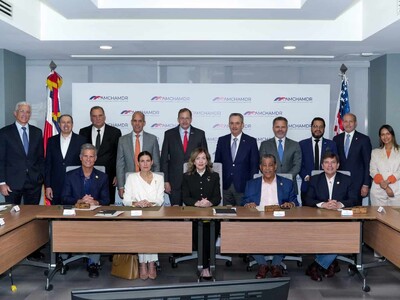
The American Chamber of Commerce of the Dominican Republic (AmchamDR) met with a bipartisan delegation from the United States Congress to discuss economic and trade relations between the two countries, with a focus on investment and business opportunities linked to Texas and Pennsylvania.
The meeting, held at the Chamber's offices, brought together AmchamDR representatives, the Dominican ambassador to the United States, Maria Isabel Castillo, members of AmchamDR's board of directors and representatives of its working committees.
On the American side, the delegation included Congressmen Adriano Espaillat, Dan Meuser and Vicente Gonzalez. Espaillat represents a district in New York and is of Dominican descent, Meuser represents Pennsylvania, and Gonzalez represents Texas, the two states AmchamDR singled out for closer business ties.
Topics discussed
Participants covered the state of the Dominican economy, bilateral trade flows, the impact of United States tariff policies, trade facilitation, and the Dominican Republic's potential as a platform for advanced manufacturing, logistics and nearshoring to strengthen supply chains across the Western Hemisphere. Special attention was given to the possibility of deeper productive and commercial integration with Texas and Pennsylvania.
William Malamud, AmchamDR's executive vice president, presented the organization's strategic priorities and highlighted the bipartisan support that has historically characterized relations between the two nations. He thanked Ambassador Castillo for her leadership in coordinating the visit.
Malamud argued that United States trade policy should recognize the Dominican Republic's strategic value as a reliable partner, and said the country should receive, at minimum, tariff treatment comparable to that given to the United States' most favored trading partners.
Economic outlook presented
Raul Ovalle, president of AmchamDR's Committee on Economy and Capital Markets, presented an overview of the Dominican economy and the evolution of trade and investment between the two countries, along with the implications of tariff policy for national competitiveness.
Jose Alfredo Rizek, president of the Committee on Bilateral Relations, addressed the main items on the bilateral agenda and outlined opportunities to continue strengthening economic and commercial ties between the two nations.
The meeting allowed for an exchange of views with the American lawmakers on the potential for greater economic integration between the two countries, drawing on geographic proximity, logistics infrastructure, the Dominican Republic's production capacity and the trade framework established under the Dominican Republic-Central America Free Trade Agreement, known as DR-CAFTA.
Part of a wider effort
AmchamDR said the meeting is part of its ongoing work to strengthen channels of communication with strategic actors in both countries, promote the interests of the business community, and help consolidate the Dominican Republic's position as an economic and trade ally of the United States.
Also taking part in the meeting were Maria Alvarez, Steven Puig, Eduardo Cruz, Carlos Cueto, Fernando Villanueva and Edwin de los Santos, along with Morela Baez, director of relations with the United States and Canada at the Dominican Ministry of Foreign Affairs; Johanny Adames, chief of staff to Congressman Adriano Espaillat; and Anyris Pascual, a counselor.
Test yourself
Which two US states did AmchamDR highlight for investment and business ties?
What did William Malamud ask regarding US tariff policy toward the Dominican Republic?
What trade framework did the meeting reference as a basis for integration?
Have your say
Should the United States grant the Dominican Republic the same tariff treatment as its most favored trading partners?
Where it happened
Washington, D.C., United States