Chinese startup Pekin Sawes Energy Technology has tested an airborne power plant called the S4000 at an altitude of 4,000 meters in China.
The system uses a blimp-like airship equipped with turbines to harvest stronger, more consistent high-altitude winds and transmit electricity back to the ground using a tethered cable.
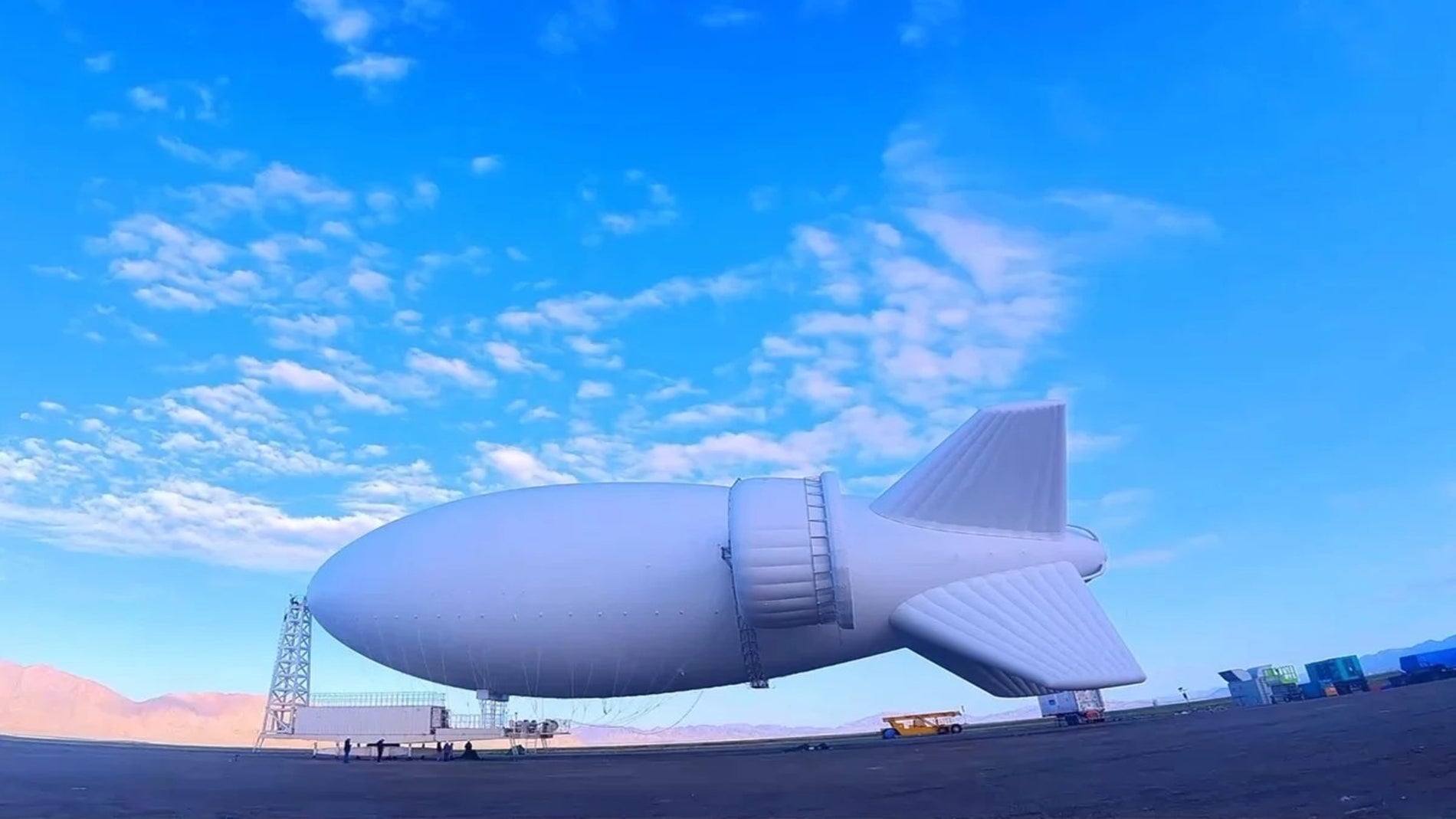
State broadcaster CCTV was present during the flight trial. Pekin Sawes Energy Technology confirmed that the S4000 successfully completed a full operational cycle, encompassing its vertical ascent into the atmosphere, electricity generation, stationary airborne hovering, and final recovery back to the ground.
Airborne wind energy systems aim to capture energy from tropospheric winds, which blow at significantly higher speeds and with greater stability than air currents near ground level or over hilly terrain. Surface-level wind turbines face physical limits imposed by mechanical tower height and structural load, whereas tethered aerostats can tap into high-altitude air streams thousands of meters above sea level.
High altitude flight and aircraft design
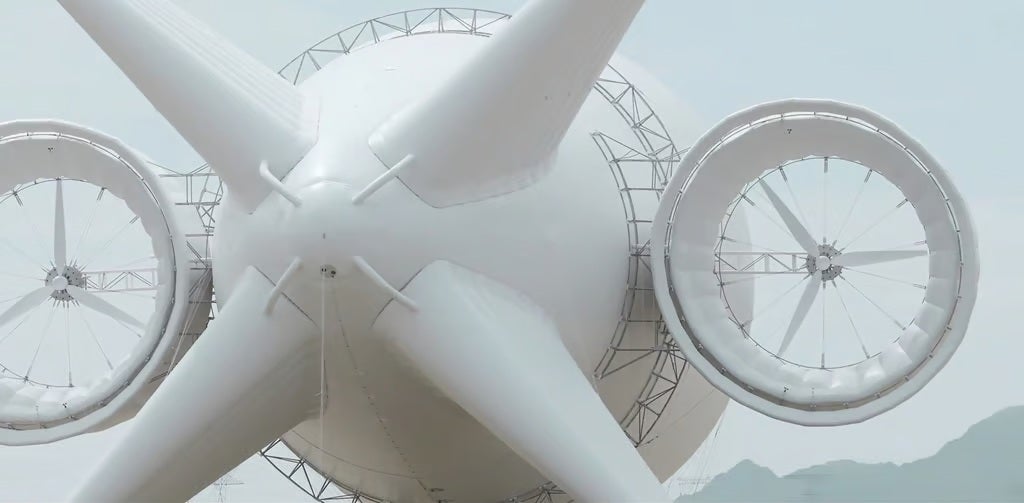
The S4000 prototype is roughly the size of a Boeing 747 commercial airliner. Its blimp-shaped hull is filled with helium gas, providing the static buoyancy needed to lift the aircraft and its lightweight electrical turbines into the sky.
The Boeing 747 is a wide-body commercial airliner with a length of around 70 meters, making it a common benchmark for large-scale aerospace structures. Using lighter-than-air helium gas inside a rigid or semi-rigid envelope allows large aerostats to remain aloft for extended periods without consuming fuel for lift.
Beyond stationary power production, the airborne power plant is fully mobile. Pekin Sawes Energy Technology stated that the unit functions as a deployable emergency generator suitable for remote regions, deserts, high-altitude plateaus, islands, or disaster zones where terrestrial power stations and electrical grids have been damaged.
Restoring traditional ground-based power infrastructure after severe weather or natural disasters often requires extensive repairs to distribution lines and substations. Mobile aerial units can be rapidly deployed to provide immediate off-grid power to critical emergency facilities.
Collaborative development and earlier prototypes
The S4000 represents an evolved aircraft design building on earlier flight models developed by Pekin Sawes Energy Technology. The startup previously collaborated with Tsinghua University and the Aerospace Information Research Institute of the Chinese Academy of Sciences to construct and test two predecessor models, designated as the S1500 and the S2000.
Both the S1500 and the S2000 achieved notable success during initial flight trials. In those earlier tests, the precursor systems reached power generation outputs exceeding 1 megawatt.
Tsinghua University, situated in Beijing, is widely recognized as one of China's premier public research universities, recognized globally for engineering and technological innovation. The Aerospace Information Research Institute operates under the Chinese Academy of Sciences, the principal national institute overseeing natural science research and technology applications across China.
Future commercial goals and production targets
Following the test of the S4000, Pekin Sawes Energy Technology announced that its engineering team is currently designing a larger model designated as the S6000. The planned S6000 is intended to reach higher flight altitudes and generate increased volumes of electricity.
Pekin Sawes Energy Technology reported that it has recorded commercial orders valued at more than $74 million as of March 2026. The startup secured these orders within three years of beginning its operations.
The company has set long-term operational targets for its flying generators, aiming to maintain stable power generation for more than 8,000 hours per year. Pekin Sawes Energy Technology aims to supply electricity at a target cost of $0.0045 per kilowatt-hour.