


State-owned firm China Information and Communication Technologies has transmitted 3.2 petabits of data per second across a single strand of optical fibre.
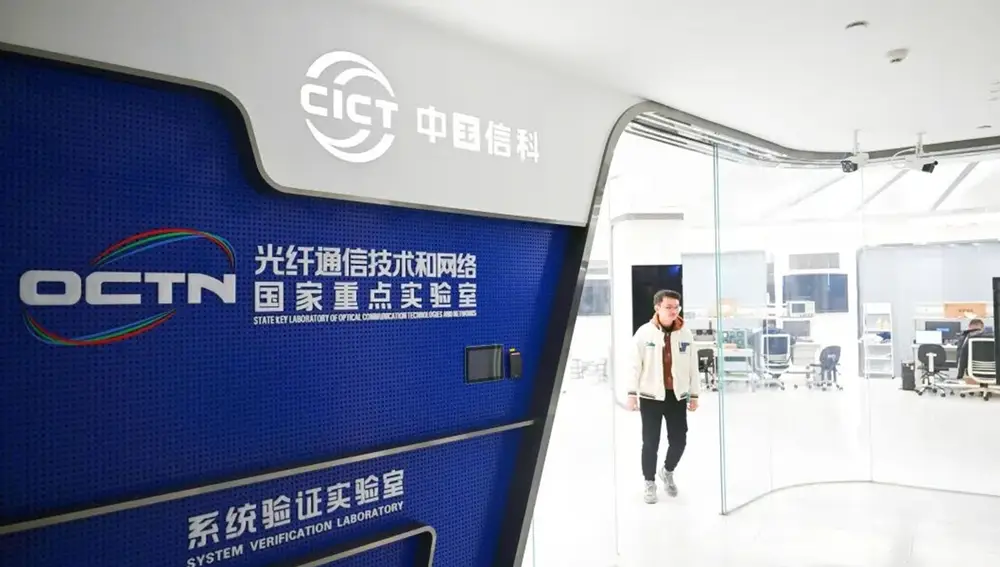
The Wuhan-based company, also known as CICT, announced the record-breaking test after sending information across a cable measuring 10.3 kilometres in length.
The experiment was carried out in partnership with the Peng Cheng laboratory in Shenzhen and Sino-Japanese joint venture FiberHome Fujikura. It surpassed the previous global transmission record of 2.5 petabits per second, which was established by the same research group in March, by nearly 30 percent.
Global data transfer comparison
A single petabit corresponds to 1,000 terabits, or one million billion bits of digital information. For comparison, ordinary commercial broadband services for homes and offices deliver speeds measured in megabits or gigabits per second, meaning a petabit connection operates at many millions of times that capacity.
The scale of the transmission speed becomes clear when compared with historical data storage benchmarks. In 2007, the entire population of the world stored approximately 2,360,000 petabits of digital information across all computers, archives, and servers.
At an operating speed of 3.2 petabits per second, a single Chinese fibre optic line could transmit that entire 2007 global store of digital knowledge in just over 12 minutes.
CICT is headquartered in Wuhan, the provincial capital of Hubei in central China. The city is widely recognised as the cradle of China's optical communications industry, centred on an industrial development zone known as Optics Valley, which supplies telecommunications components to domestic and international markets.
Multi-core fibre engineering
Conventional fibre optic lines rely on a single glass core surrounded by reflective cladding, carrying light pulses that encode digital ones and zeros. Under current physical limitations, conventional single-core fibres reach an operational ceiling of approximately 0.1 petabits per second before optical distortions degrade the signal.
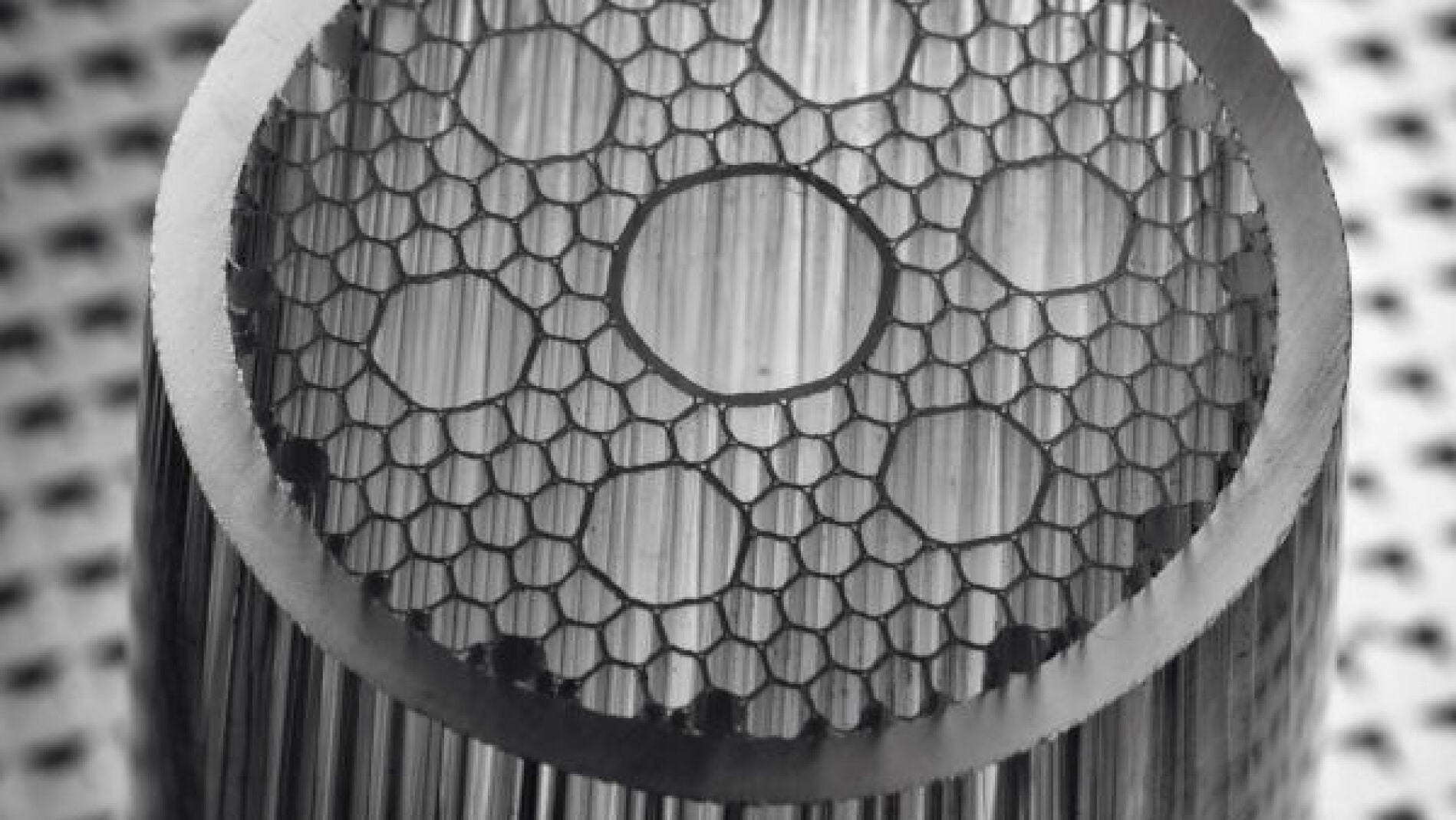
To overcome this physical bottleneck, the engineers integrated 24 separate glass cores inside a single strand measuring only a few millimetres in diameter. The researchers carefully designed the internal layout and spatial geometry of the cores to prevent optical signals from leaking between adjacent channels.
Inside each of the 24 cores, light pulses travel through three distinct colour bands in the infrared spectrum: the S band, the C band, and the L band. Each of these spectral bands is subdivided into hundreds of independent channels, allowing several thousand parallel streams of light to traverse the 10.3-kilometre cable at the same time.
In optical networking, the C band represents the conventional transmission window between 1,530 and 1,565 nanometres, where silica glass causes minimal light loss. Network engineers expand bandwidth by activating the neighbouring S band, or short-wavelength band, and the L band, or long-wavelength band, effectively tripling the usable spectrum within a glass filament.
Commercial hardware integration
The experimental system operated using commercially available coherent optical modules, representing hardware that industry already manufactures in volume. CICT noted that the transmission did not require custom laboratory prototypes or complex digital post-processing to reconstruct the received data signals.
Coherent optical technology increases data transmission rates by modulating the phase, amplitude, and polarisation of light waves rather than merely turning a laser pulse on and off. Because the Wuhan trial relied on commercial transceivers, the test demonstrates that multi-core glass cables can function alongside standard optical hardware.
The project combined expertise from major Chinese research centres and industrial manufacturers. Shenzhen's Peng Cheng Laboratory conducts high-level research into network switching and computing infrastructure, while FiberHome Fujikura brings together Chinese optical systems production and Japanese speciality fibre manufacturing.
Challenges for national deployment
Despite the transmission benchmark, scaling the technology for broad commercial use across national and international communications backbones involves substantial technical obstacles. A distance of 10.3 kilometres is roughly equivalent to the size of a university campus or the distance separating two neighbouring data centres.
Extending the technology across thousands of kilometres will require telecommunications operators to redesign optical amplifiers, connectors, and cable splicing techniques. In practical installations, network engineers must align and join 24 microscopic glass cores across spliced cables without causing signal attenuation or excessive reflection.
Cost sustainability remains the primary hurdle for large-scale adoption. Multi-core glass fibres remain intricate pieces of precision engineering, requiring strict manufacturing tolerances to prevent crosstalk between channels over prolonged distances.
CICT confirmed that its researchers intend to push transmission boundaries further rather than pausing at the current record. The Wuhan team has already established a target of achieving 10 petabits per second next year, an ambitious milestone that would more than triple the existing global speed mark.


