Allianz Global Investors, the asset management arm of Germany's Allianz Group, manages 653 billion euros worldwide and has built a reputation for backing innovation strategies in artificial intelligence, cybersecurity and Chinese technology despite the traditionally conservative outlook of insurance-linked investing.
Allianz Group set up Allianz Global Investors in 1998 to manage one of the largest balance sheets of any insurer in the world. The manager grew through a string of acquisitions, including Dresdner, RCM, Oppenheimer, NFJ and, more recently, UOB in the Asian market. Together with Pimco, the US fixed-income specialist that Allianz bought in 2000, the two firms form Allianz Group's main asset management brands.
Marisa Aguilar, Allianz Global Investors' general manager for Iberia, said the manager was not simply a product of those acquisitions but also of the transfer of skills from the people who manage the insurer's own balance sheet into the asset manager. She said this gives the firm a particular way of understanding investment, with deeper knowledge of certain assets and a distinct approach to risk and to reading the market.
Allianz Global Investors' 653 billion euros in assets are spread fairly evenly across fixed income, equities, multi-asset strategies and private markets, and the business has a strongly institutional client base. Sixty percent of assets come from management mandates for large investors such as pension funds, insurers, sovereign funds and foundations.
Madrid office and private markets
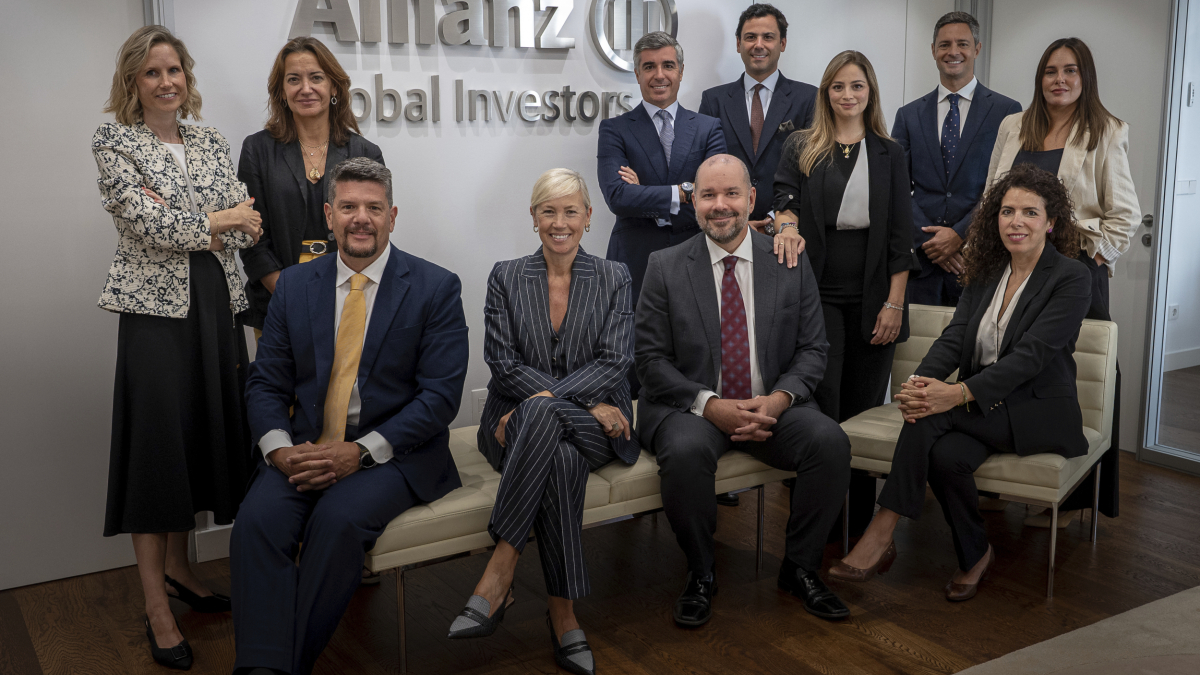
Allianz Global Investors has operated in Spain since 2001, though it has pursued a more committed and reinforced strategy there since 2015. The Madrid office now employs 11 professionals, led by Aguilar, who joined in 2016 from Banco Santander.
In private markets, the firm's main strengths lie in private debt, where the group is the largest investor in the world, and in infrastructure, where it is the largest investor in Europe and ranks among the top five globally.
Aguilar said the firm never enters private markets without investing its own capital, which changes how it looks at the market. She said this approach also gives the firm market knowledge, the ability to negotiate on price, and the capacity to finance projects that never come to the open market.
Income funds and multi-asset strategies
Among the solutions Allianz Global Investors offers are income funds and multi-asset funds. Aguilar said income strategies interest her greatly as a way of complementing savings for longer life expectancy. She added that multi-asset solutions are regaining relevance for investors who lack the savings capacity to pay for advice or for discretionary managed portfolios.
Betting on artificial intelligence and China
Despite insurers' generally conservative character, Allianz backs innovation. In 2016 the manager launched an artificial intelligence strategy that targeted not only companies building AI infrastructure but also traditional-economy companies expected to become more efficient by adopting AI. The firm is also active in cybersecurity, and both strategies are run from its teams in San Francisco, close to Silicon Valley.
Allianz Global Investors has also pushed into Chinese technology. The firm holds a license to operate in the Chinese market and launched a strategy two years ago that invests in the technology sector of the Asian giant. Aguilar said China remains the world's factory but is changing its growth model, shifting from a production model centred on price and the domestic property market toward generating technological value.
Active management in a volatile market
Allianz Global Investors only practices active management, Aguilar said, though the vehicles used, such as exchange-traded funds and traditional funds, can vary.
She pointed to high public deficits and the growing need for governments to issue debt, the pressure that longer life expectancy places on welfare states, the need to renew infrastructure, and the technological revolution reshaping how every sector operates through AI. Together, she said, these forces are producing more volatile and uncertain bond and equity markets, which is why active management makes far more sense.
In her view, portfolios need greater diversification, including gold and commodities alongside other return-generating diversifiers such as liquid alternatives and private markets.
Among the firm's other strengths, Aguilar highlighted systematic management, a quantitative approach that seeks to add alpha over benchmark indices through highly diversified portfolios while staying close to relative risk limits, a requirement commonly set by institutional investors.
Energy transition commitment
On sustainability, Aguilar said the energy transition is fundamental and runs through the firm's work. She said this applies not only to Allianz Global Investors but to its parent company and the wider group, and features as a core mandate across many strategies, particularly in private markets involving impact investment, with the firm remaining strongly committed to it.
The firm
- International headquarters: Munich, Germany
- Spain headquarters: Calle Serrano 49, 28006 Madrid
- Established in Spain: 2001
- Staff in Spain: 11 professionals
- Assets managed in Spain: 6 billion euros
- Total assets managed: 653 billion euros, split between 28% equities, 28% fixed income, 29% multi-asset and 15% private markets