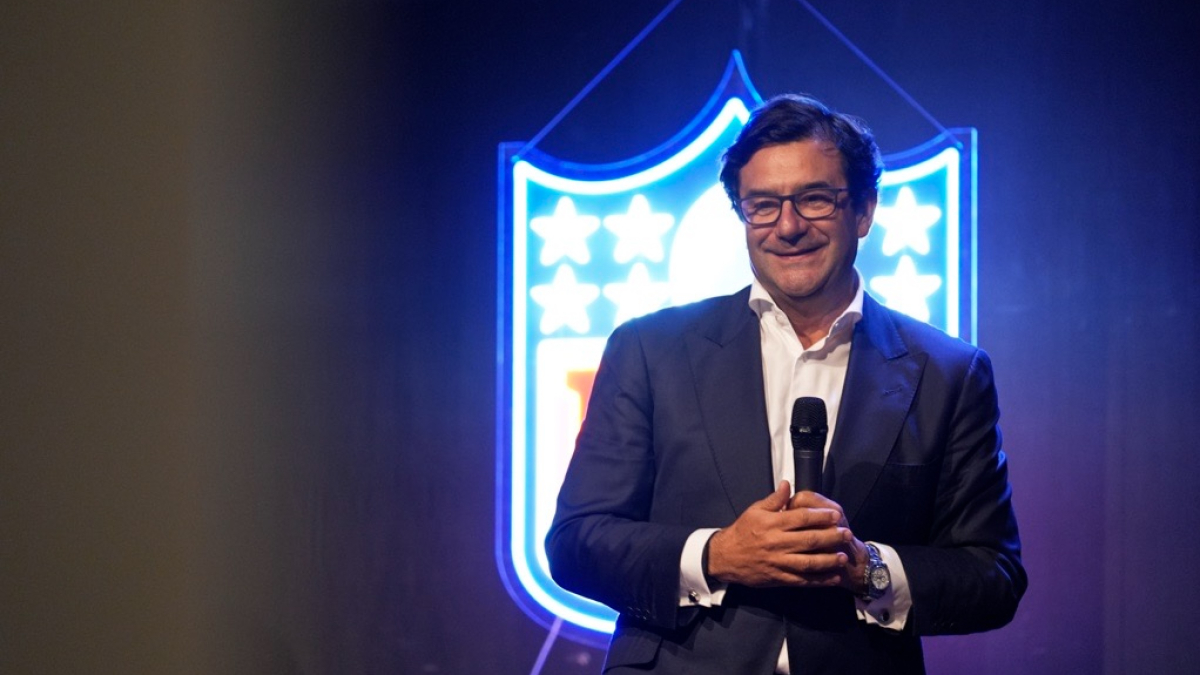
NetApp, the Nasdaq-listed data infrastructure company, played a central role behind the scenes as the National Football League held its second official game in Spain last Sunday, filling the Santiago Bernabéu stadium in Madrid and confirming that the league's international expansion plan is on track.
NetApp serves as the NFL's official intelligent data infrastructure partner, managing the vast volumes of information that shape in-game strategy in real time, improve broadcast quality and enhance the fan experience. The company trades on the Nasdaq and has a market capitalization close to $40 billion. It is led by César Cernuda, a Spaniard who serves as the company's global president.
Cernuda told the Spanish newspaper Expansión that the sports world closely resembles the business world, since both aim to increase productivity, expand returns and gain better access to data. He said achieving that requires connecting with fans in the best way, enriching their experience, raising player performance, monitoring athletes, helping coaching staff make critical decisions and improving stadium safety and services. He said data is the common denominator behind all of it.
Managing the NFL's data infrastructure
Cernuda said NetApp's work with the NFL has built a strategic alliance to manage the league's entire data infrastructure, which he described as the foundation for artificial intelligence. He said the company offers secure storage logistics that make information accessible within a hybrid cloud environment.
That infrastructure lets the NFL build applications and services integrated with major technology platforms. Cernuda said one of NetApp's biggest advantages over rivals, besides security, is that it is the only provider whose technology runs natively on all four major cloud platforms: Microsoft, Amazon, Google and Oracle. He said the company's operating system, called ONTAP, lets the league avoid migrating data between platforms, which he called a key differentiator.
Cernuda said this arrangement lets the league keep control of its own applications, from ticket sales to broadcasts and fan services. He said NetApp does not run the applications themselves but provides the infrastructure that generates the data making everything possible, describing the company as the heart and the engine driving it all.
NFL's international expansion
The game between the Cincinnati Bengals and the Atlanta Falcons, played in Madrid with NetApp as main sponsor, is part of the league's plan to win new markets, Cernuda said, adding that NetApp plays an active role in that push. He said NetApp's data infrastructure supports the NFL's international plan, and that the league's biggest challenge is taking American football beyond the borders of the United States and helping deliver fans not just a game but an experience, delivered more intelligently.
Cernuda said the NFL will play nine games outside the United States this year as part of that strategy. He said that, as a Spaniard, he feels tremendous pride that Madrid is one of the league's main hubs abroad. He said the NFL has close to 400 million fans worldwide, 80 percent of them in the United States, and that NetApp helps grow that fan base and localize the experience for them. NetApp is the league's main partner in London, Madrid and Melbourne, he said.
Looking ahead
Cernuda said that, as a fan himself, he would like to be able to interact in real time with what is happening during games. He said he believes the league wants the experience of fans watching from outside the stadium to become as close as possible to that of fans inside it.
Beyond the NFL
Besides its NFL partnership, which also includes an agreement with the San Francisco 49ers, NetApp holds sponsorship roles in motor racing and ice hockey. The company works with the Aston Martin Aramco Formula One team, Porsche Motorsport and the Ducati Corse motorcycling team, as well as the San Jose Sharks ice hockey team.
Cernuda said that, as with any company, decisions across all of these organizations ultimately come down to data sovereignty. He said that if you tell him how much data a company has, he can tell you how much that company is worth.