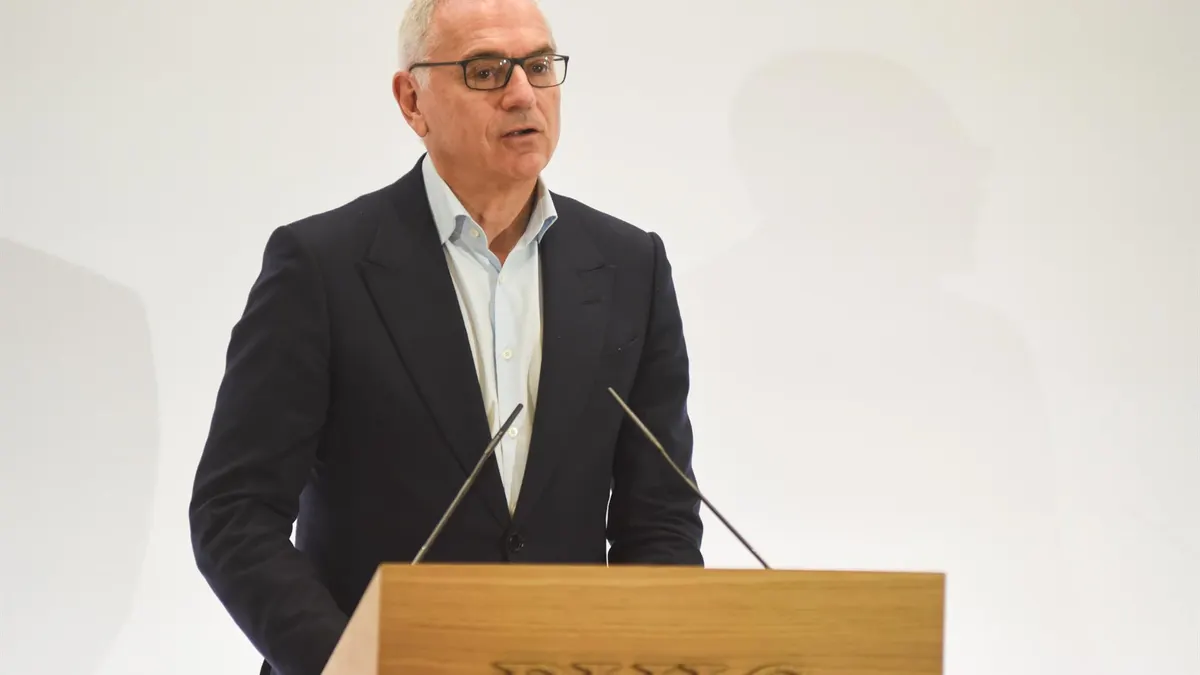
Andrei Belevtsev, senior vice president and head of Sberbank's Technological Development division, said only 5% of companies are currently feeling a direct economic effect from adopting artificial intelligence, even as AI agents grow capable of tackling complex scientific problems and working autonomously for days at a stretch.
Belevtsev made the comments at the AI Journey conference, where he moderated a session titled "B2B on the Way to the Agent Economy."

The panel also included Maxim Reshetnikov, Russia's Minister of Economic Development; Maksut Shadayev, Russia's Minister of Digital Development, Communications and Mass Media; and Rostislav Konyashkin, First Deputy Minister of Artificial Intelligence and Digital Development of Kazakhstan.
Uneven adoption across industries
Belevtsev said artificial intelligence is spreading unevenly across the economy. He pointed to IT, finance, consulting and healthcare as sectors with many successful AI deployments already in place.
By contrast, he said industries closely tied to the physical world, such as logistics, construction and food service, have so far seen a less visible effect from the technology.
Agents working for days, not hours
Belevtsev said the level of artificial intelligence has risen sharply, and that modern multi-agent systems can now handle extremely complex tasks. He said the length of time these systems can work toward a final result has grown significantly, so that an agent given a task today might work on it for a day, two days or even longer.
He said that while some models are already learning to manage scientific laboratories, many users still only ask them to prepare presentations. In his view, the systems are capable of far more than what is currently being asked of them, and businesses need to be more creative in setting new tasks for them.
What comes next for the agent economy
Belevtsev said the next stage in the development of the agent economy will be AI agents interacting with one another independently on behalf of people and companies. He said building this requires a trusted environment, since most people are not yet ready to hand control of their money to an AI agent.
He said the introduction of a guarantor into the system, one that takes on responsibility for the risks involved, could change how users feel about trusting agents with financial decisions.
About Sberbank and AI Journey
Sberbank is Russia's largest bank by assets and has positioned itself as a major developer of artificial intelligence tools, including its own language models. AI Journey is an annual conference it organises to showcase AI research and its applications across business and government.
Test yourself
What share of companies does Belevtsev say feel a direct economic effect from AI?
Which sectors does Belevtsev say have seen the most successful AI deployments?
What does Belevtsev say is needed before people trust AI agents with money?
Have your say
Would you trust an AI agent to make financial decisions on your behalf?