

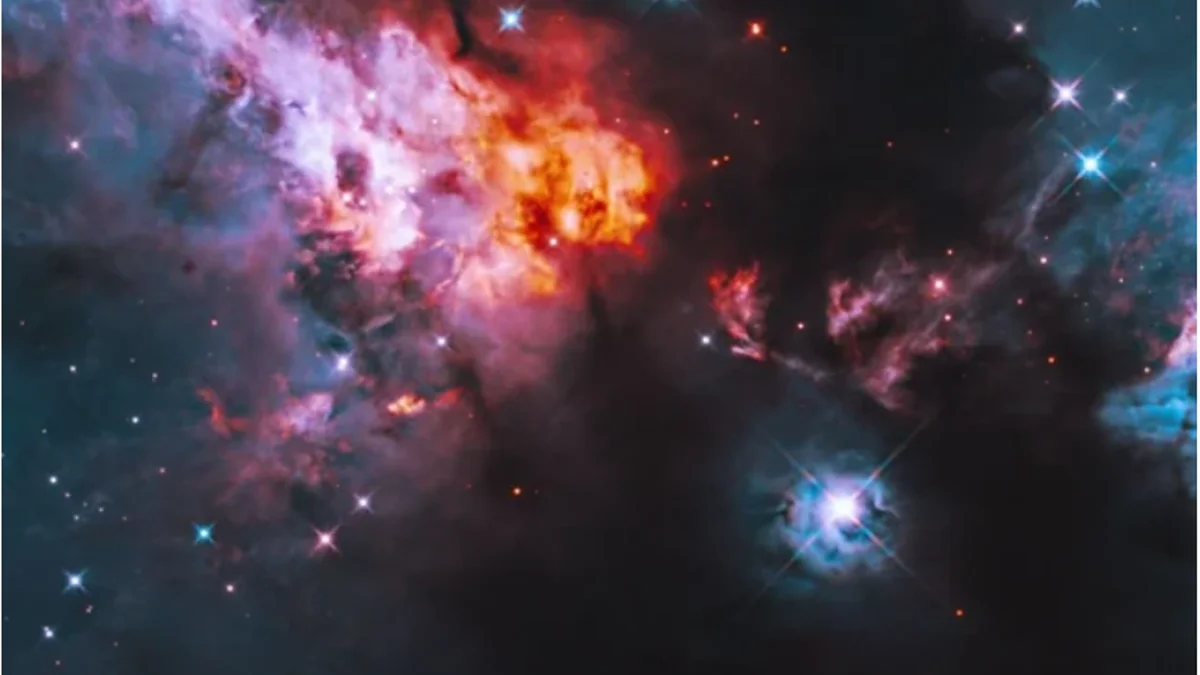
The James Webb Space Telescope has detected a "forbidden" radiation signal from the H3+ ion about 700 light-years from Earth, in a region where a newborn star is battering the surrounding gas with violent shock waves. The signal, predicted by physicists four decades ago, had never been observed before, not even in a laboratory.
The findings, published on arXiv and accepted for publication in The Astrophysical Journal Letters, come from a team led by David Neufeld of Johns Hopkins University, working with scientists from the Space Telescope Science Institute, the University of Rochester and the European Space Agency. The researchers identified 26 spectral lines corresponding to so-called forbidden rotational transitions of H3+ in the object Herbig-Haro 168, located in the Cepheus A West star-forming region. Some of the lines were detected with a statistical significance above five sigma, the "gold standard" physicists use to confirm a result.
Why the signal evaded detection for decades
The delay in observing this radiation comes down to the unusual structure of H3+, an ion made of three hydrogen nuclei sharing two electrons. The three nuclei sit at the corners of an equilateral triangle, a highly symmetrical shape that leaves the molecule without a permanent electric dipole moment. In practice, that means it cannot easily emit radiation the normal way as it spins.
Under the conventional rules of molecular spectroscopy, this makes its rotational transitions "forbidden", not because they break the laws of physics, but because they are extremely unlikely. In 1986, physicists Fu-Shih Pan and Takeshi Oka calculated that the rotation of H3+ could slightly distort its structure through centrifugal force. That small distortion partially breaks the molecule's symmetry and creates a tiny electric dipole moment, just enough to produce a very weak emission of light. The prediction had stood for 40 years without anyone managing to observe it.
A stellar nursery with the right conditions
What was missing was the right setting and an instrument sensitive enough to catch it. That opportunity came from Herbig-Haro objects, structures formed when a young star ejects surrounding material through narrow, fast-moving jets. Driven by magnetic fields, these flows can travel at hundreds of kilometers per second and, on colliding with nearby clouds of gas and dust, generate shock waves that push temperatures up to thousands of degrees. The result is a turbulent region that radiates across a range of wavelengths.
The James Webb telescope, built to observe the universe in infrared light, can see through much of the dust that normally hides these stellar nurseries. Its MIRI instrument gave researchers the sensitivity and spectral resolution needed to pick out the faint H3+ lines from among the emissions of other molecules and atoms.
A building block of interstellar chemistry
The significance of H3+ extends far beyond this single observation. The ion is a central piece of interstellar chemistry. It forms when cosmic rays ionize molecular hydrogen, and the product of that reaction combines with another hydrogen molecule to produce H3+. From there, the ion can hand off a proton to other substances, setting off a chain of reactions that helps build increasingly complex molecules. Scientists regard it as something of a starting point for much of the chemistry that unfolds inside the interstellar clouds where stars and their planetary systems are born.

The observation shows that a prediction made four decades ago can still be confirmed in a remote corner of the cosmos once the right instrument comes along. It also raises a new question: why this molecule emits so intensely under conditions that current models cannot yet fully explain. The James Webb telescope has not only caught a signal that once seemed impossible to see. It has opened a new window onto how hydrogen, the most abundant element in the universe, turns into the complex chemistry from which new worlds will eventually emerge.


