
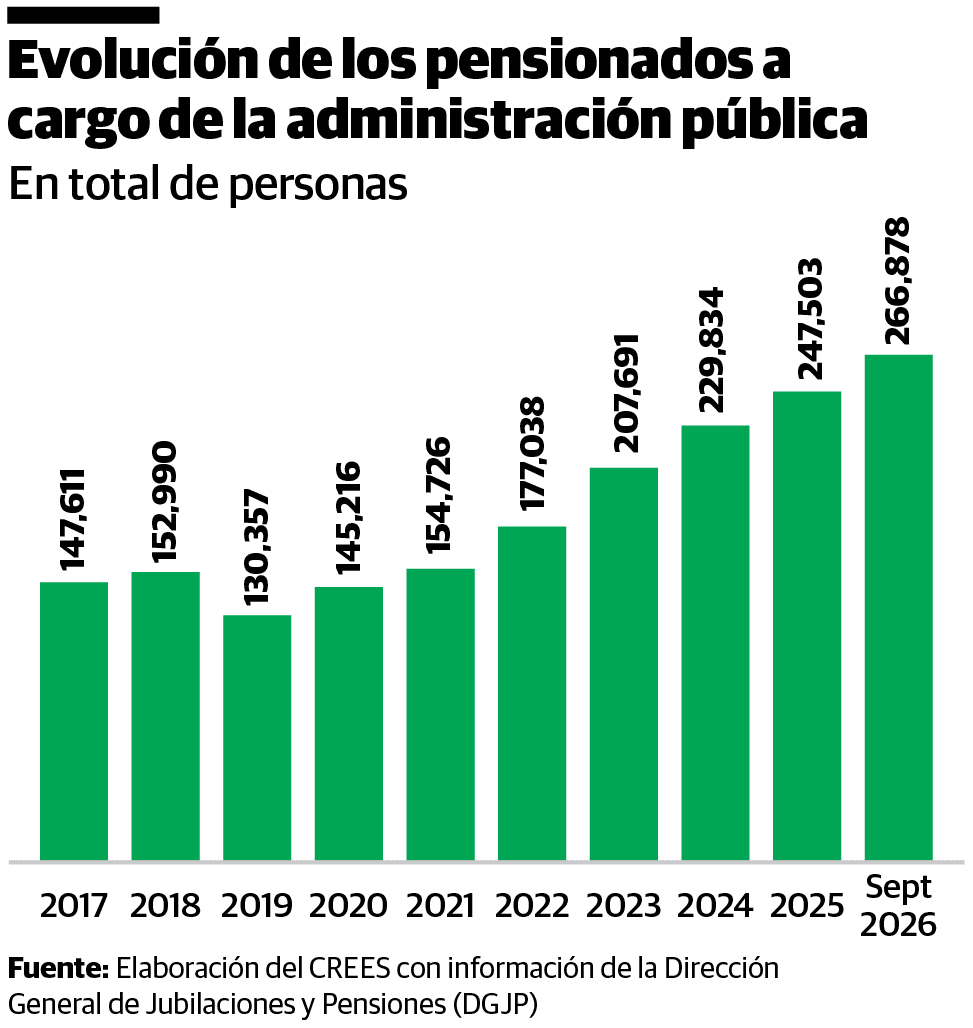
The number of people receiving pensions through the Dominican Republic's Dirección General de Jubilaciones y Pensiones (DGJP) reached 266,878 as of September 2026, according to the agency, marking a 7.8% increase from December 2025 and an 80.8% rise over the past decade.
Of the total beneficiaries, 64.7% receive civil pensions, 10.3% are tied to the National Police, and 25.0% receive solidarity pensions, the DGJP reported.

The agency's data shows the number of pensioners has climbed every year since 2019, when it stood at 130,357 beneficiaries. That figure has now more than doubled by September 2026.
Pension payments climb 11.3%
Between January and September 2026, pension payments made through the DGJP totaled RD$39,003.5 million, which is RD$3,962.8 million, or 11.3%, more than in the same period a year earlier.
Of the RD$97,818.6 million allocated in the current 2026 budget for state-funded social security benefits, RD$59,311.7 million is assigned to the DGJP.
What this means for public finances
The DGJP is the Dominican Republic's state agency responsible for managing retirement and pension payments for civil servants, police personnel and other designated beneficiaries.
The growing number of beneficiaries carries implications for public finances because pension payments represent a spending commitment that extends over many years. Unlike other types of government spending, these obligations are not confined to the budget of the year in which the pensions are granted.
Given this trend and the gradual aging of the population, it is necessary to assess the long-term financial sustainability of these obligations, according to the analysis. It added that this assessment should not be limited to the present cost of granting new pensions, but should also account for the financial commitments generated for future years, which will have to be met by taxpayers.
The analysis was produced in collaboration with the Centro Regional de Estrategias Económicas Sostenibles (Crees), a regional research organization focused on sustainable economic strategies.
Test yourself
How many people were receiving pensions through the DGJP as of September 2026?
By how much did DGJP pension payments increase in the first nine months of 2026 compared to the same period the year before?
What share of DGJP beneficiaries receive solidarity pensions?
Have your say
Should governments prioritize long-term pension sustainability over expanding current benefits?
Where it happened
Santo Domingo, Dominican Republic