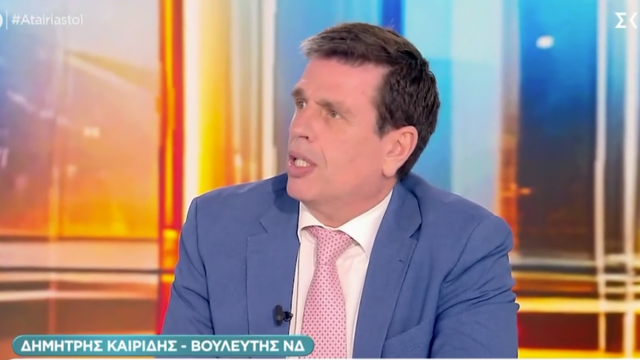
Greek lawmaker Dimitris Kairidis walked back his description of eastern Libya's ratification of the Turkish-Libyan maritime memorandum as a defeat on Monday, saying his remark referred mainly to Egypt.

Speaking on Greek broadcaster SKAI on Monday morning, the governing New Democracy member of parliament defended Foreign Minister Giorgos Gerapetritis, saying the minister had done everything within his power to counter the agreement ratified by the House of Representatives in Benghazi.
Kairidis said he had given 30 media interviews in recent days and had spoken under pressure in one of them when he used the word defeat. He argued that the diplomatic blow fell primarily on Cairo rather than Athens because Egypt had invested the most in cultivating ties with eastern Libya.
Reports in Athens had suggested that Kairidis's initial comments on Thursday night had strongly displeased Prime Minister Kyriakos Mitsotakis. Addressing those accounts on SKAI, Kairidis denied any rift with the prime minister and said there had never been any issue between them, describing their working relationship as very close.
Seven years of Greek diplomacy in Libya
Defending the Greek government's handling of the issue, Kairidis said Athens had fought a seven-year battle using the diplomatic means at its disposal against superior forces on the ground, pointing out that Turkey maintains military troops in Libya.
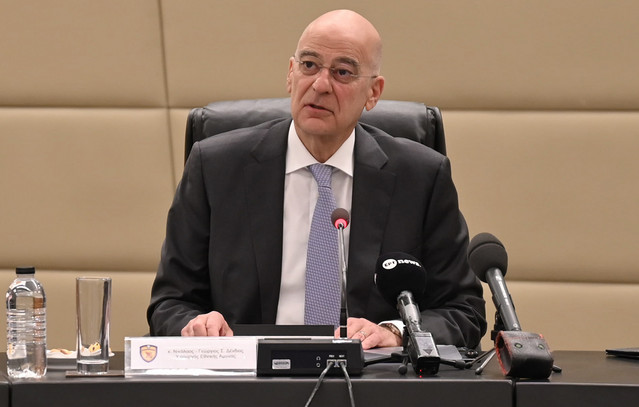
He added that the Libyan dispute was a long-standing challenge that Gerapetritis had inherited from his predecessor at the Foreign Ministry, Nikos Dendias, who had in turn inherited the file from former Foreign Minister Nikos Kotzias.
Kairidis, a professor of international relations at Panteion University in Athens who previously served as Greece's Minister for Migration and Asylum, is a prominent foreign policy figure within the centre-right New Democracy party. Kotzias led the Foreign Ministry under the former Syriza-led government from 2015 to 2018, while Dendias held the portfolio under Mitsotakis from 2019 to 2023 before becoming Minister of National Defence.
The dispute centres on a November 2019 bilateral memorandum of understanding signed between Turkey and the Tripoli-based Government of National Accord to demarcate maritime zones across the eastern Mediterranean. Greece and Egypt reject the accord as invalid under international maritime law because it disregards the continental shelf and exclusive economic zone entitlements of Greek islands, including Crete, Karpathos and Rhodes, and overlaps with waters covered by a rival Greek-Egyptian maritime boundary treaty signed in 2020.
Libya has remained split between rival administrations in Tripoli in the west and Benghazi in the east since the aftermath of the 2011 overthrow of Muammar Gaddafi. When Tripoli first signed the 2019 pact with Ankara, the Benghazi-based parliament initially refused to ratify it, prompting both Cairo and Athens to build diplomatic relations with eastern Libyan authorities over the past seven years.
US State Department response and Washington lobbying
Kairidis described the broader regional rivalry as an ongoing competition with many rounds that brings both setbacks and successes. He pointed to a revised statement issued on Sunday by the United States Department of State as an example of a success for Athens following the Benghazi vote.
In its follow-up statement on Sunday evening, the State Department called the Turkish-Libyan maritime memorandum provocative and said it increases tensions in the region. That position followed an initial reaction from Washington three days earlier that had drawn strong objections from Athens for keeping an equal distance between the parties.
Kairidis noted that he had been the first Greek politician to characterise the State Department's initial announcement as reprehensible. He said that although he is a moderate and not anti-American, even he had been angered by an approach that sought to place the victim on the same footing in the dispute.
According to Kairidis, an internal battle took place inside the State Department over Washington's stance on the Benghazi ratification. He credited the corrective statement issued three days later to a forceful response by the Greek government working in cooperation with the US charge d'affaires in Athens, alongside interventions in Washington by the Hellenic American Leadership Council, a Greek-American advocacy organisation known as HALC.