The US Army has received its first XM30 Wolf combat vehicle prototype from General Dynamics Land Systems at Aberdeen Proving Ground in Maryland.
The delivery marks the first physical milestone in an official military program to replace the M2 Bradley infantry fighting vehicle, which has served as the primary mechanized troop transport for American ground forces for more than 40 years.
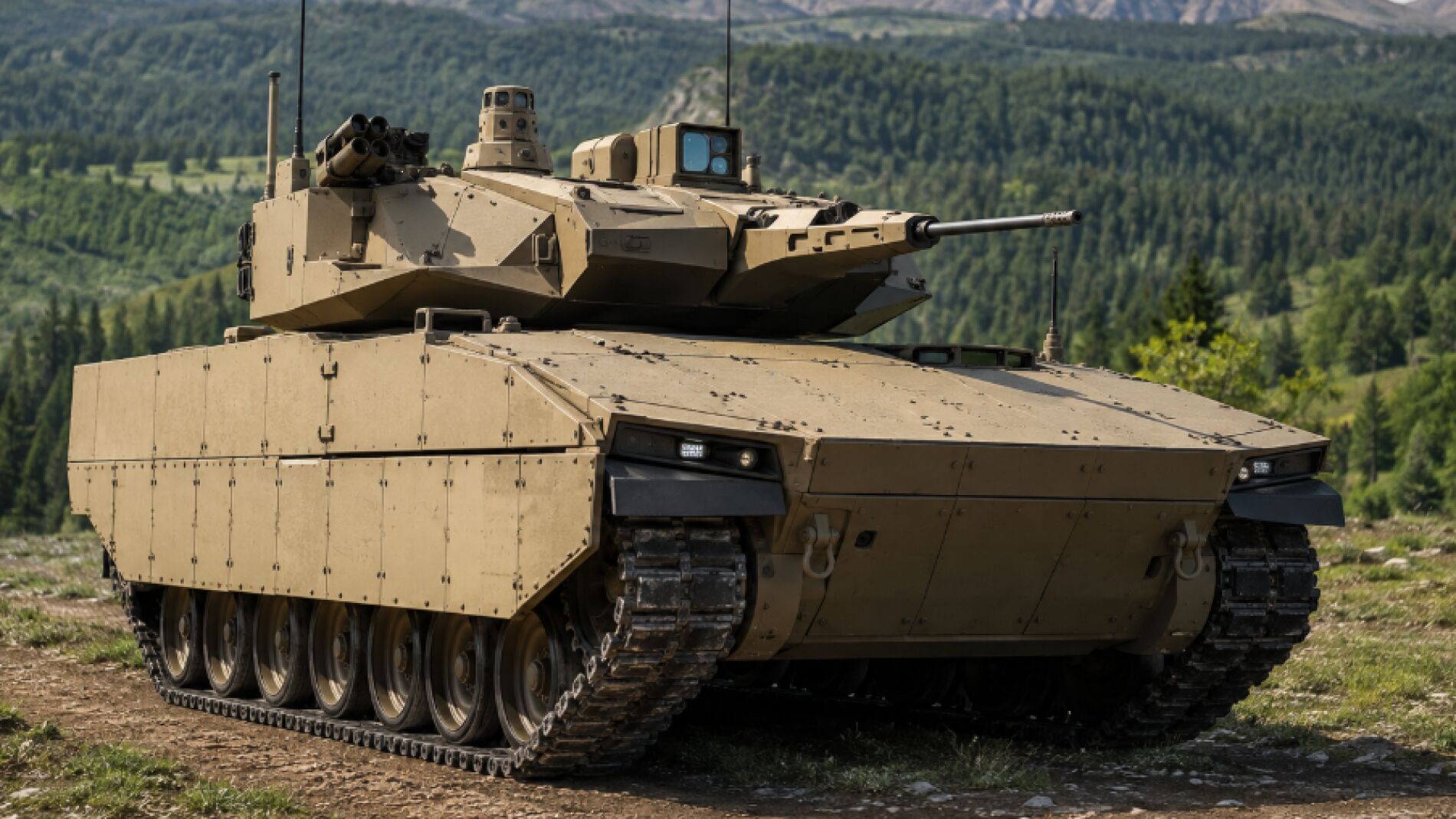
The XM30 Wolf is one of two competing designs selected by army leadership for the Mechanized Infantry Combat Vehicle replacement initiative. The rival design is the Lynx, developed by defense manufacturer American Rheinmetall Vehicles. The US Army plans to select a single winning contractor in 2027 following comparative field trials.
The XM30 program represents a structural change in how armored vehicles operate on modern battlefields. Official program objectives require the vehicle to transport infantry troops, provide armor protection and direct firepower, and function as an operational node capable of interacting with robotic and semi-autonomous platforms.
Tactical planners designed the vehicle for combat environments increasingly defined by aerial drones, ground sensors, and autonomous systems. Rather than operating as an isolated armored unit relying solely on onboard sensors to spot targets, the XM30 is built to operate as a mobile front line operations hub that receives and processes data from external networked systems.
Modular Open Systems Architecture
A central feature of the XM30 Wolf is its Modular Open Systems Architecture, known as MOSA. This open architecture applies to both hardware and software components, allowing the military to integrate new hardware modules and tactical applications without undergoing a full redesign of the vehicle.
The vehicle operates under design principles similar to those of a modern personal computer. By separating structural hardware from software systems, defense engineers can install digital upgrades over time, preventing electronic systems from becoming obsolete while the physical vehicle hull remains structurally sound.
Armored vehicles typically remain in military service for several decades. Under traditional manufacturing models, advanced electronics could become outdated long before a vehicle reached the end of its operational life. The MOSA framework is intended to ensure the XM30 can evolve at the pace of technological change.
General Dynamics Land Systems described the XM30 as a vehicle born digital, designed from its initial stages using digital engineering tools. The company uses a continuous digital thread to connect design models, testing data, manufacturing processes, and maintenance management across the life cycle of the vehicle.
General Dynamics Land Systems, headquartered in Sterling Heights, Michigan, is the long-standing defense contractor responsible for producing major ground combat systems for the US military, including the M1 Abrams main battle tank.
Uncrewed Turret and Modern Armament
The XM30 Wolf features an uncrewed turret, marking a significant structural departure from the Bradley. Placing weapon systems in an automated turret separates crew members physically from armaments and stored ammunition, allowing interior cabin space to be reconfigured for soldier safety and command equipment.
Occupants will monitor surrounding conditions using 360-degree situational awareness sensors. These external sensors transmit live imagery to displays inside the vehicle, providing soldiers with complete visibility of the external battlefield from within the armored hull.
Both competing prototypes in the XM30 competition feature a 50 millimeter automatic cannon. The 50mm main gun doubles the caliber of the 25mm M242 Bushmaster cannon used on the M2 Bradley, offering significantly increased range and armor penetration.
The XM30 platform is also engineered to integrate anti-armor guided missiles, loitering munitions, and airburst ammunition. Airburst rounds can be programmed to explode at designated distances in mid-air, allowing forces to strike targets behind terrain cover or neutralize low-flying uncrewed aerial vehicles.
The legacy M2 Bradley infantry fighting vehicle entered active military service in 1981, manufactured by FMC Corporation and later BAE Systems. Named after World War II commander General Omar Bradley, the tracked vehicle was designed to carry infantry into combat alongside main battle tanks, but its physical frame limits further electronic and armor upgrades.
Troop Evaluation and Testing Schedule
The delivery to Aberdeen Proving Ground initiates a critical testing phase for the XM30 Wolf. General Dynamics Land Systems is scheduled to deliver additional prototype units to the military as evaluations progress.
Aberdeen Proving Ground, located in Harford County, Maryland, is the oldest active proving ground in the US Army. Established during World War I in 1917, the facility serves as the military's primary site for ordnance testing, ballistic evaluation, and combat vehicle trials.
Subsequent prototypes will be dispatched to Fort Hood in Texas for field trials with active military units. Soldiers from the 1st Armored Brigade of the 1st Cavalry Division will test the vehicles under simulated operational conditions to assess performance in real-world tactical environments.
The 1st Cavalry Division, based at Fort Hood, is one of the Army's premier heavy armored formations. The 1st Armored Brigade Combat Team, known as the Ironhorse Brigade, specializes in combined arms maneuver using tracked armor.
The competitor in the program, American Rheinmetall Vehicles, is a US subsidiary of German defense manufacturer Rheinmetall AG, based in Sterling Heights, Michigan. Rheinmetall developed the Lynx combat vehicle platform as its entry for the American competition.
Comparative testing between the General Dynamics XM30 Wolf and the Rheinmetall Lynx will continue through 2026 and into 2027. The US Army expects to select a winning design in 2027 to begin full fleet replacement.